Fantom was made for the fiftieth anniversary of Josef Sudek's death. Sudek's studio, a wooden building on Prague's Újezd, collapsed and was pulled down. The building on the site today is a replica and houses the gallery.
The video returns to the ruin just before the demolition. The space was modelled from surviving photographs of the burned building, through photogrammetry, hand modelling and texturing. A single algorithmically generated shot moves through it in a 21-minute loop. Across the film the camera takes on a succession of bodies, none of which is ever seen.
Text from the exhibition brochure
What am I looking at? Am I alone here? Where should I go now? There is a fence. The paint has peeled off the pickets. Behind it, there is a tree, taller than the house it shades. The house is wooden, low and dark. Its planks have turned black. I pass through the gate. I do not remember opening it. Ivy covers the ground. A ladder leans against the wall. I walk inside. It is chaos. The roof has collapsed. Beams hang down into the room. Light falls through the opening onto the floor. The windows are dirty and broken. I can hardly see through them. The floor is covered in paper. Letters, envelopes, torn packaging. Pages that curl at the edges. Broken glass between them. An overturned crate. A stool that still stands. Glass bottles remain on the shelves. Cobwebs over the glass. Someone left in a hurry. Or slowly. How long have I been here? My eyes are those of an old man. Slow. I limp. One side of me drops and the other catches it. Then I am a cat, close to the floor, with dust at eye level. Quiet. I hold still for a long time. Then I start hovering. Steady. The hum is mine. I rise past the shelves and beams, out through the hole in the roof. I see the garden from above. My head does not turn. It snaps. Hold, snap, hold. I glide down. I slip along the wall. Thin as a draft. For a while I am water in the basement, looking up. Patient. For a while I am the stool. Still. I do not choose any of this. I weigh it. Every place in this house carries a number. The window weighs more than the door. The glass bottles weigh more than the floor. I draw from the weights. Whatever weighs more, I return to more often. My walk is noise laid over a straight line. Two misaligned waves create the limp. A small, fast tremble makes the fly. Between two bodies I interpolate. The height of my gaze shifts from one number to another. Somewhere at the beginning a seed was planted. Everything I do grows out of it. Plant the same seed and I will take the same walk. Change one digit and someone else will walk here. I move without taking steps. I pass through walls and feel nothing. I cast no shadow. The window does not reflect me. The path continues. Someone is calculating the next position, the next body. It might be me. This house burned down. It exists because I keep looking at it. I hold the lens at 40 millimetres. That is the only human thing about me. I see things the way you would. I move in a way that nothing else does.
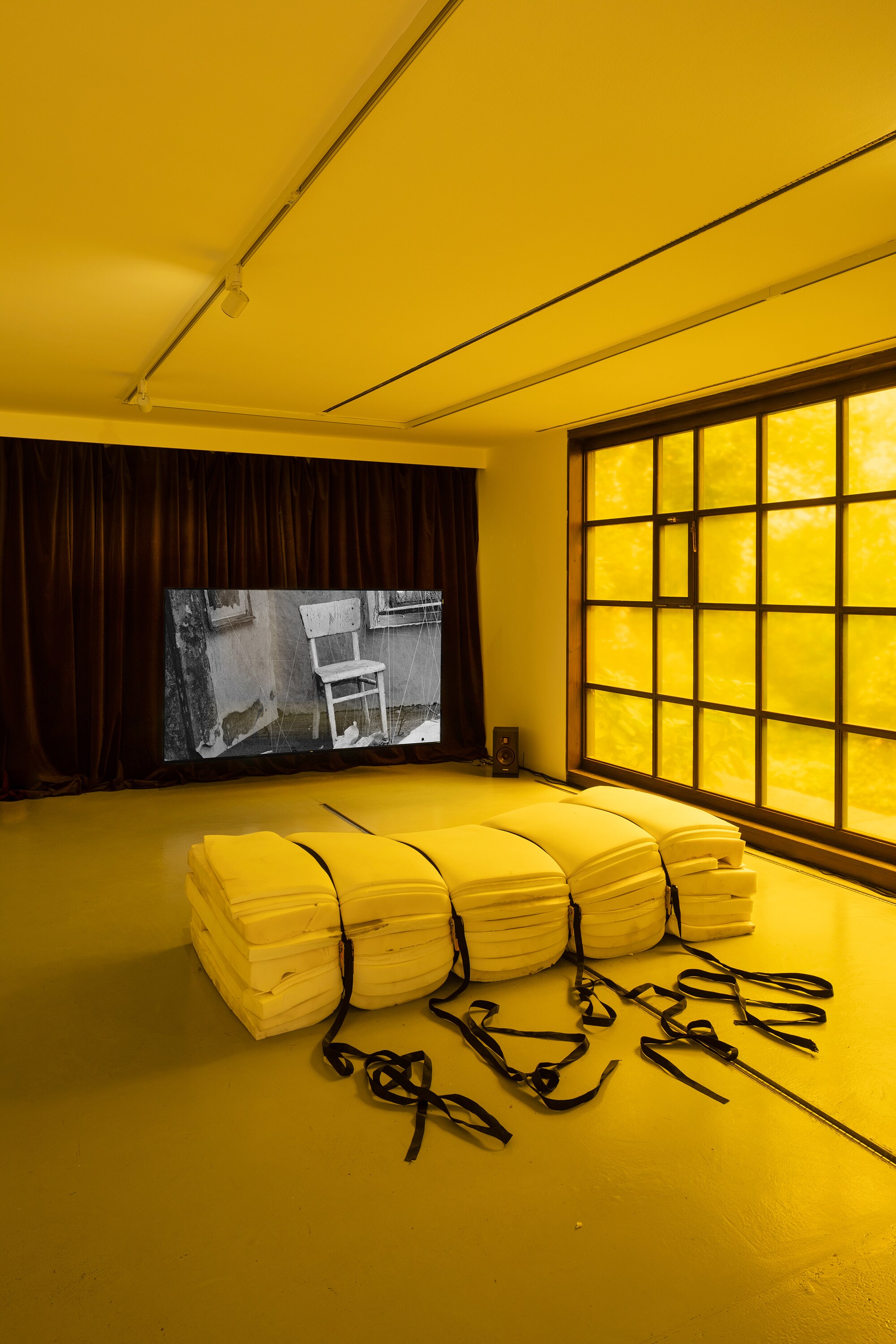
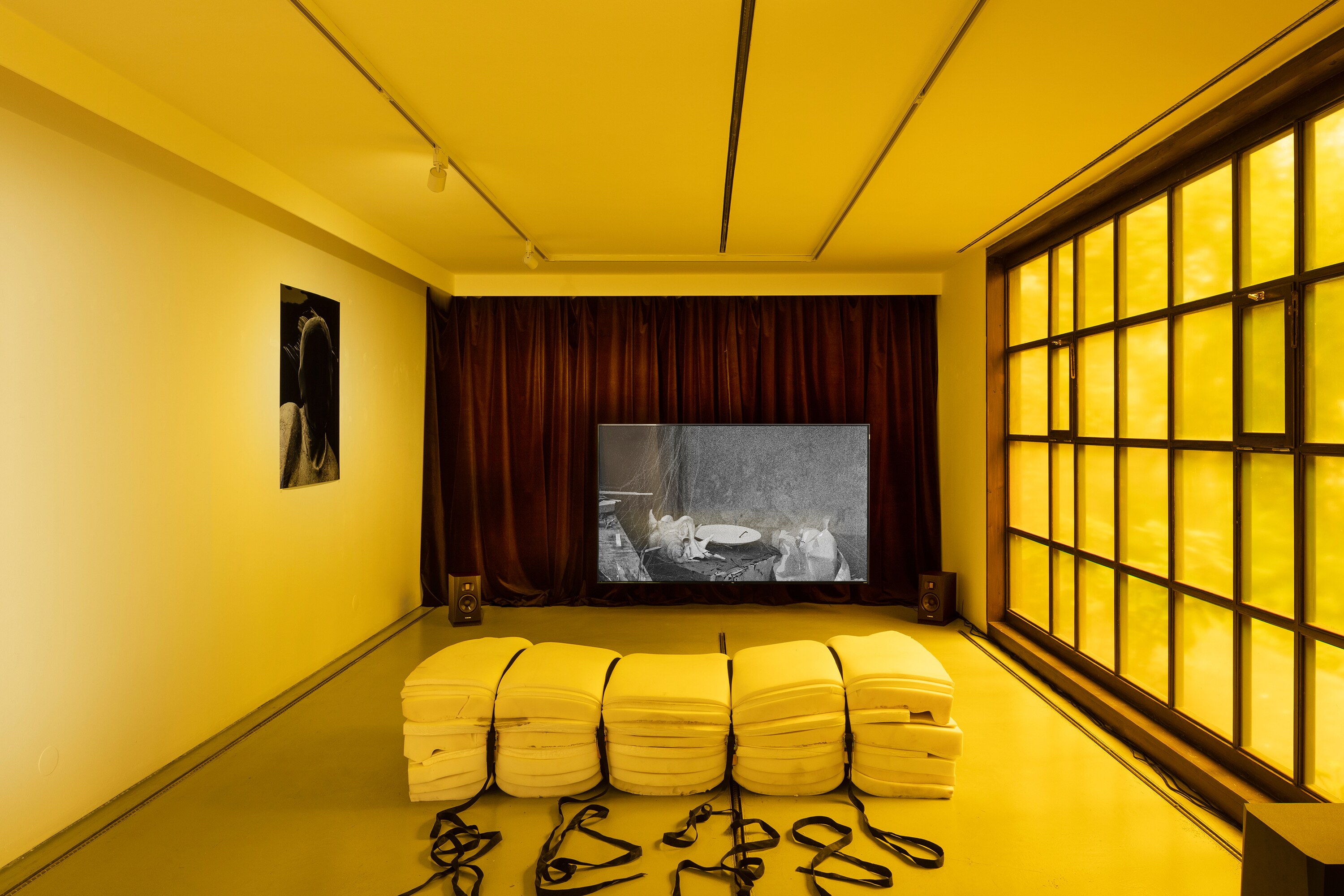
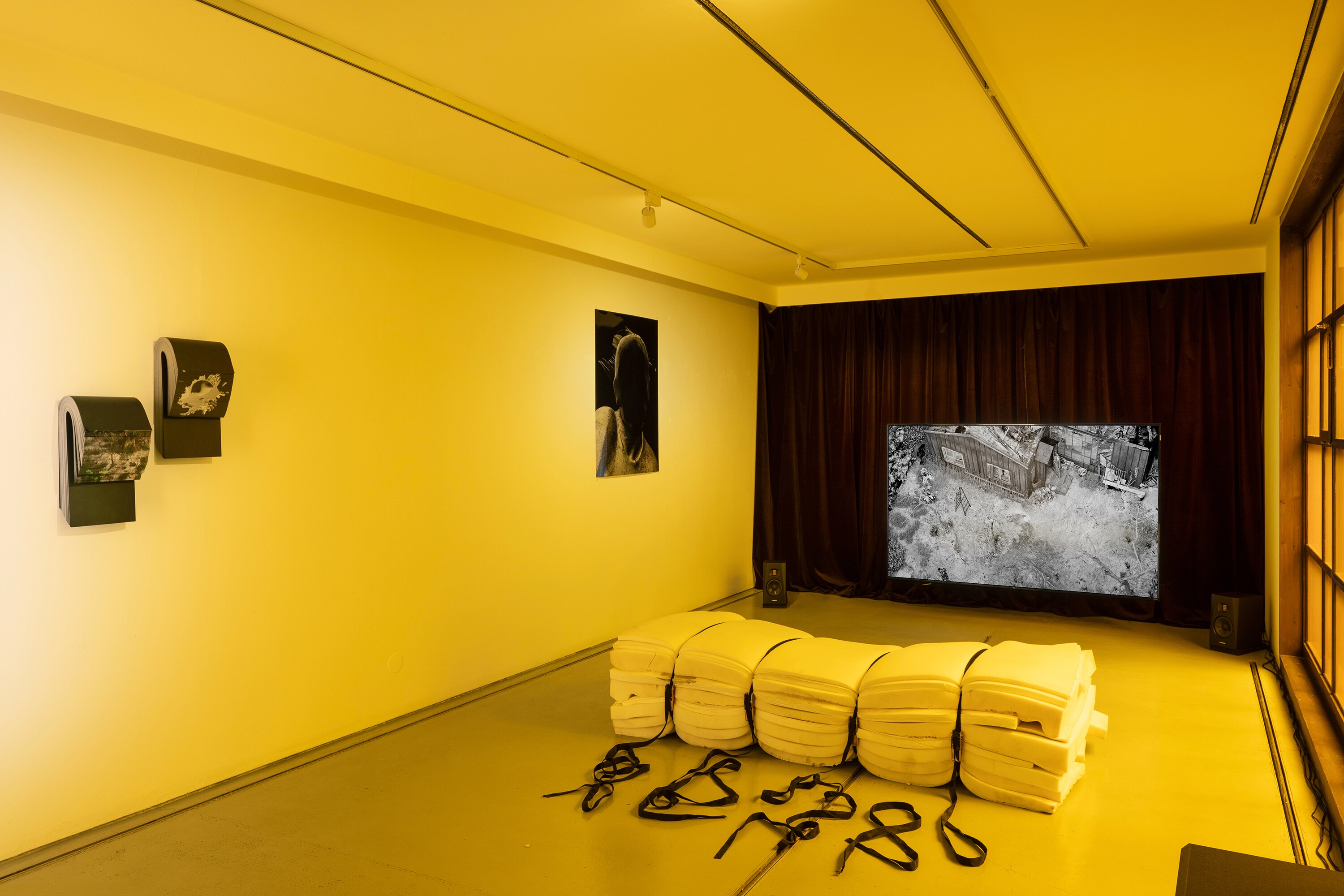
Tomáš Dvořák, A Scene in a Studio
In 1844 William Henry Fox Talbot included in his book The Pencil of Nature a photograph titled "A Scene in a Library." The picture shows several shelves with rows of books, a simple still life that works almost as a catalogue of things. His commentary, however, is within the context of the book somewhat enigmatic, even out of place: instead of describing the picture, it develops a reflection on invisible rays and on a camera that would be able to see what remains hidden from the human eye.
Among the many novel ideas which the discovery of Photography has suggested, is the following rather curious experiment or speculation. I have never tried it, indeed, nor am I aware that any one else has either tried or proposed it, yet I think it is one which, if properly managed, must inevitably succeed. When a ray of solar light is refracted by a prism and thrown upon a screen, it forms there the very beautiful coloured band known by the name of the solar spectrum. Experimenters have found that if this spectrum is thrown upon a sheet of sensitive paper, the violet end of it produces the principal effect: and, what is truly remarkable, a similar effect is produced by certain invisible rays which lie beyond the violet, and beyond the limits of the spectrum, and whose existence is only revealed to us by this action which they exert. Now, I would propose to separate these invisible rays from the rest, by suffering them to pass into an adjoining apartment through an aperture in a wall or screen of partition. This apartment would thus become filled (we must not call it illuminated) with invisible rays, which might be scattered in all directions by a convex lens placed behind the aperture. If there were a number of persons in the room, no one would see the other: and yet nevertheless if a camera were so placed as to point in the direction in which any one were standing, it would take his portrait, and reveal his actions. For, to use a metaphor we have already employed, the eye of the camera would see plainly where the human eye would find nothing but darkness. Alas! that this speculation is somewhat too refined to be introduced with effect into a modern novel or romance; for what a dénouement we should have, if we could suppose the secrets of the darkened chamber to be revealed by the testimony of the imprinted paper.
Talbot's room is a peculiar space. It is not illuminated, and yet it is full of radiation; it is dark only for the human eye. The images in it already exist, in a manner of speaking, they simply have no visible form yet. The camera does not create them out of nothing. It makes present something that was present in another way: as a trace, a possibility, a latent image. At the same time the whole room here turns into an apparatus. What is at stake is no longer a camera placed in a space. It is a space that itself organises seeing: the walls, the aperture, the lens, the invisible radiation and the bodies inside form a single system. The room is not merely the scene of the image; it becomes an image apparatus itself.
Today this notion acquires a new technological meaning. A photograph need no longer be only the result of light falling on a sensitive surface. It can become input material for further computation: from several images a space can be derived, missing views can be reconstructed from fragments, and generative models can be used to produce images of places the camera never directly saw. 3D reconstruction and artificial intelligence thus turn photography from a final record into a stock of possibilities, out of which space and movement can be assembled again.
Such a space has no single fixed time and no single point of view. A past image enters a present computation, the trace turns into a model, and the model into a new sequence of images. The gaze detaches itself from the human body that would give it height, direction and scale. It can glide through the room, come close to the ground, rise towards the ceiling and pass through places from which no historical photograph ever looked. It is no longer only the eye of the camera. It is a gaze composed of the photographic record, the spatial model and statistical imagination.
And perhaps in the end we find ourselves inside Talbot's room. We stand in a space that is full of images, data, past gazes and invisible computation, although we directly perceive only a tiny part of them. We look at an image that arose from what was recorded, computed and assembled again, and at the same time we are almost blind to the apparatus as a whole. Like the persons in Talbot's darkened chamber, we are surrounded by a world that exceeds us and that we cannot glimpse directly; we are part of it, and yet we remain each other's blind spot.