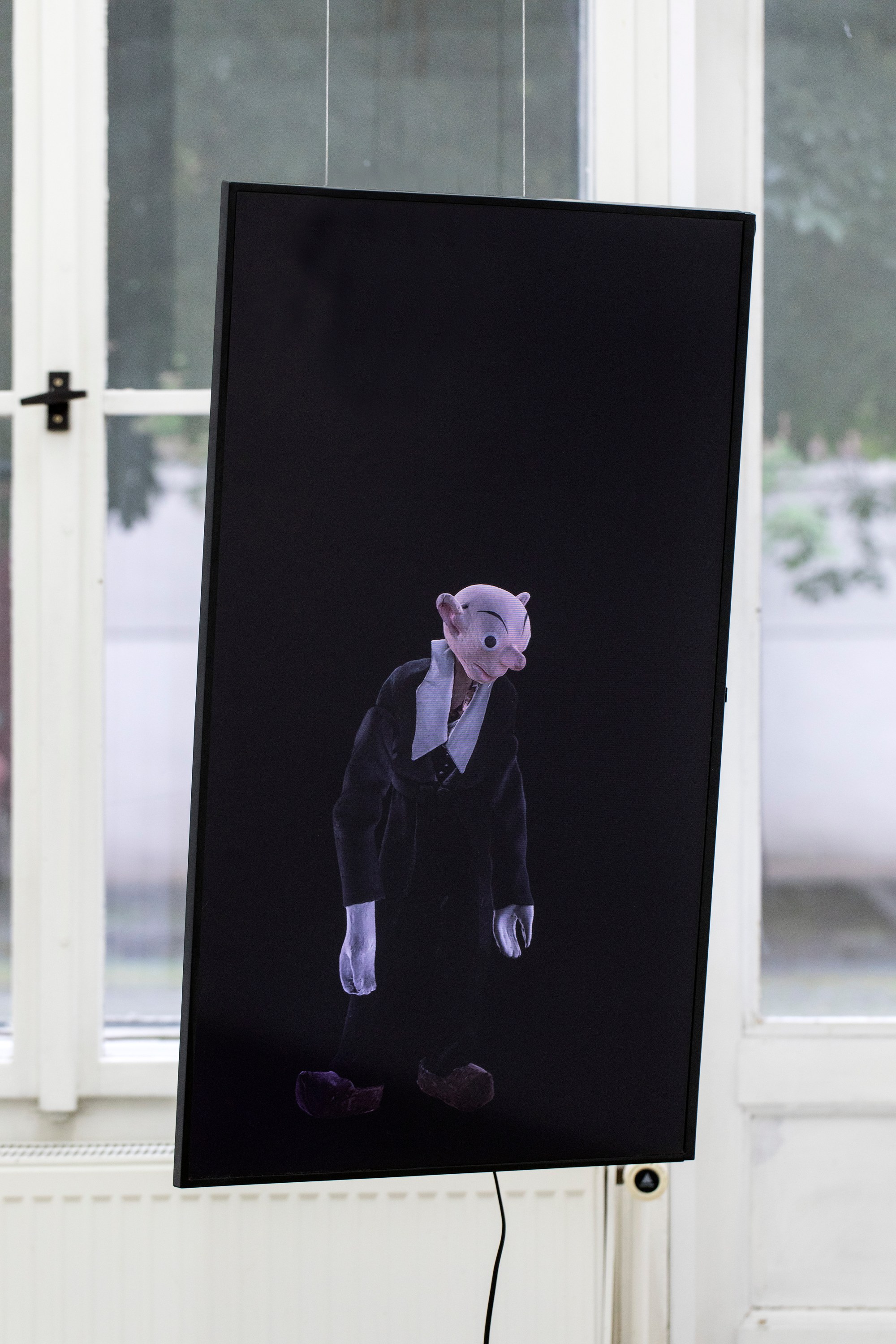
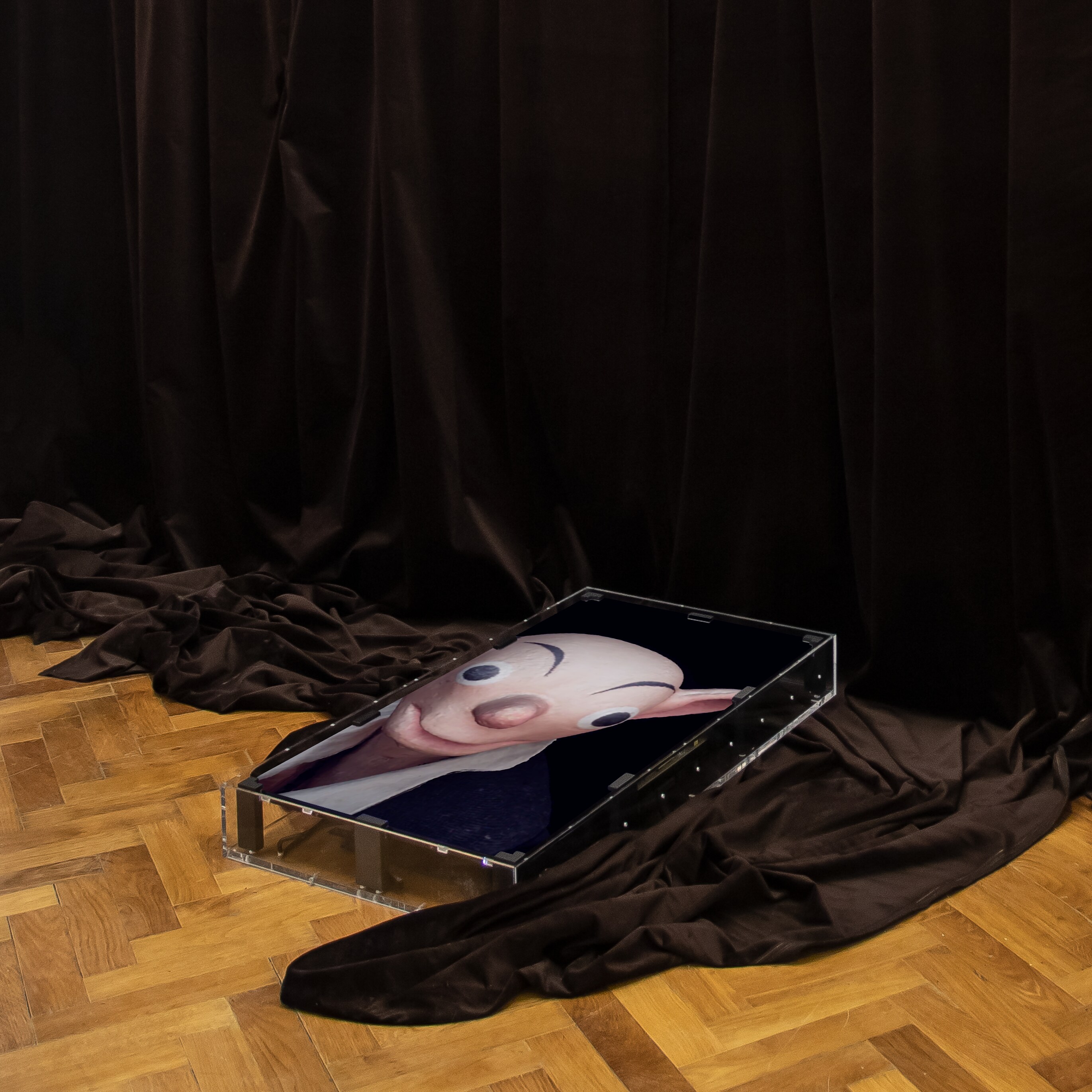
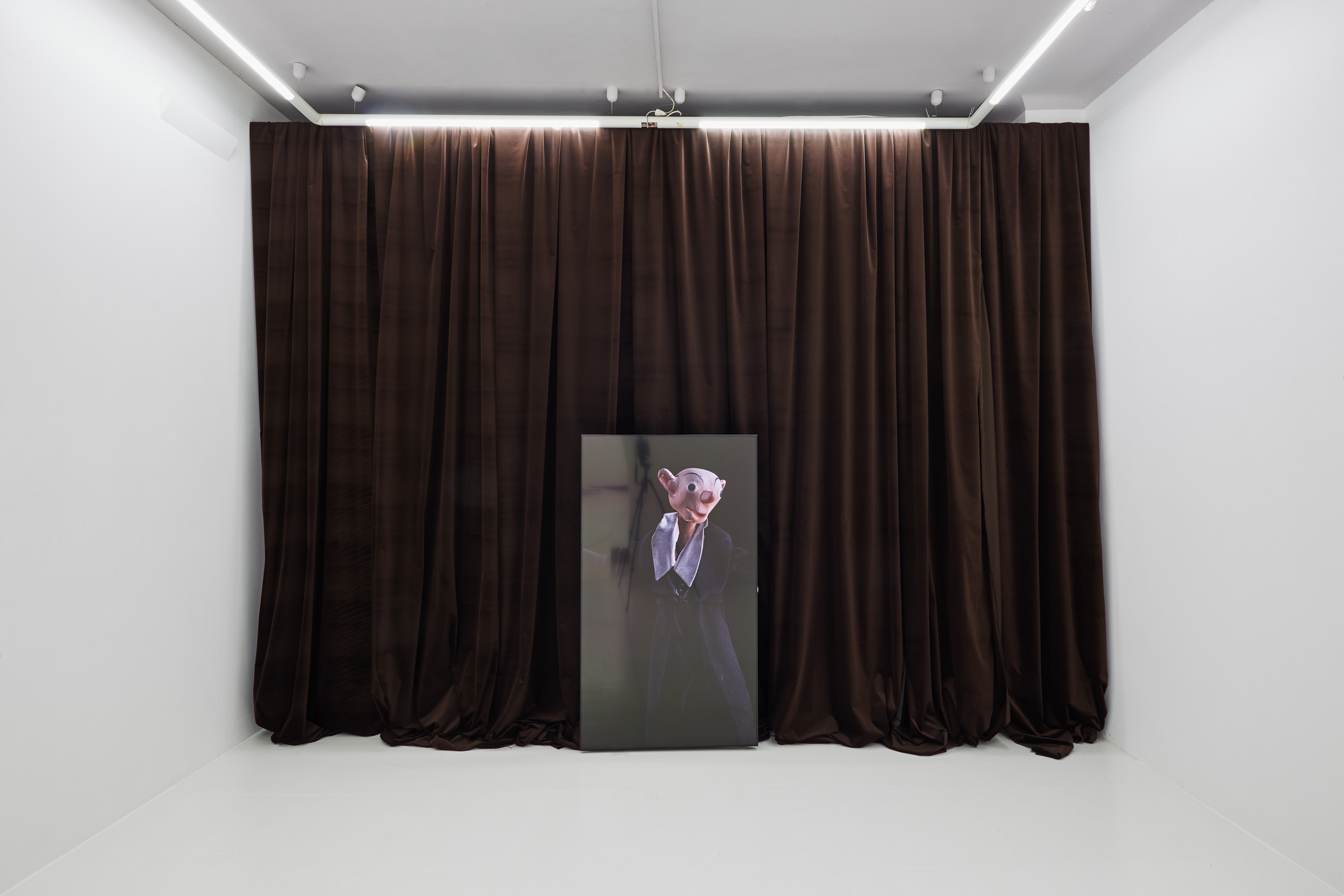
Spejbl is a Czech puppet. Josef Skupa conceived him in Plzeň in 1920. Karel Nosek carved him. He is a pompous man in a formal coat who talks about everything and knows little. The jokes are always on him.
The work uses a 3D scan of the original puppet. The scan is animated with motion capture. The movements are the artist's own, under a high dose of ketamine. They stop being conscious and have no purpose. The puppet waits in idle mode. The video has no sound.
Thumb push puppets were the name of those small wooden toys in my childhood, that could be pressed with a button under the feet of the figure, as a result of which the cords running in the hollow body parts of the figure were loosened and the figure collapsed. By releasing the button, the cords were tensioned again and the figure took up its original position. Essentially, nothing else could be done with this toy. It could not really be moved or controlled like a puppet, what one could only achieve with it is that it collapsed and fell to the ground, thus rendering visible the prone structure of thin yarns holding its figure. It's as if Hynek Alt presses something like this wooden button when taking photographs.
[…]
In Hynek Alt's video work Untitled (Spejbl, Ketamine, 2020), we see a 3D animated puppet. The movement of the puppet is controlled by the real movement of the artist with the help of motion capture technology, therefore, in the Kleistian sense, the puppeteer's movements (and thus the vis motrix, the soul as well) can be translated into the puppet's movements accordingly, so theoretically nothing forestalls the puppet's capability of the above mentioned 'affectation'. In this case, however, the operator cuts the imaginary cords between him and the puppet by consuming a high dose of ketamine, resulting in a loss of orientation and control, and even in the forgetting of his role as an operator.
Alt attempts to liberate the puppet and the figure of Spejbl that was created in 1920 but since then, hasn't undergone any substantial changes, being a character who is usually just the subject of jokes, whose awkwardness makes the audience laugh, from whom no one ever expects anything, who is only a supporting character next to his own son. However, Spejbl does not take advantage of this 'freedom', only staring blankly and just waiting, suspended in this limbo state. As a result of the drug, a void is created between the puppeteer and the puppet, which, although it changed the paradigm of the puppet's existence, as the puppet is no longer forced to follow the puppeteer's movements and will, does not necessarily mean liberation.
While for the Romantic Kleist the floating of an impassive, helpless, and involuntary marionette appeared as the utopian image of human existence, in Alt's work, the inert hovering of the liberated figure (freed from the puppeteer's will) emerges as a kind of existentialist crisis.
Borbála Szalai, How Soon Is Now, NoD Gallery, Prague, 2020