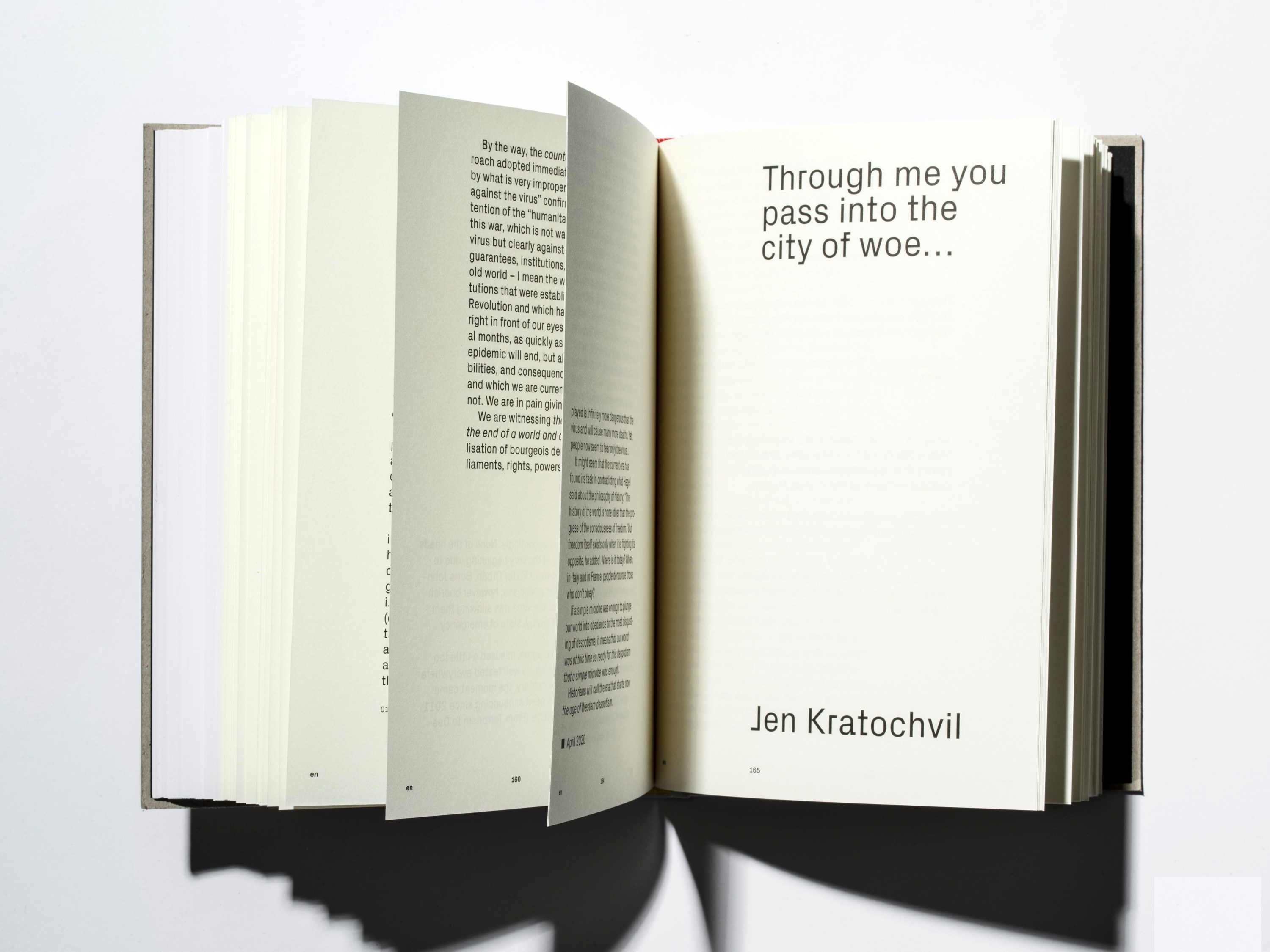
Jen Kratochvil, Through me you pass into the city of woe…
Through me you pass into the city of woe: Through me you pass into eternal pain: Through me among the people lost for aye.
Dante Alighieri, The Vision of Hell, I, Canto I, verse 3 01
* * *
Image A: Julius Caesar looks down from his villa upon Rome, criss-crossed by an urban network of aqueducts connected to the central network of the Cloaca Maxima.
Image B: An unknown masked citizen hurls a Molotov cocktail at a 5G cellular tower under construction.
Image C: Elon Musk observes the launch of rockets carrying Starlink satellites into lower Earth orbit.
* “Limbo.” That was the final comment on a long transatlantic Zoom call regarding our present feelings of lack of clarity, loss of anchoring, and the torn lineage in the continuity of projects carved with certainty into a Google calendar synchronised across all available devices. Limbo, i.e. the space found at the entrance to the Christian hell, where the mothers and fathers of ancient wisdom, honour, and heroism dwell, side by side with the Old Testament figures and prophets who erred on a single problem in Christian eschatology: they were born before the Resurrection and Assumption of Christ, thus missing the milestone for universal redemption and liberation from sin. Also in Limbo are the unchristened children – endlessly awaiting the apocalypse and the second round of universal mercy. The inhabitants of Limbo do not suffer like their neighbours in the lower rungs of the fiery Inferno – they merely roam and contemplate in timelessness.
Limbo is the condition of the economically stable portion of Western society, unaffected by the coronavirus and retaining many of its comforts even during the pandemic. There is a crucial difference, however. In 2007, a decree of the Roman Catholic Church abolished Limbo, supposedly for the comfort of the growing number of unbaptised children in contemporary secularised society. Good for the kids. But what about Socrates, Hippocrates, Julius Caesar, Avicenna, and Averroës? What about Saladin and Homer, who inhabited Limbo for centuries? Old Testament heroes such as Abel, Noah, Abraham, Rachel, or David were lucky; shortly after their deaths, Jesus dropped by to pick them up and take them to his new place of work up in heaven. The rest are now homeless. Pluto must have felt similar when, a year before the abolishment of Limbo, it was stripped of its status as a planet by the International Astronomical Union. Interplanetary transport probably just made a few changes to the map. Even so, the bureaucratic apparatus of international institutions notwithstanding, limbo (now with a lower-case “L”) remains an appropriate image to describe the state collectively experienced during the COVID-19 pandemic.
It does not require too much effort to imagine that Edward Snowden might also have thought of L(l)imbo in 2013, when he spent forty days in Sheremetyevo Airport in Moscow awaiting diplomatic asylum. Mehran Karimi Nasseri probably had a lot more time for symbolic similes during his timeless fifteen years in Terminal One of Charles de Gaulle Airport in Paris – as does anyone in any transitory refugee camp. In cases like these, L(l)imbo merges with Marc Augé’s concept of the non-place.
During the pandemic, even our otherwise quotidian urban environments become non-places. Boundless waiting without a clear idea of who we are waiting for. A strange heterotopia for which some unknown authority lacked the time to determine the rules. Surprisingly, however, there is something historically universal about the interweaving structure of urban squares, streets, parks, temporarily abandoned public buildings, stores, and services in the era of physical distancing. Unknown personally and generationally, yet bizarrely familiar. The gears of associative memory turn at full speed and, following immediate references to recent Hollywood films, immerse themselves in older literary sources. Albert Camus’s The Plague (1947) is certainly a good example:
“It was four in the afternoon. The town was warming up to boiling point under a sultry sky. Nobody was about, all shops were shuttered. Cottard and Rambert walked some distance without speaking, under the arcades. This was an hour of the day when the plague lay low, so to speak; the silence, the extinction of all colour and movement might have been due as much to the fierce sunlight as to the epidemic, and there was no telling if the air was heavy with menace or merely with dust and heat. You had to look closely and take thought to realise that plague was here. For it betrayed its presence only by negative signs. Thus Cottard, who had affinities with it, drew Rambert’s attention to the absence of the dogs, which in normal times would have been seen sprawling in the shadows of the doorways, panting, trying to find a non-existent patch of coolness.”
It seems like the only, though seemingly banal, difference is the absence of the dogs that would usually fill the streets of Oran, the setting chosen by Camus for his critical novel-length study of the absurd fragility of the social system. The streets of today’s metropolises are still full of dogs – not stray dogs, but domesticated pets – and they are perhaps even more visible than before, since during compulsory quarantine, dog-walking (in addition to shopping or jogging) provides one of the few compelling reasons to leave the safety of one’s home. Since antiquity, human faeces have been attended to by invisible labyrinths of sewage pipes, while animal faeces – following restrictions on the otherwise similarly invisible cleaning services – are left on the street, reflecting an abstract image of what is usually delegated under the surface of the tarmac and paving.
* The monument as an established and historically vetted form of manifesting a specific ideology or manner of thought through a symbolic form, or by accenting its specific proponents, underwent a radical critical reassessment in the second half of the 20th century, giving rise to what is known as anti-monumentalism or counter-monumentalism. At documenta 8 (1987), the Polish-born German artist Horst Hoheisel unveiled a new, negative form of Aschrott’s original fountain in front of the Kassel town hall, destroyed by the Nazis in 1939. Hoheisel decided to restore a piece of a voluntarily forgotten, pressing historical reality not by renewing the original obelisk stretching up towards the heavens, but rather by an inverted mirroring effect extending down below street level. The inhabitants of Kassel – or documenta visitors – thus enter the site of a disappeared sculpture and turn their gaze down to the entrails of the earth, where they can see and partially feel its original shape. They themselves are thus stood on the plinth, becoming temporary human monuments of renewed memory. Unlike the analogically conceived National September 11 Memorial (two negative forms of flowing waterfalls on the site and in the full dimensions of the destroyed World Trade Center), the new Aschrott fountain is a denial of the grand and clearly visible nature of its model. While the sound of both waterfalls drowns out New York’s pulsating wall of noise and provides an opportunity for inward meditation, the fountain places much greater demands on the attention of its “spectators”. A gaze downwards, under the surface, into boundless history, and a critical reading of it, can be quite uncomfortable for our subjectivities.
* * *
Until recently, the now collectively experienced image of the vacant city in the Western context belonged to surreal depictions in visual media. Cinematic scenes whose protagonists find themselves in a deserted Times Square either border on states of madness or express these directly. The canvases of Giorgio de Chirico, with their distant silhouettes of an individual or couple, connected to their environment only through the concurrence of late-afternoon shadow, convey a similar feeling of alienation to the one elicited by Michelangelo Antonioni when he shows Monica Vitti or Jeanne Moreau, their hearts torn with inner drama, walking along the infinite empty boulevards of new developments in 1960s Rome or Milan. Recent surreality has now become ordinary. The only medium that directly relies on the absence of human presence is architecture photography. The work of Gabriele Basilico or Thomas Struth, for instant, quite naturally replaces the dynamics of people with the rhythm of mutually flitting scatterings of attention between the strict lines of streets and buildings, between the tarmac and the sky, between the windows, concrete, stone, and an accent on the indispensable element of the visual pause, i.e. the physical frames of emptiness inside the frame of the photograph.
What became common only with the global pandemic for the life of Western cities, which on the surface seem to continue running smoothly, is perversely natural in military space. In his essay “Walking Through Walls”, Eyal Weizman, the founder of Forensic Architecture, reveals the military strategy of inverting the traditional communicative character of streets and squares. During military conflicts, these places become the most exposed and therefore the most inaccessible. Situations like the iconic photograph of Meliha Varešanović, taken by Tom Stoddart during the siege of Sarajevo, are simply impossible in Palestine or Iraq. It is not just that civilians can only inhabit public spaces with great difficulty, but also that the armed forces themselves abandon these spaces, creating a parallel map of the city in the city’s innards. In The Third Man, Orson Welles moved around post-war Vienna through the spacious corridors of the city’s complex sewerage system. The battlegrounds mentioned above offer no such comforts. Israeli soldiers knock through the walls of buildings, crossing the city exclusively through violated interiors. This strategy of contemporary warfare is horrifying, not simply due to the image of a masked and armed commando bursting through a wall, beyond which a family is sitting down to dinner, but also due to the fact that one of the basic references for the development of this strategy is the rhizomatic structures of Deleuze and Guattari, as described in A Thousand Plateaus. Weizman confirms this in an interview with a retired brigadier general, Shimon Naveh, currently the director of the Operational Theory Research Institute of the Israeli armed forces. According to Naveh, every soldier has to be a university graduate, and architecture and philosophy are among the most common fields of study. The strange asynchronicity of a common language.
* * *
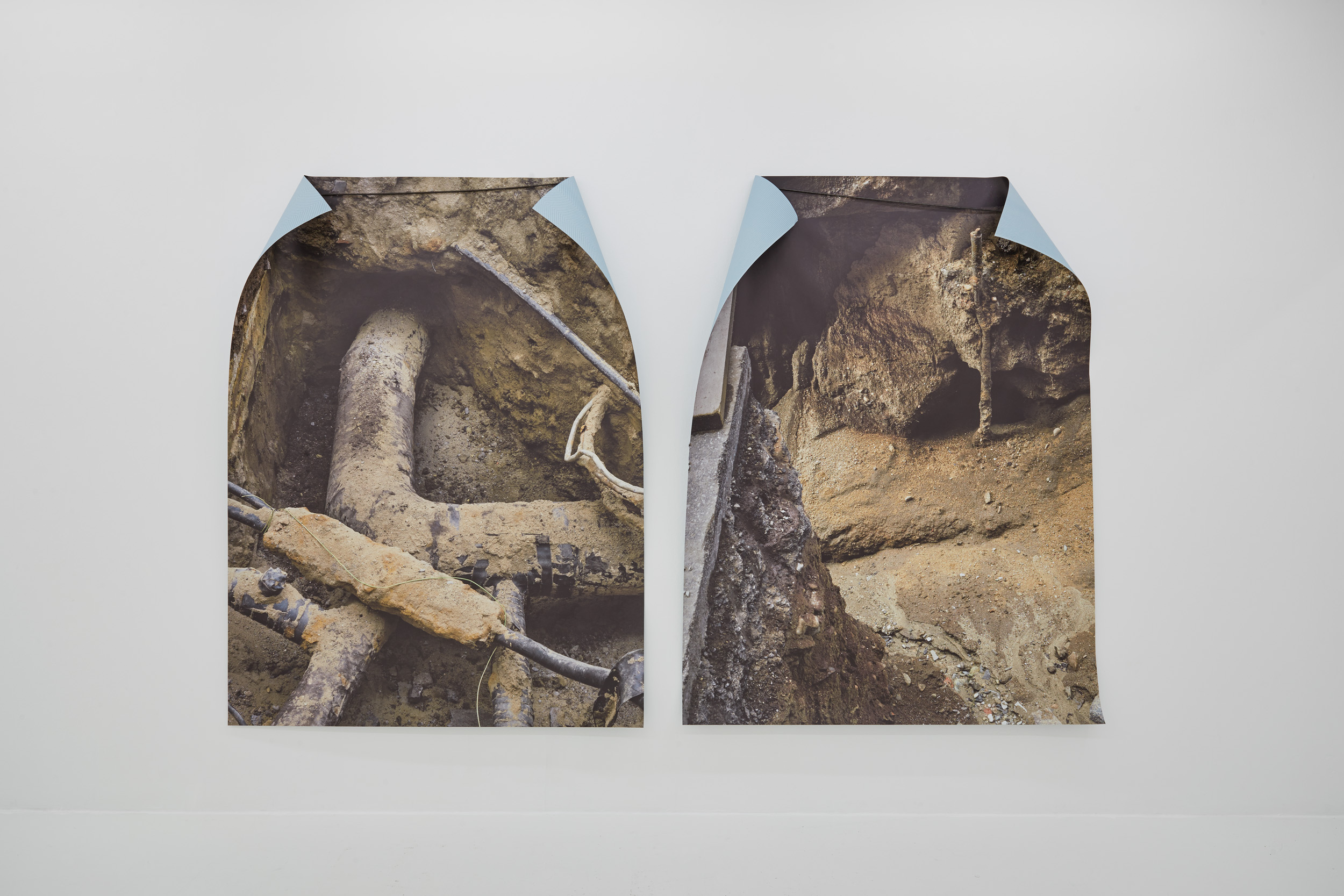
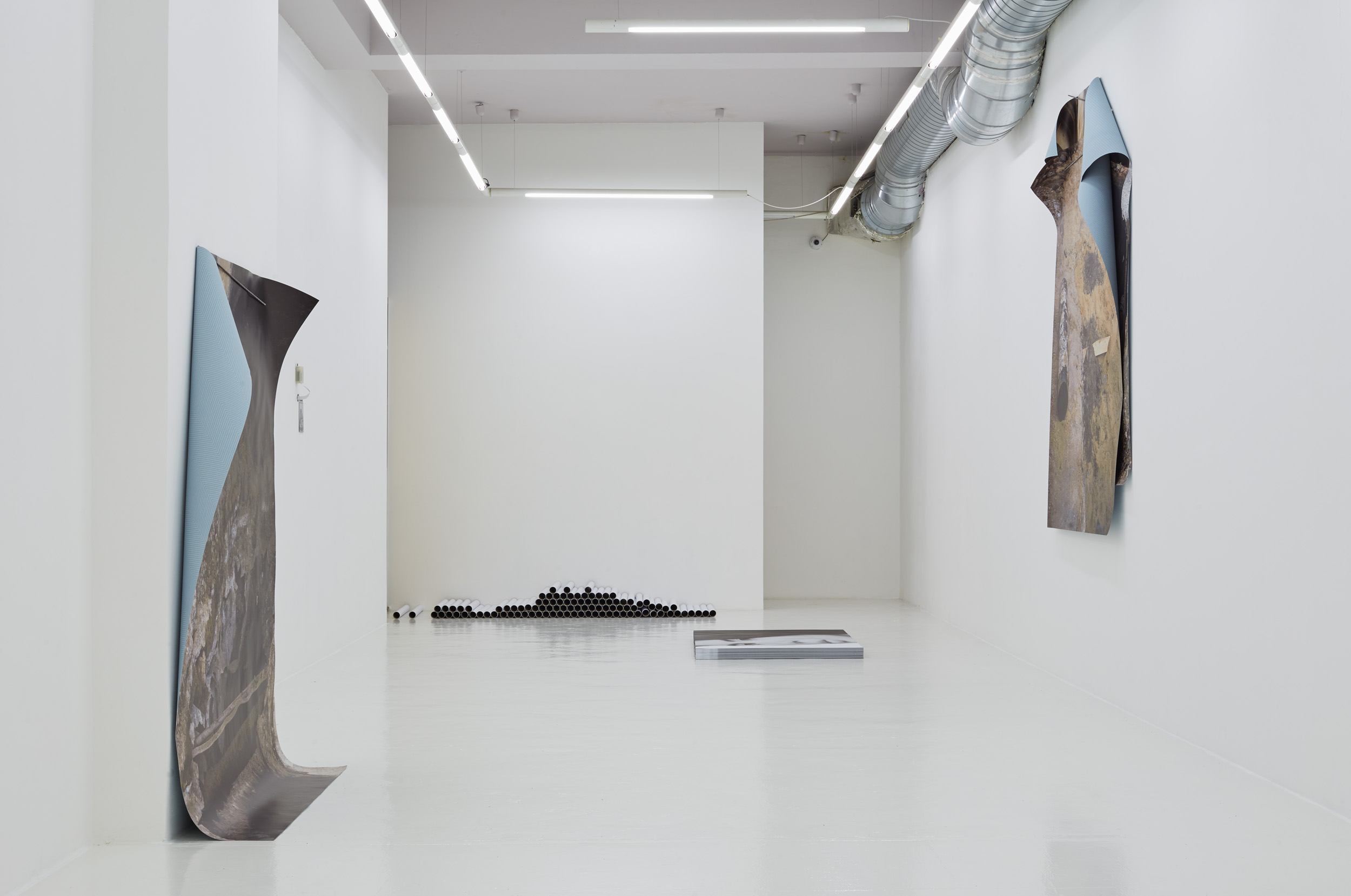
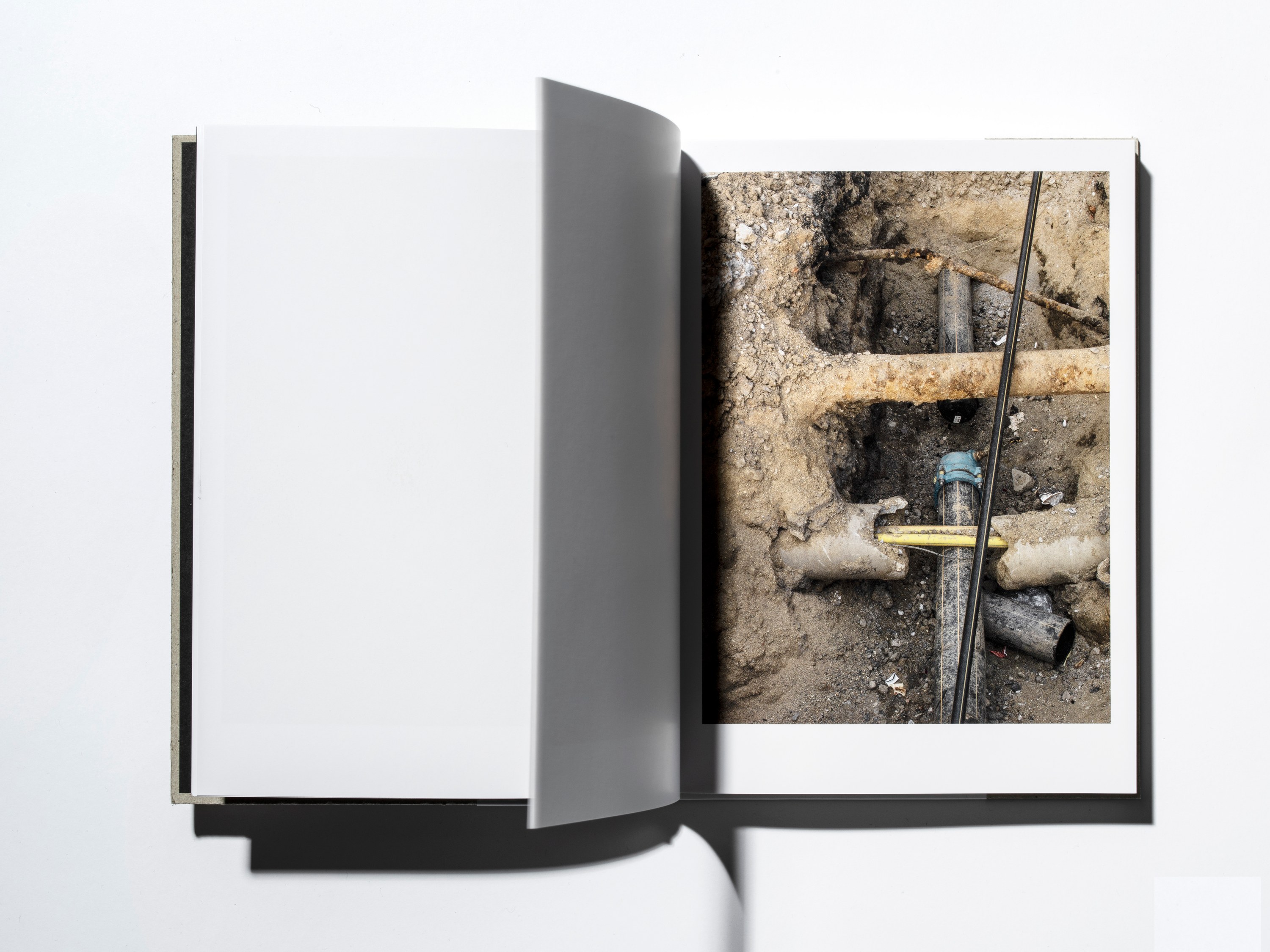
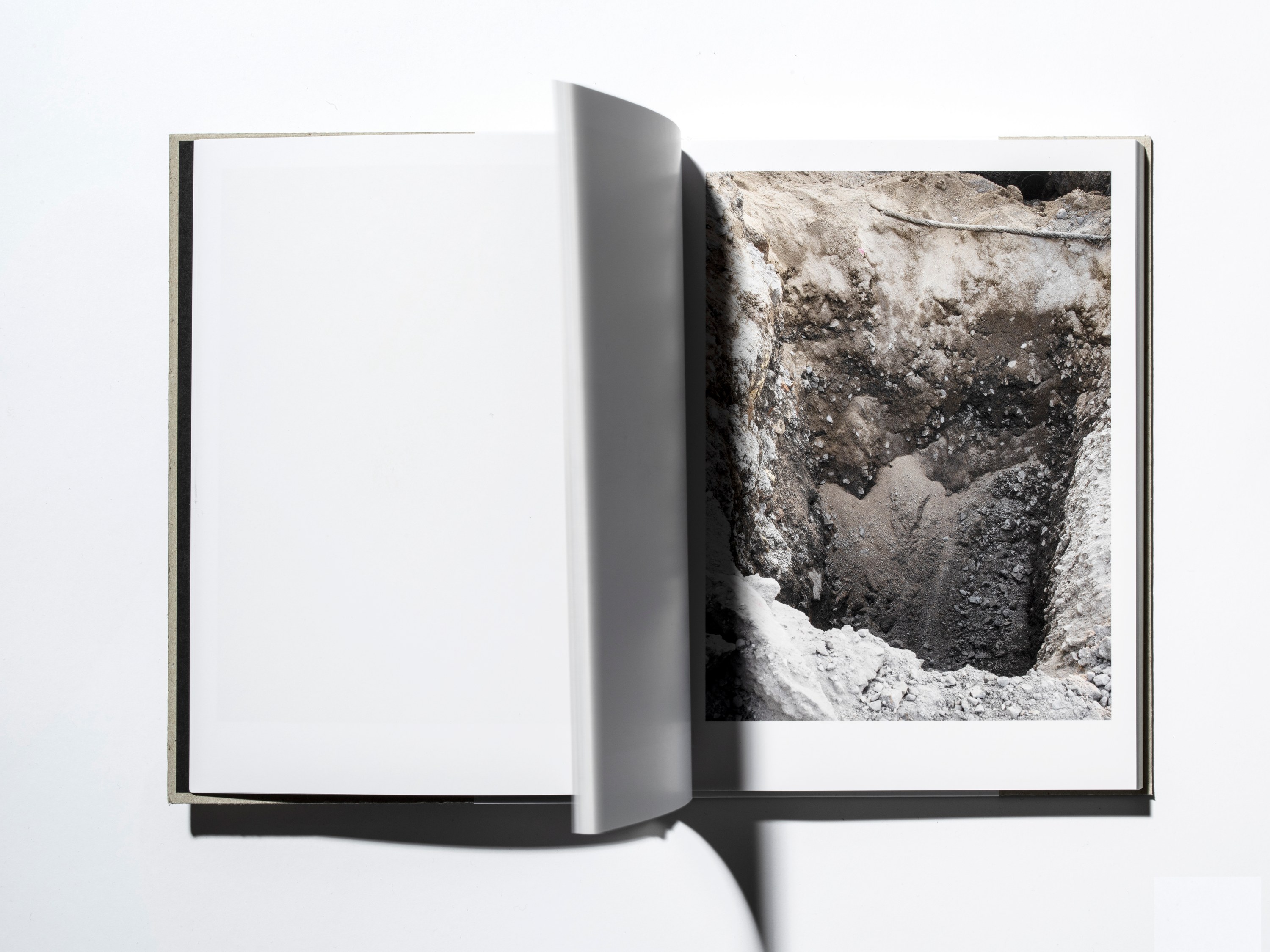
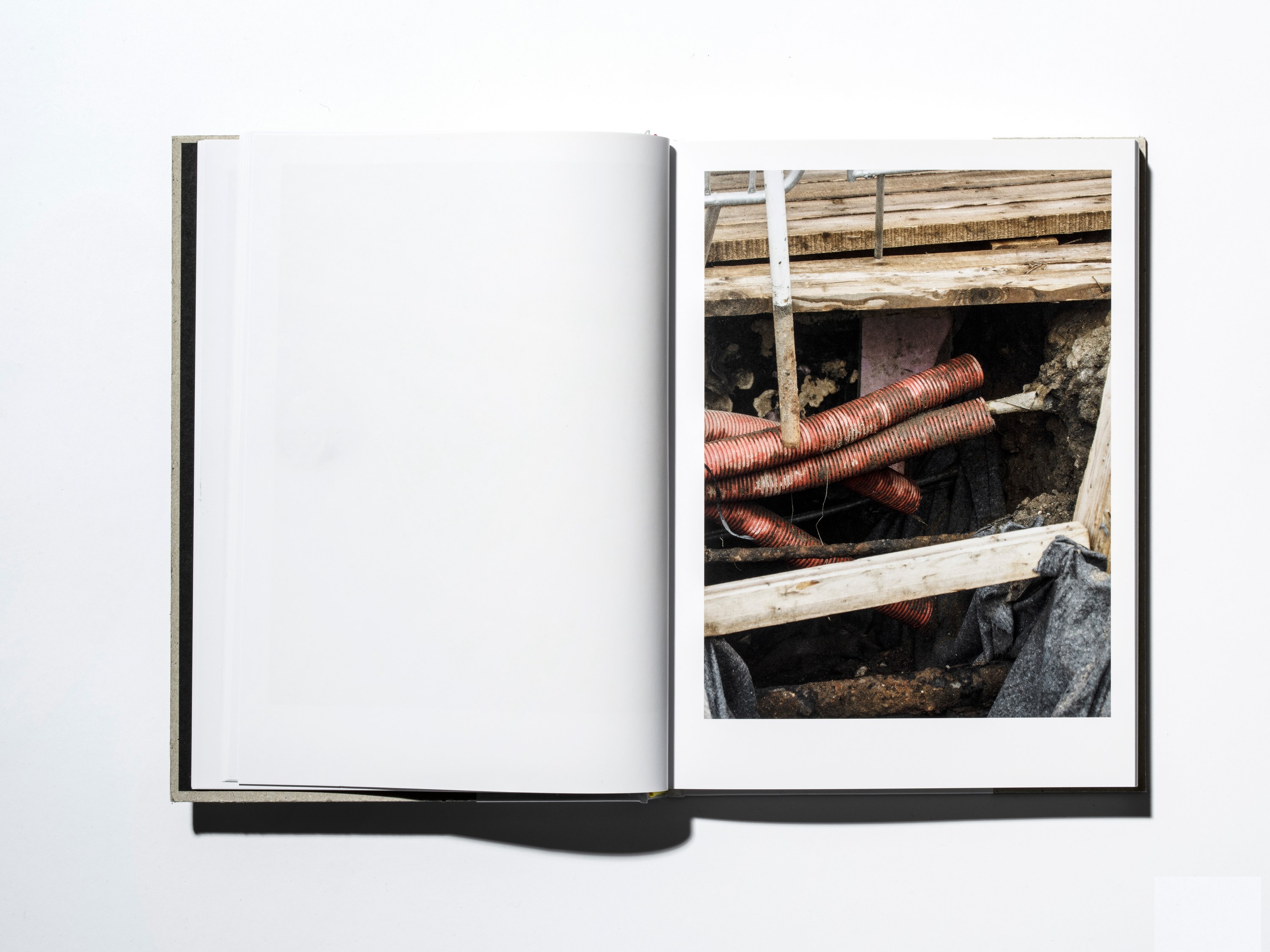
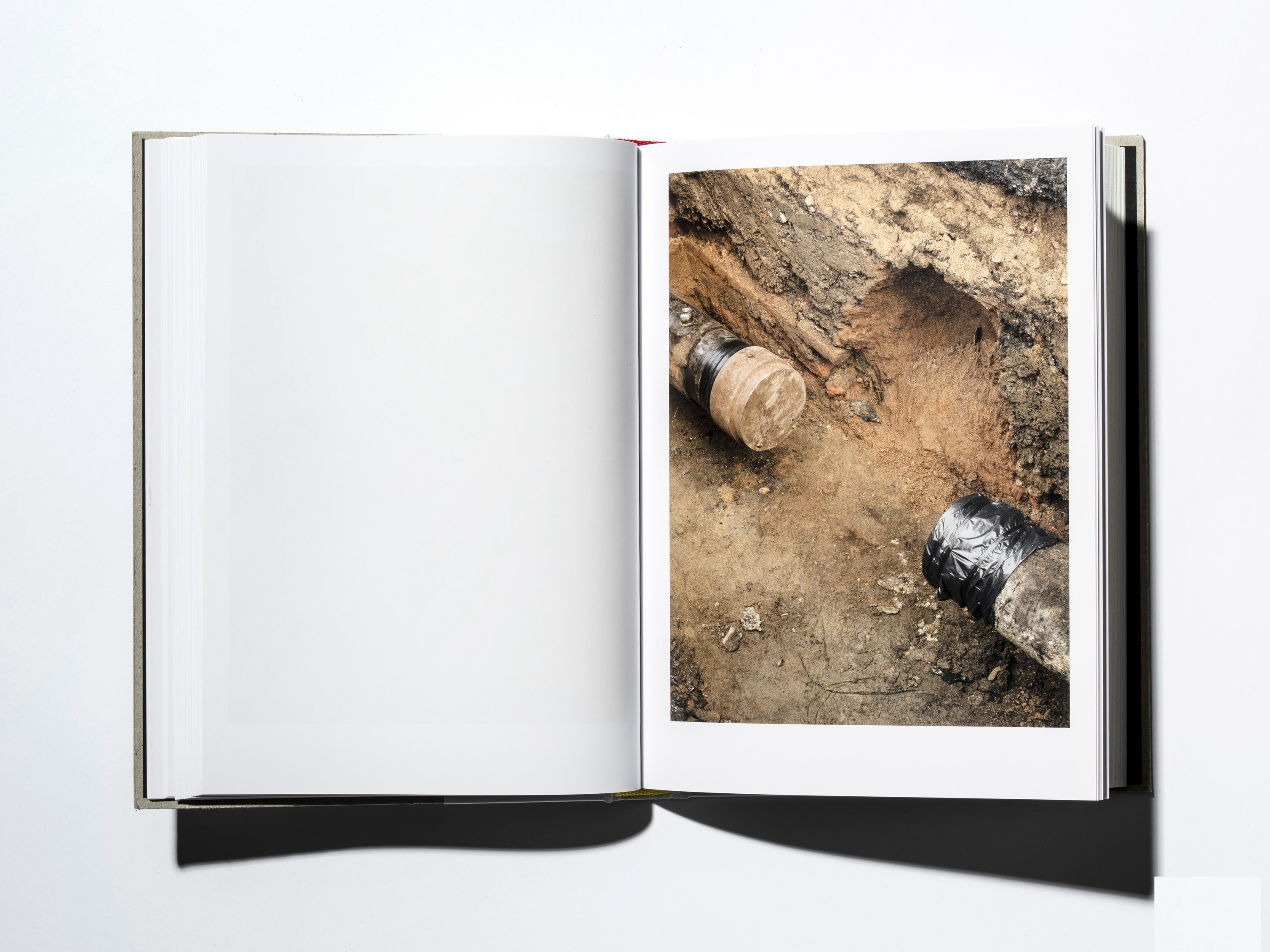
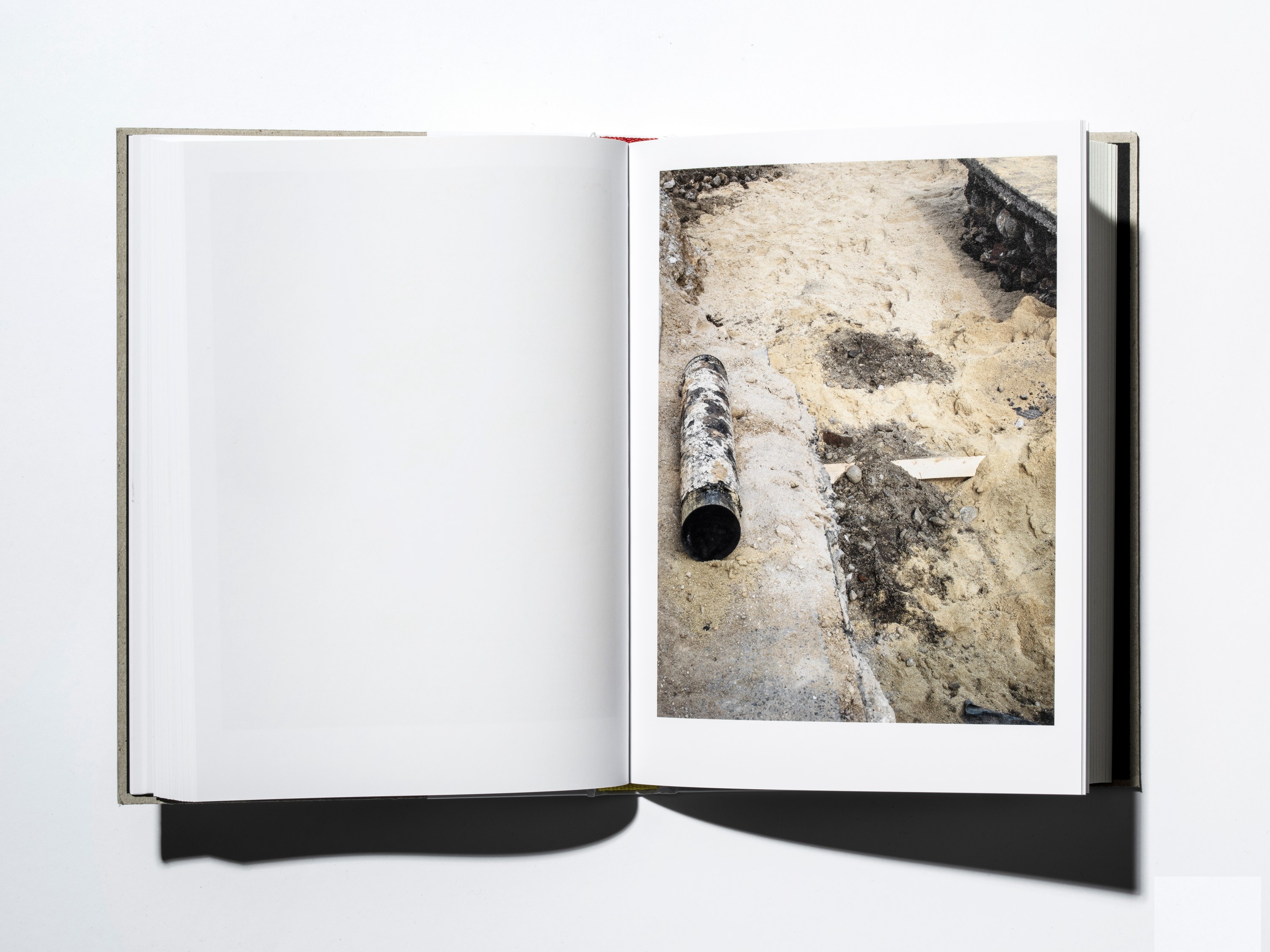
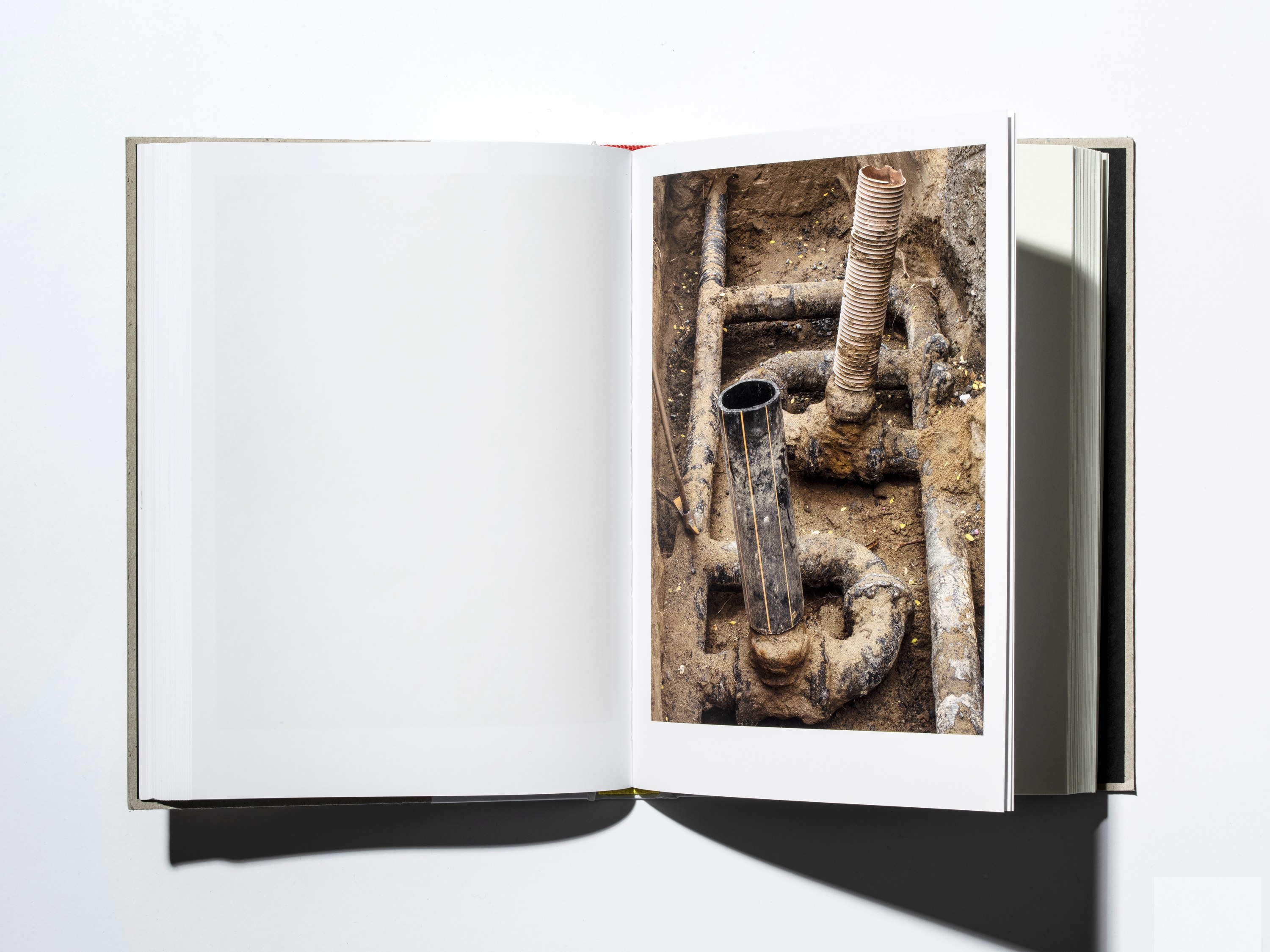
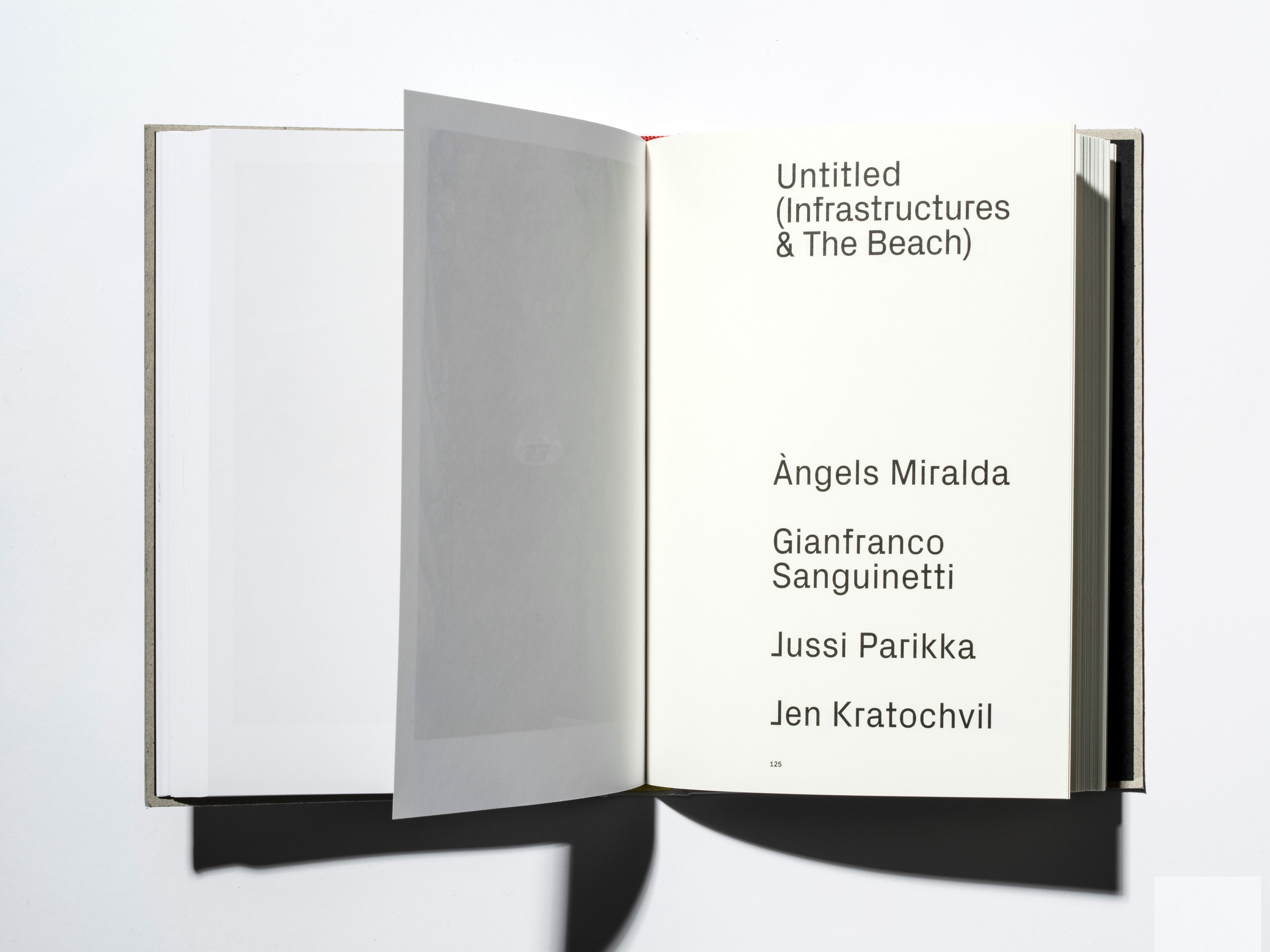
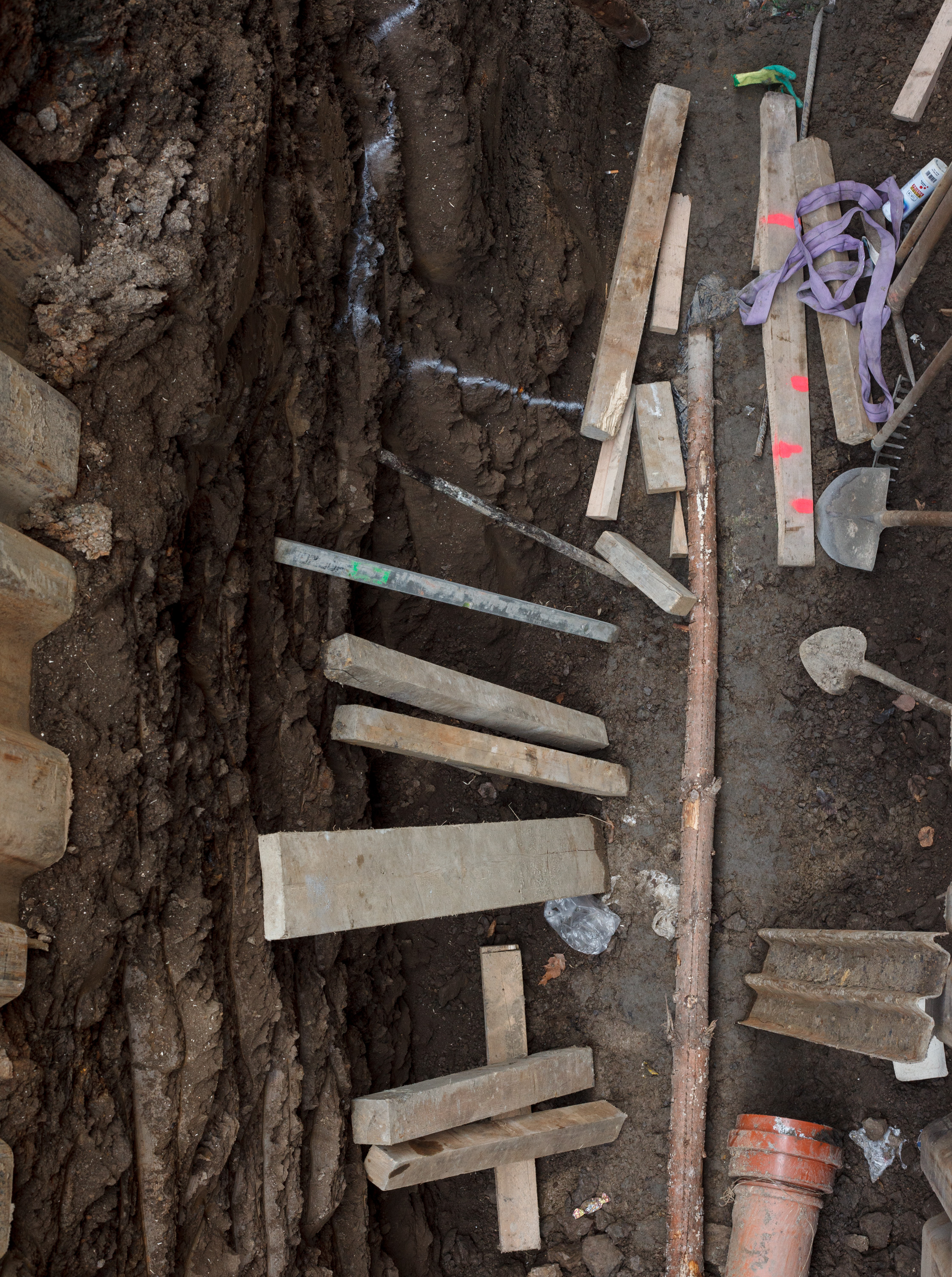
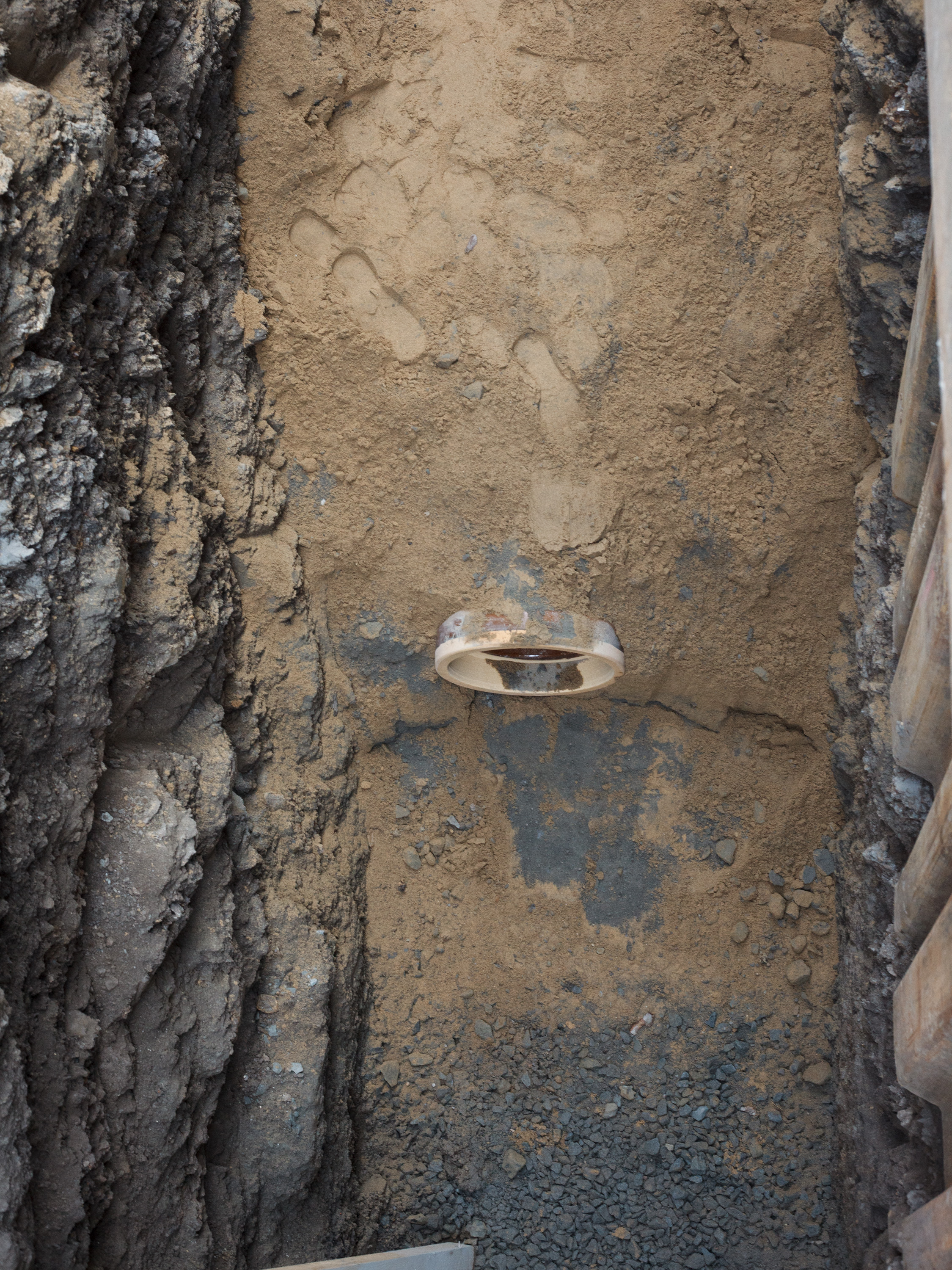
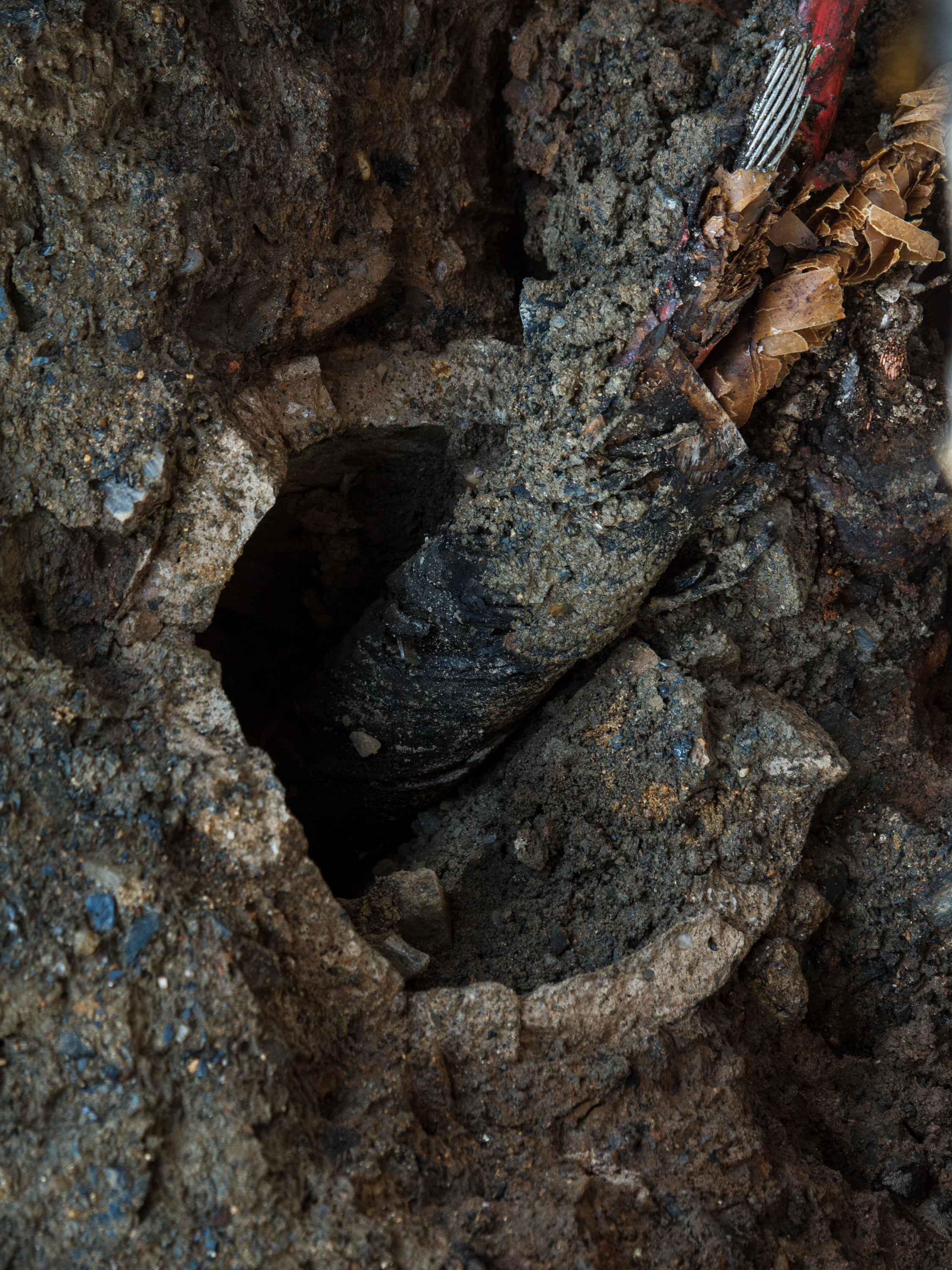
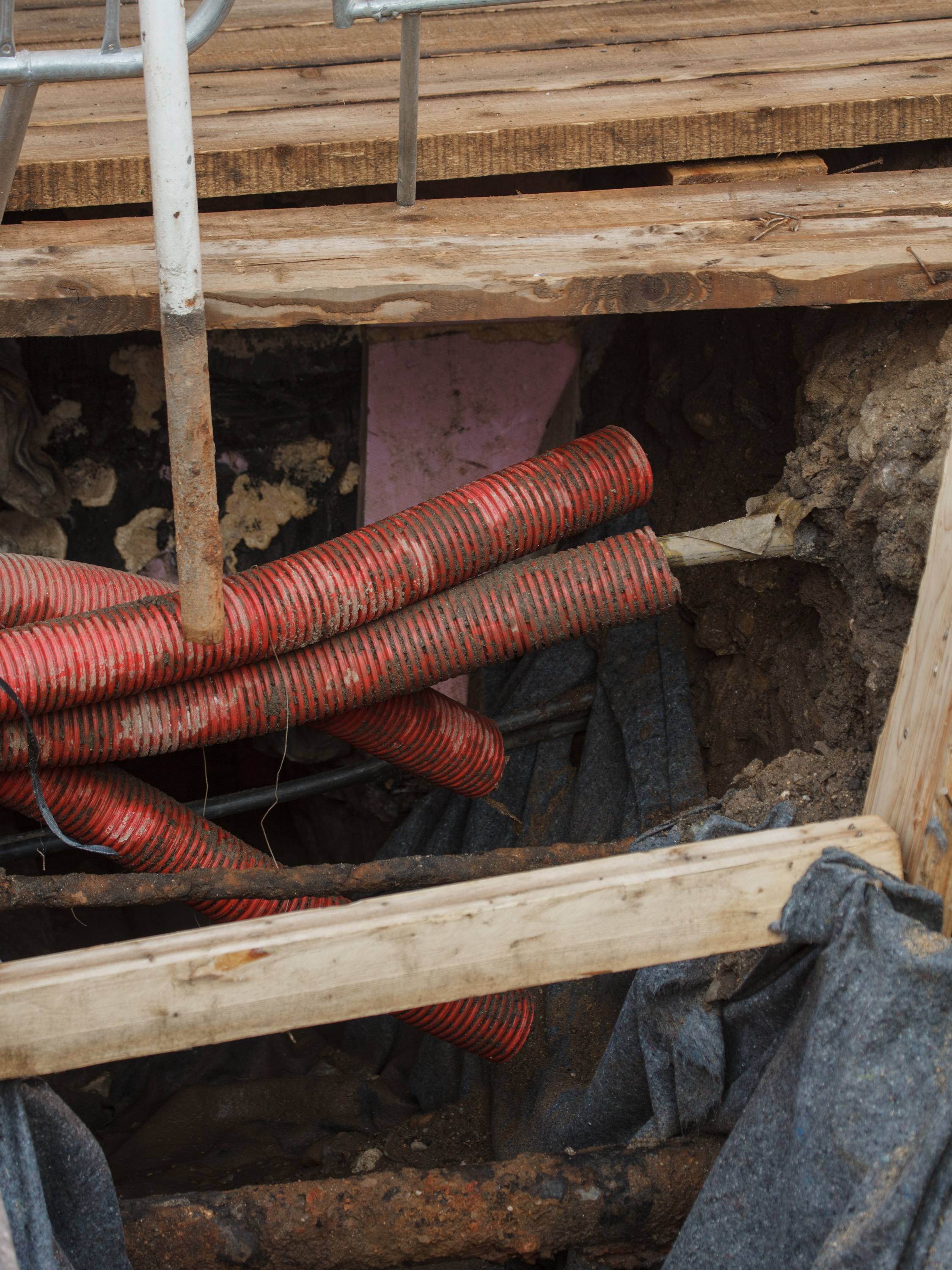
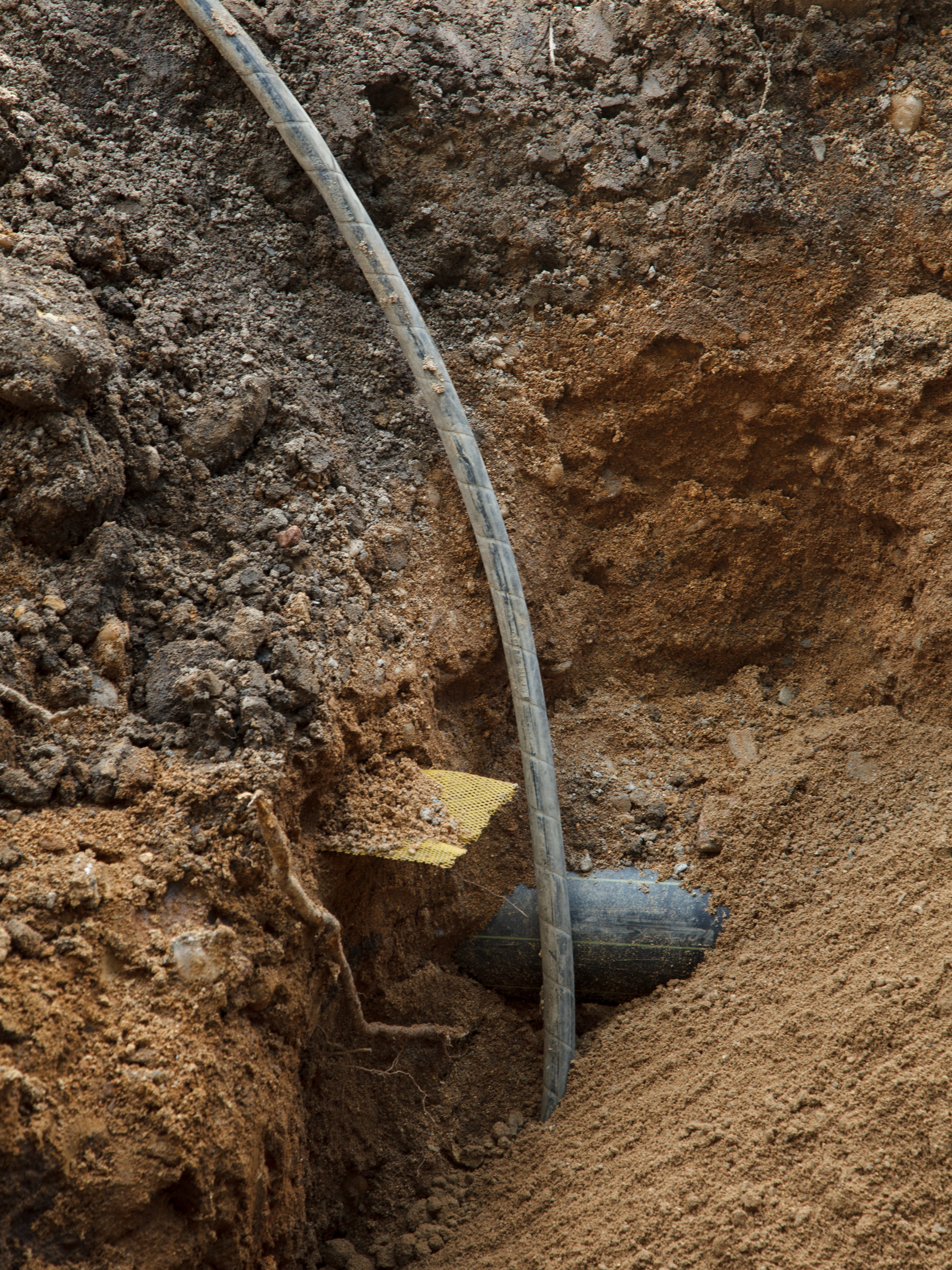
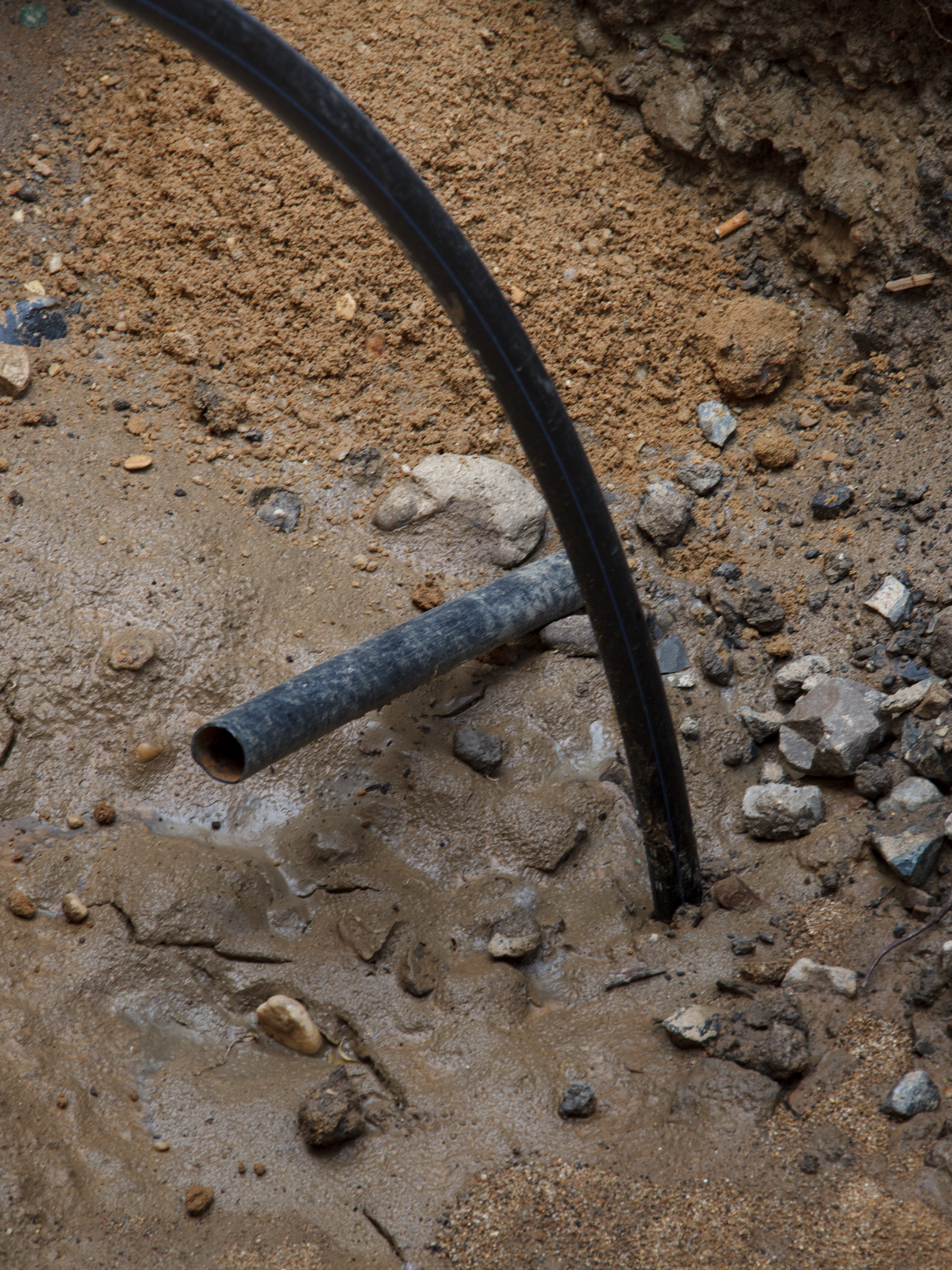
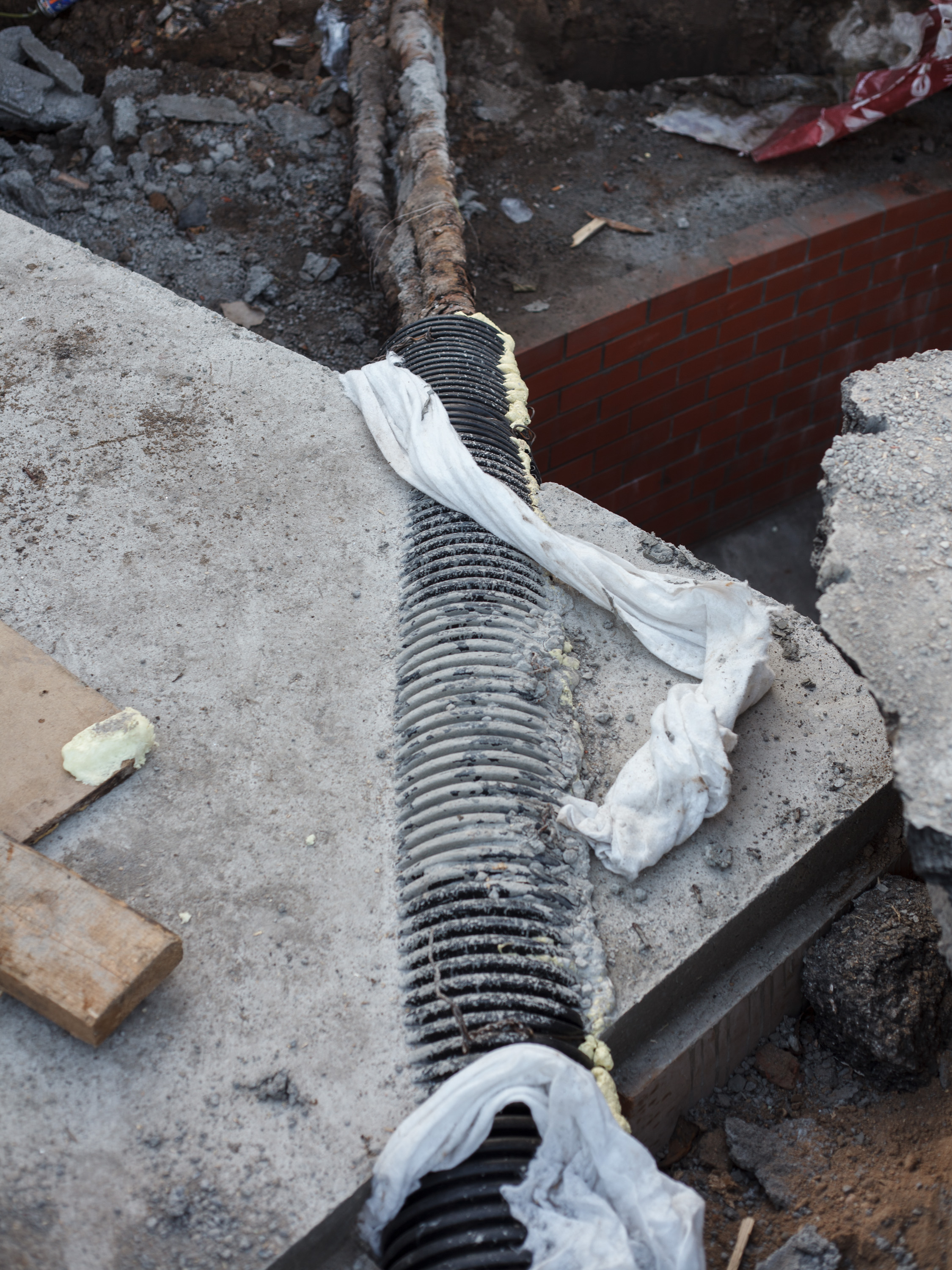
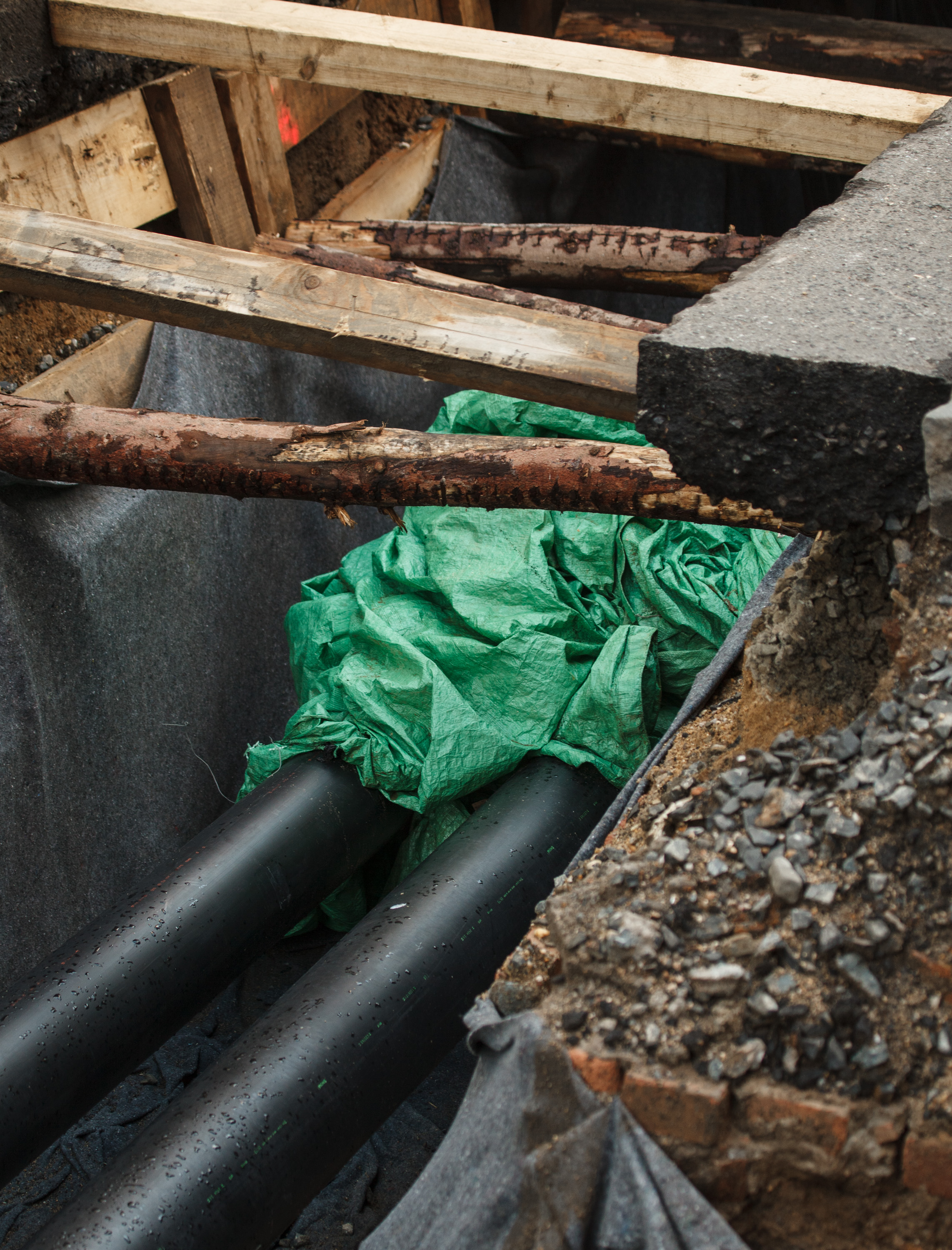
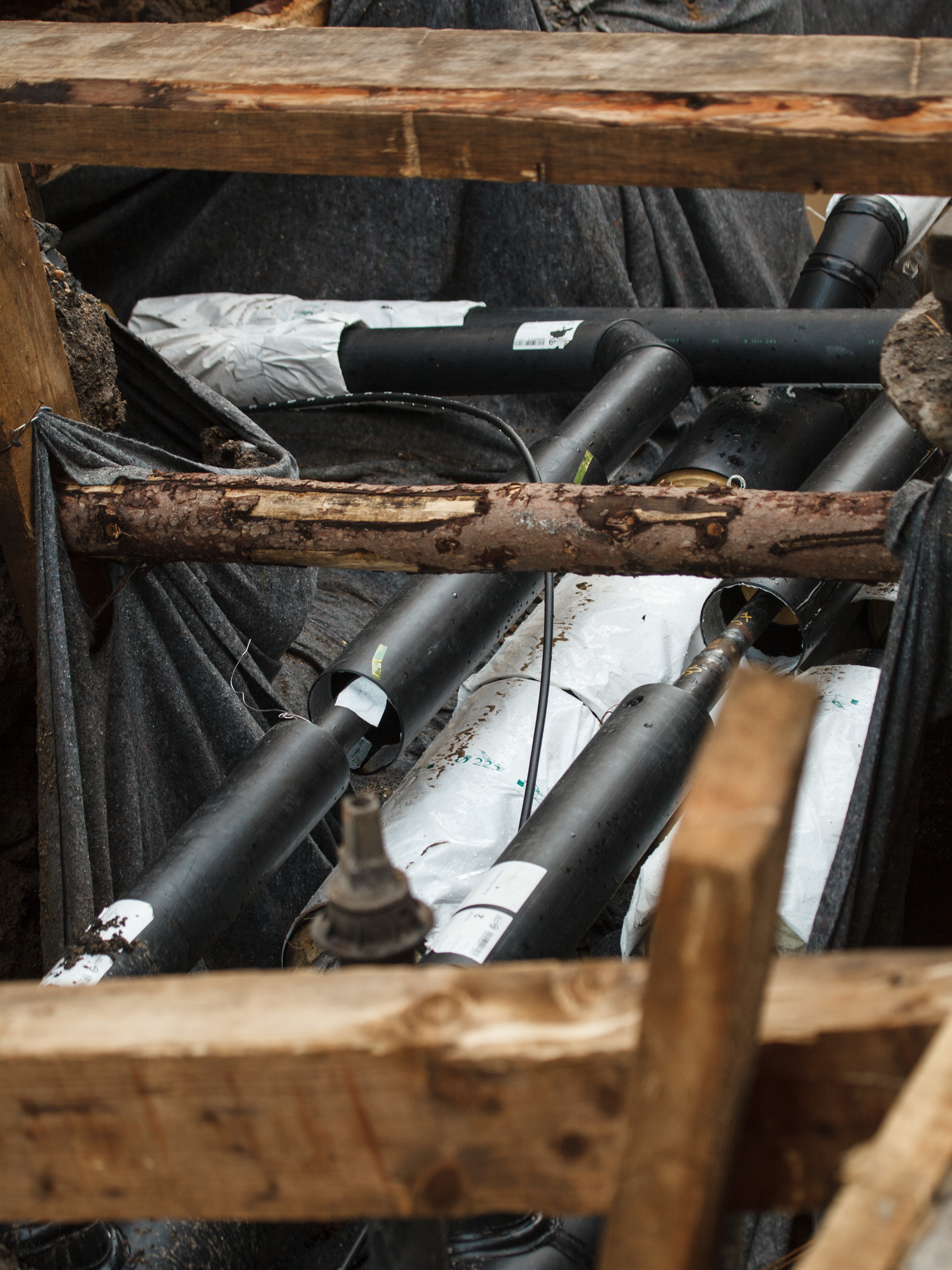
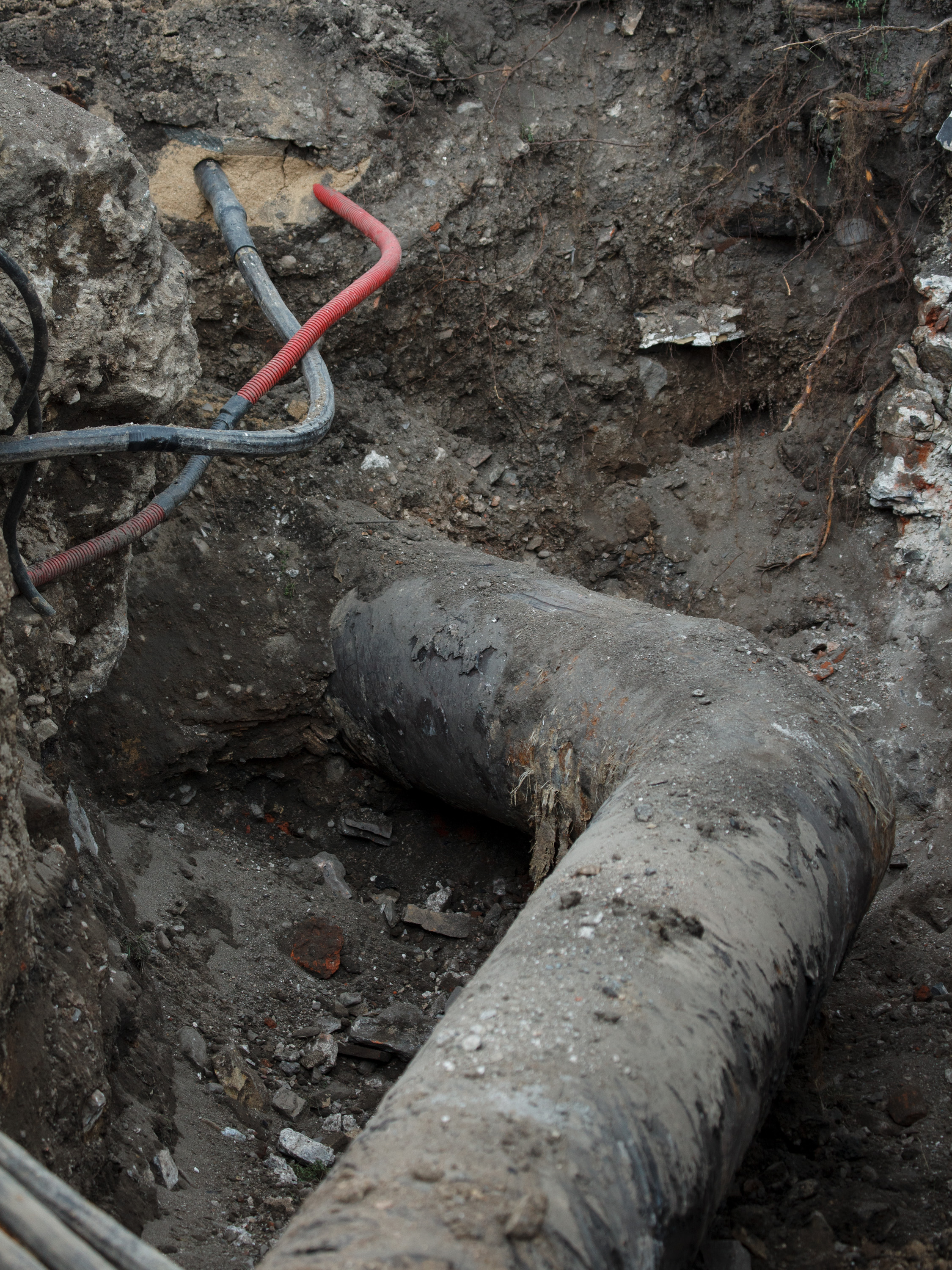
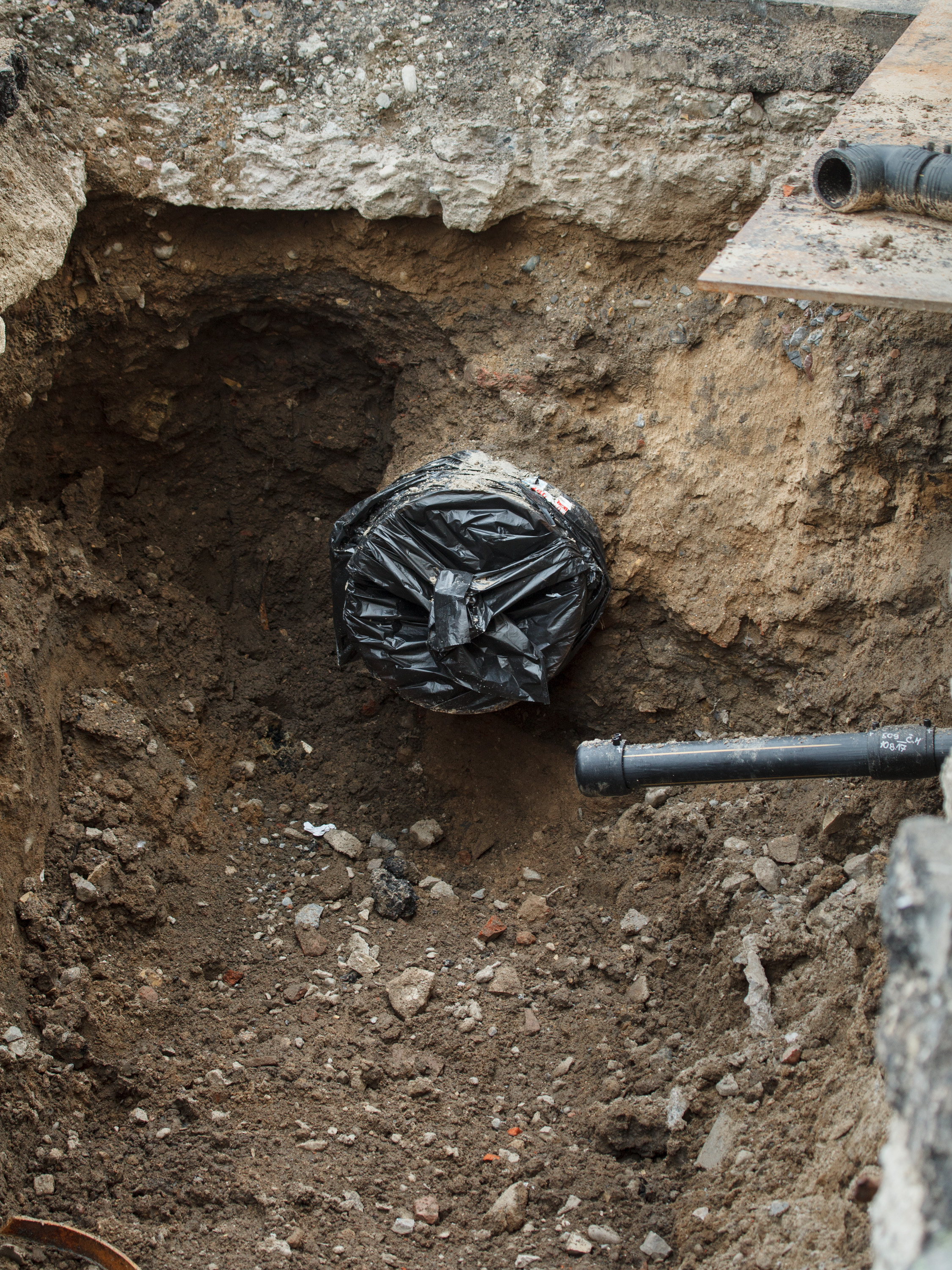
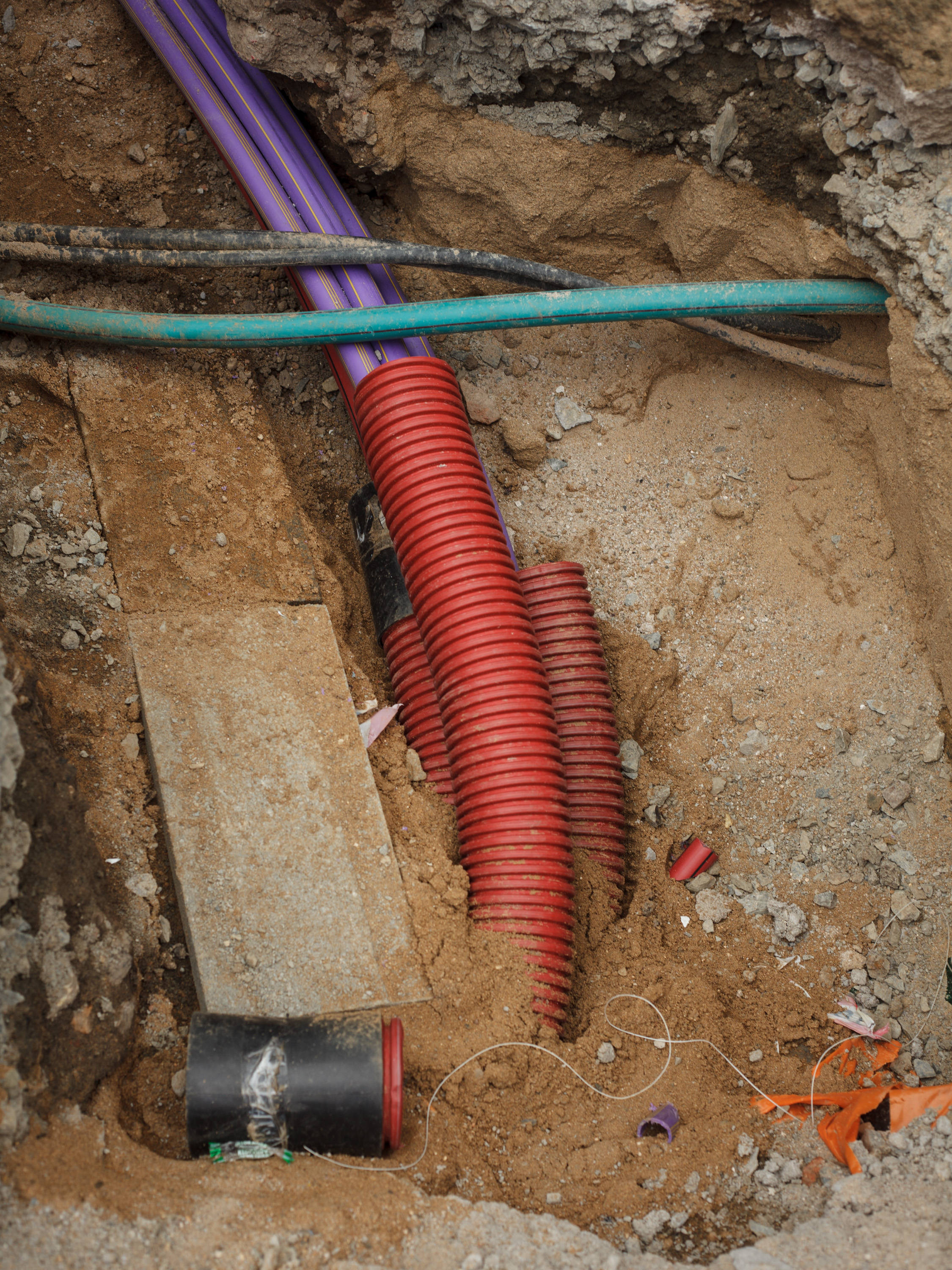
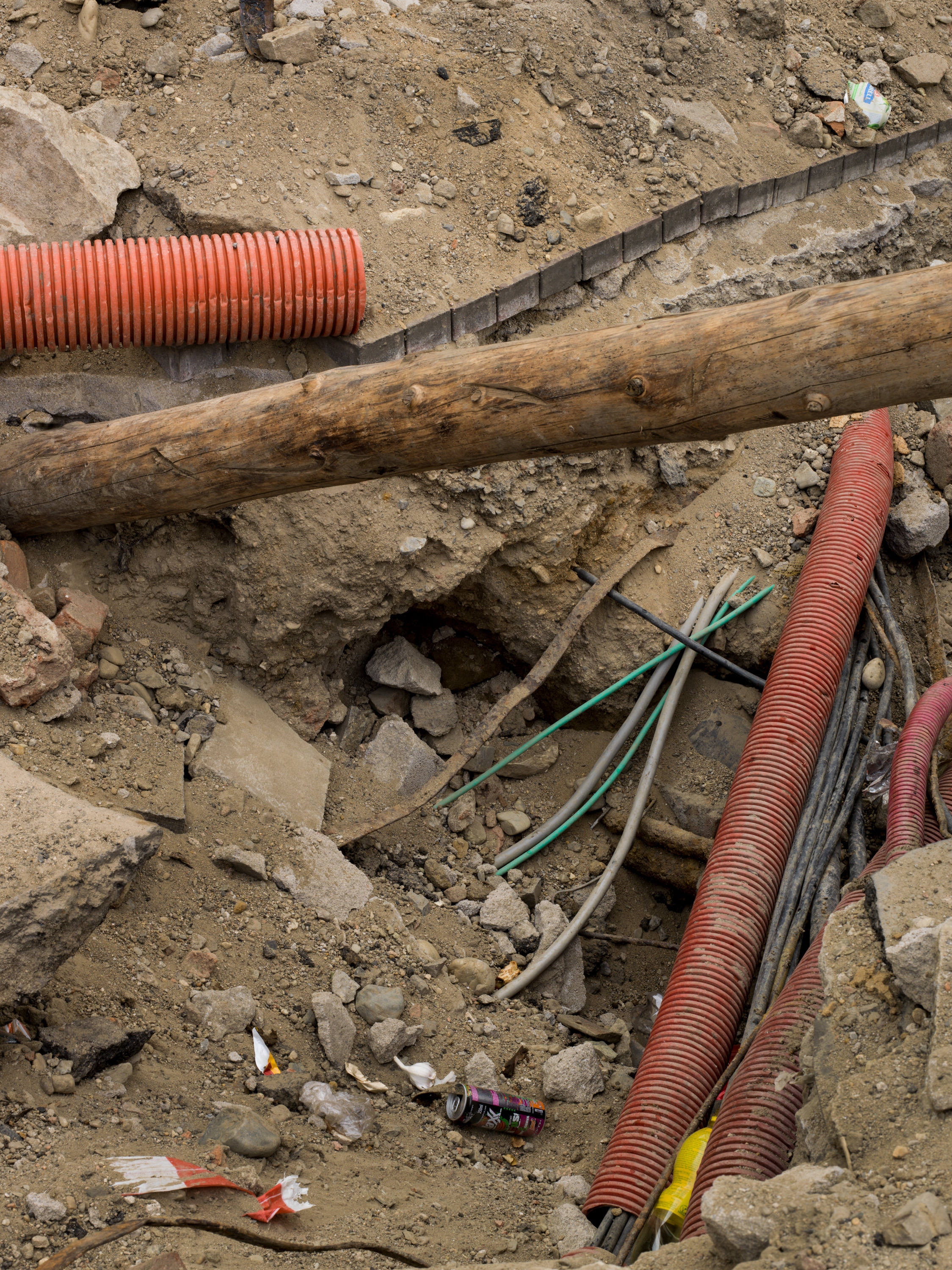
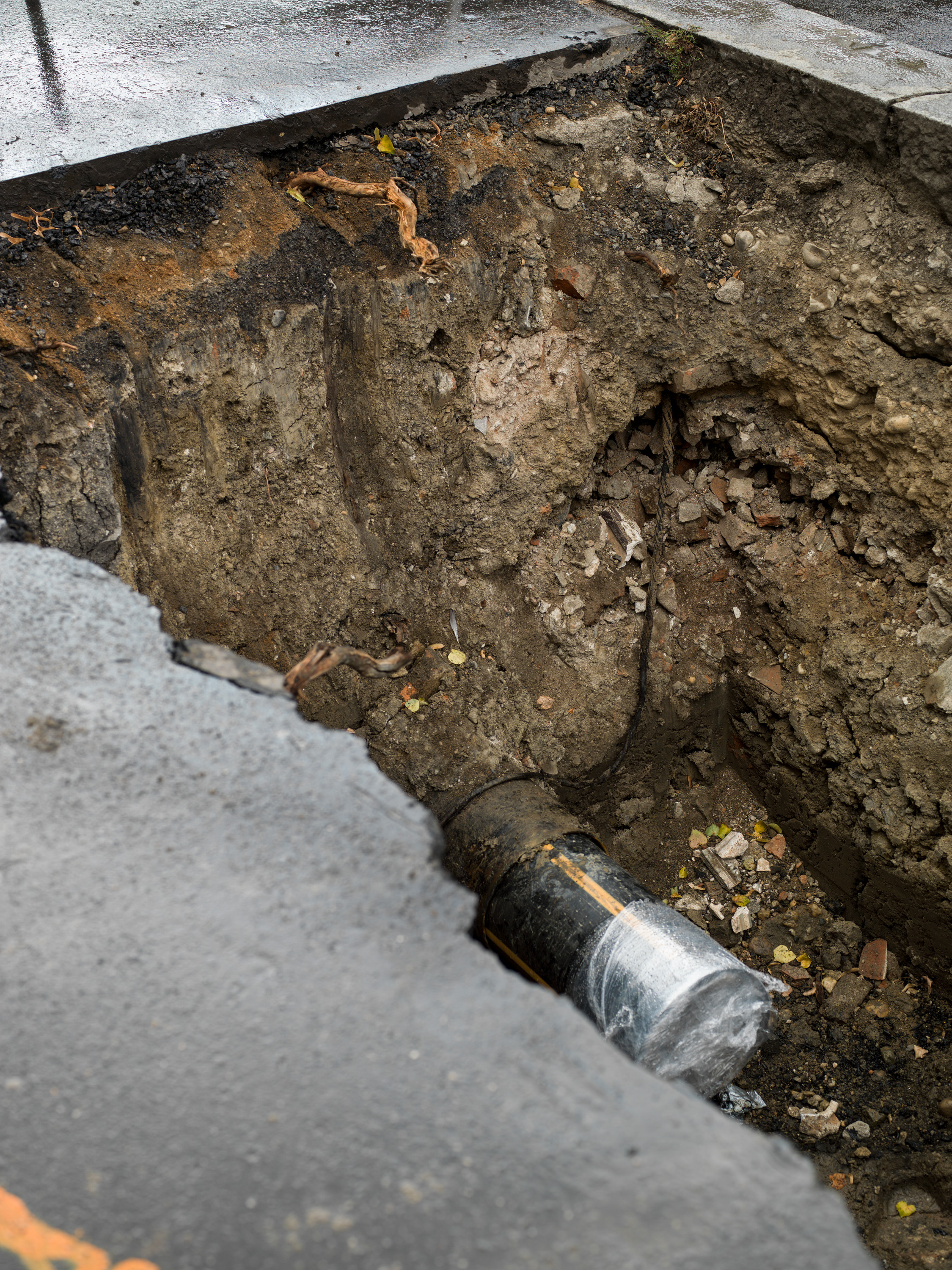
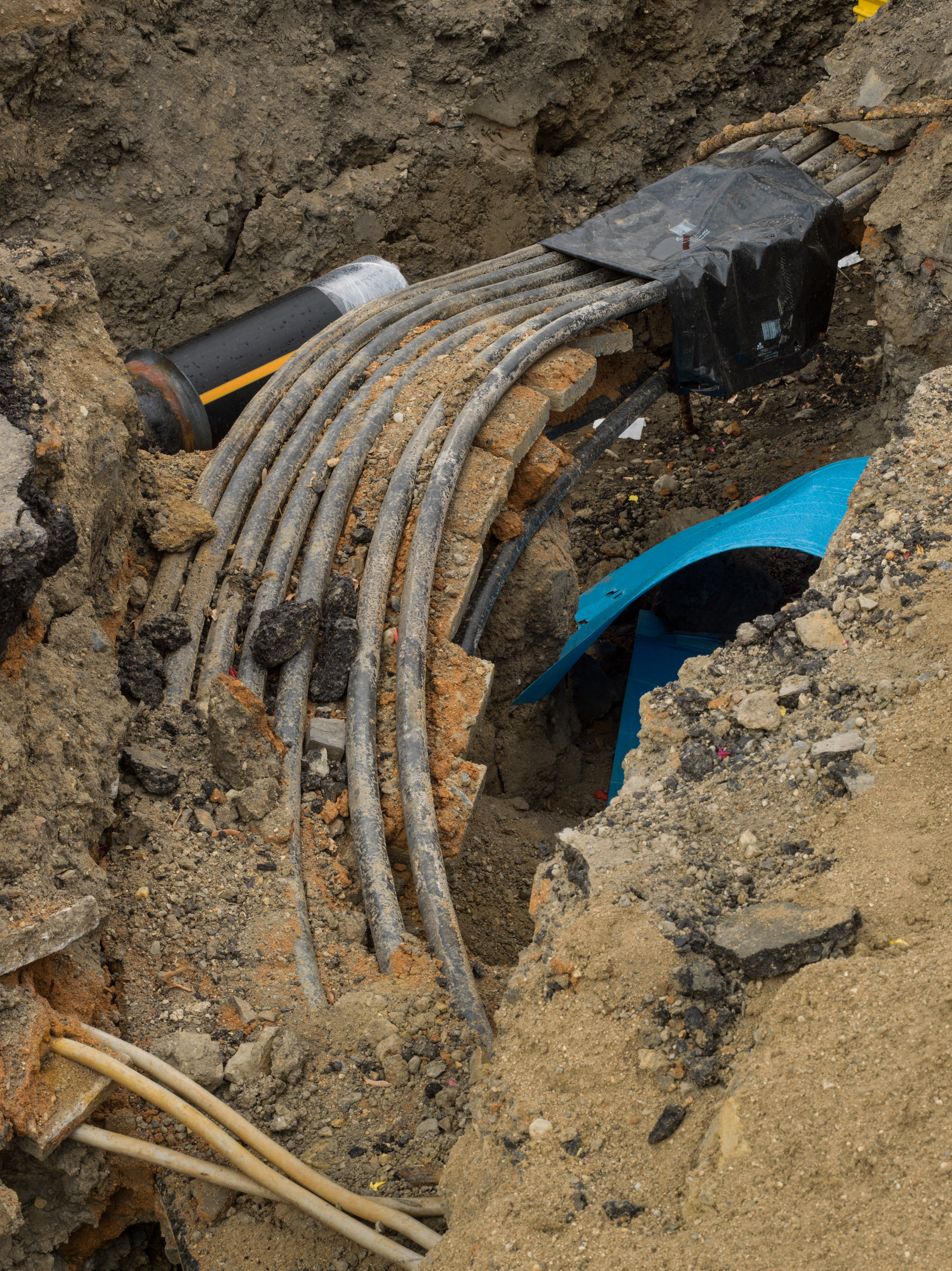
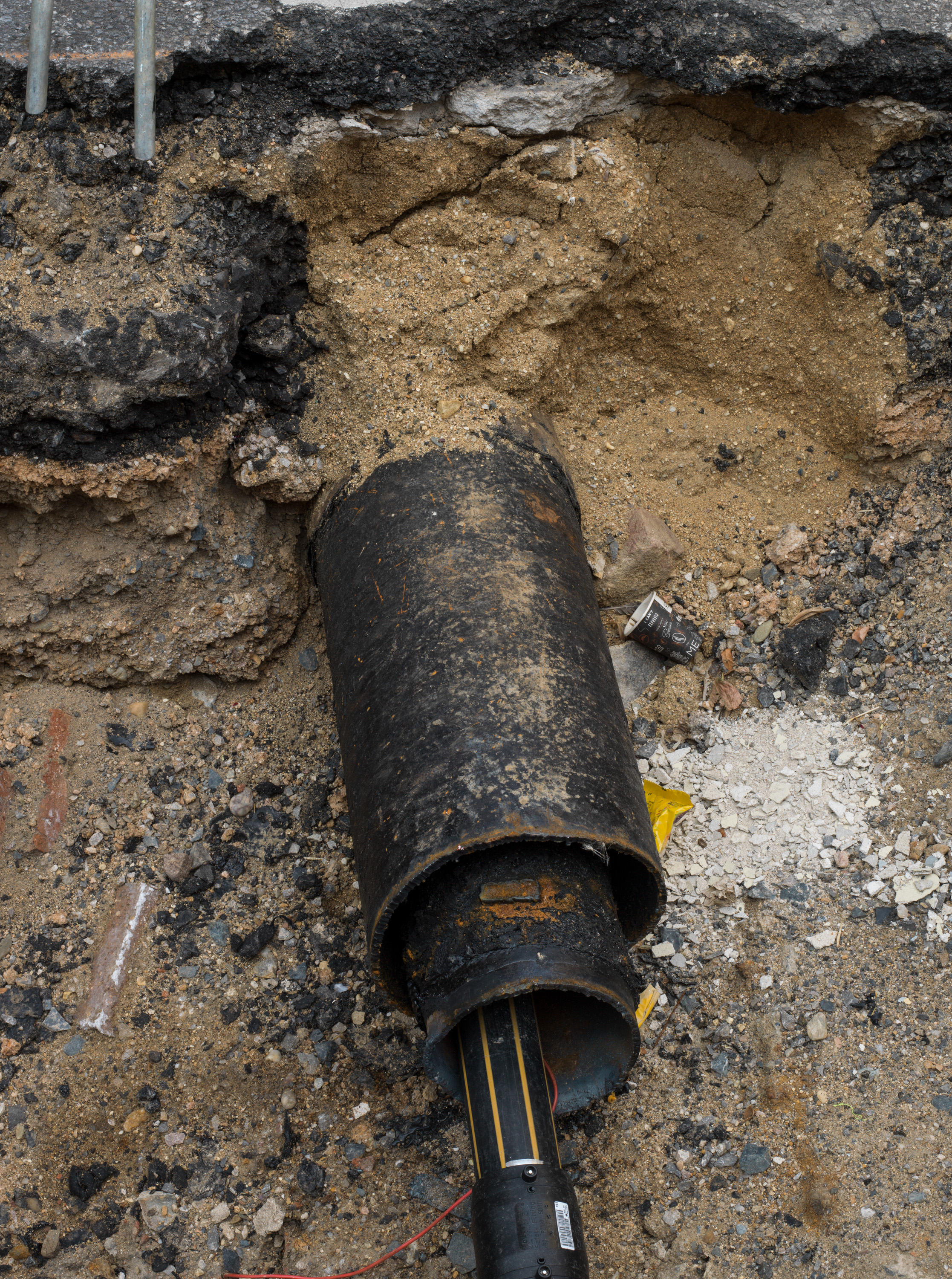
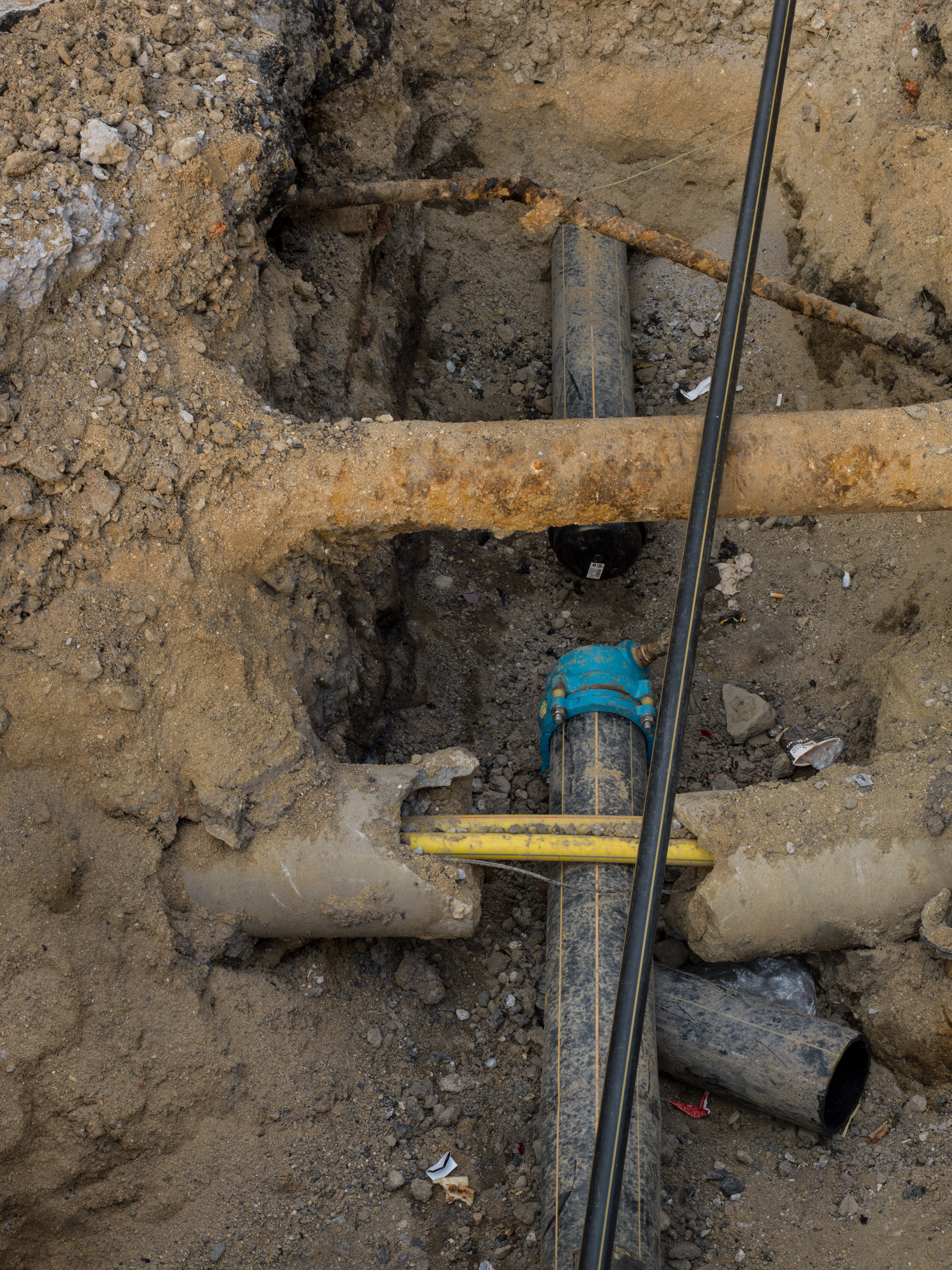
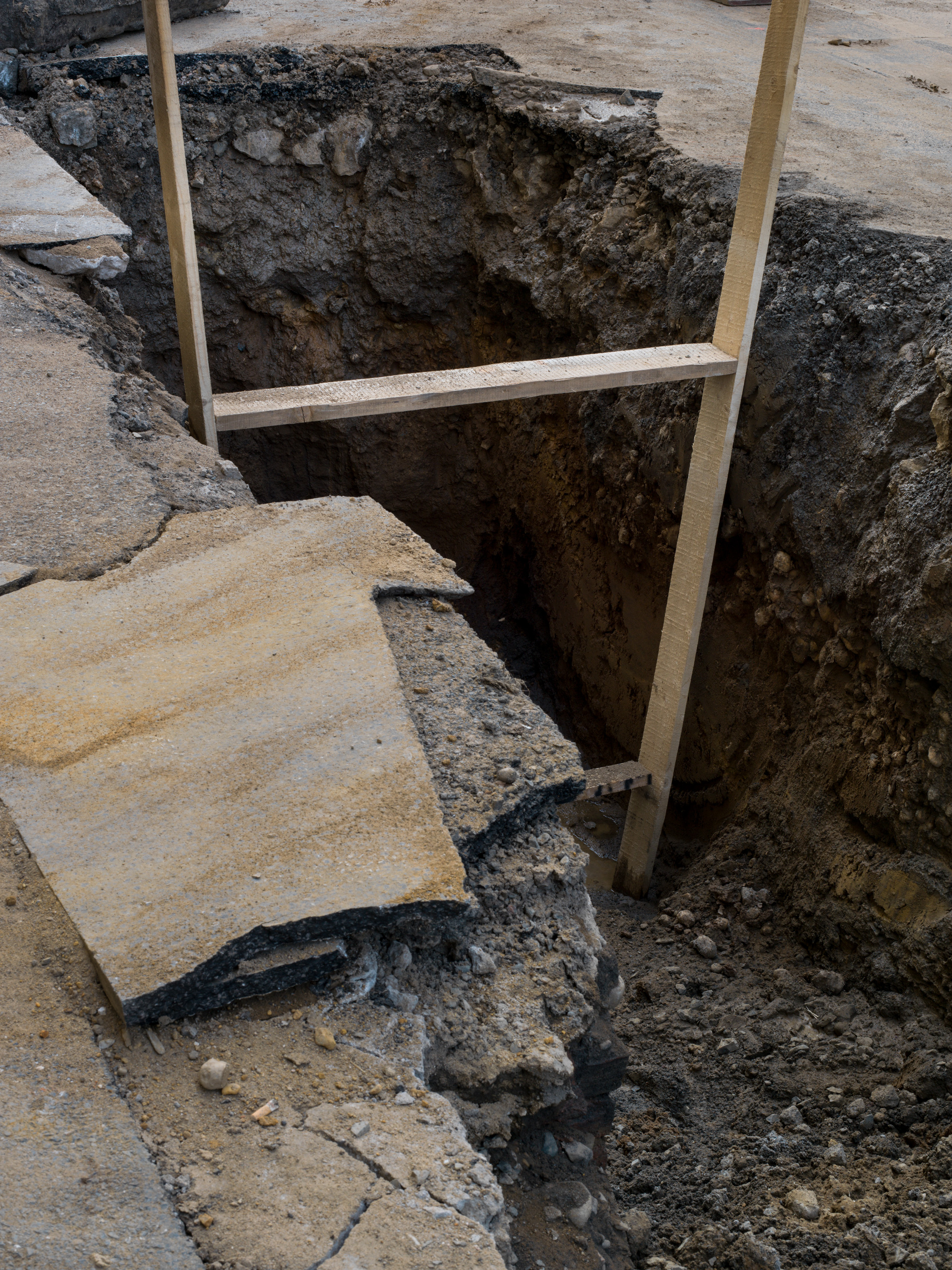
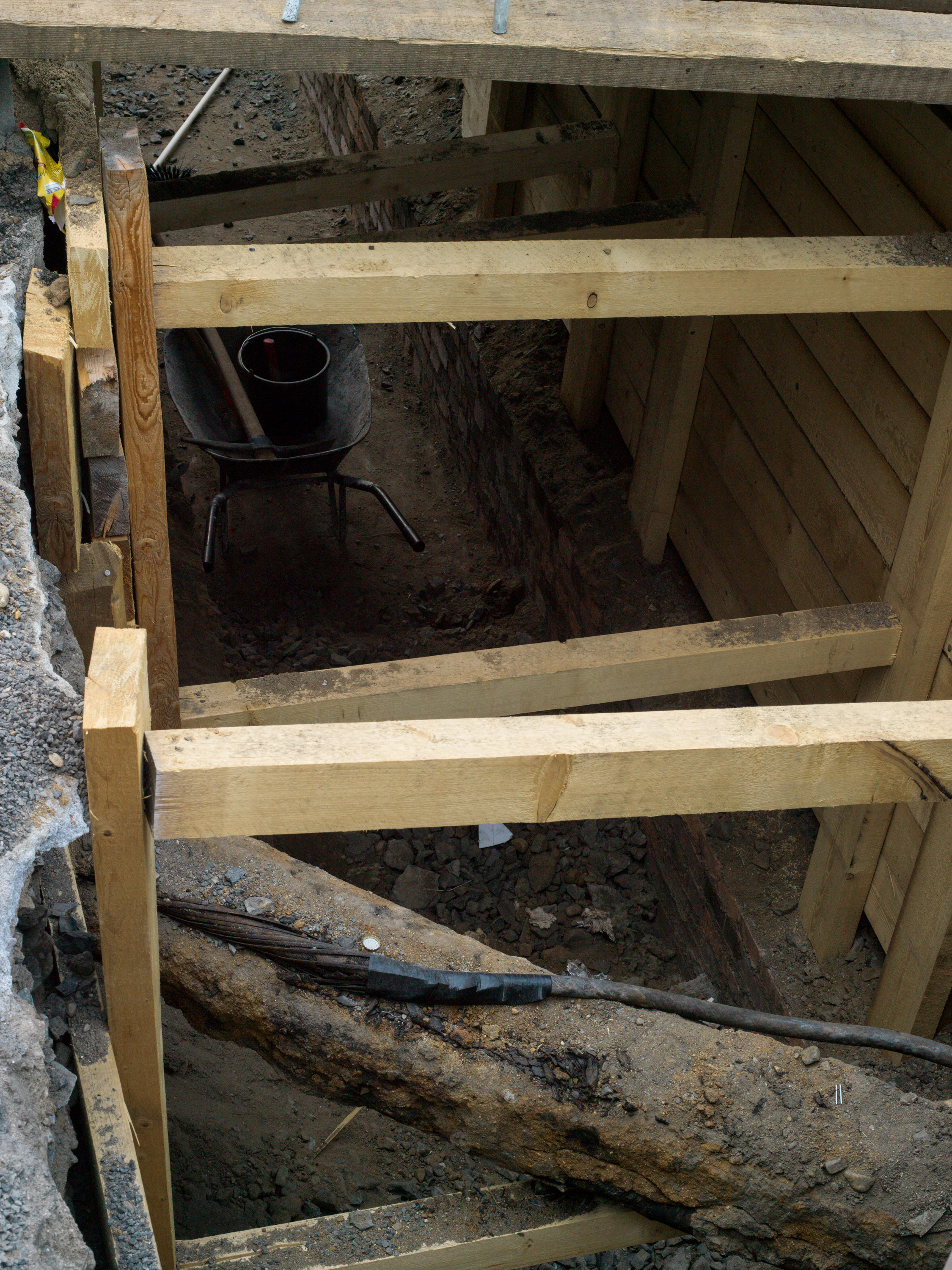
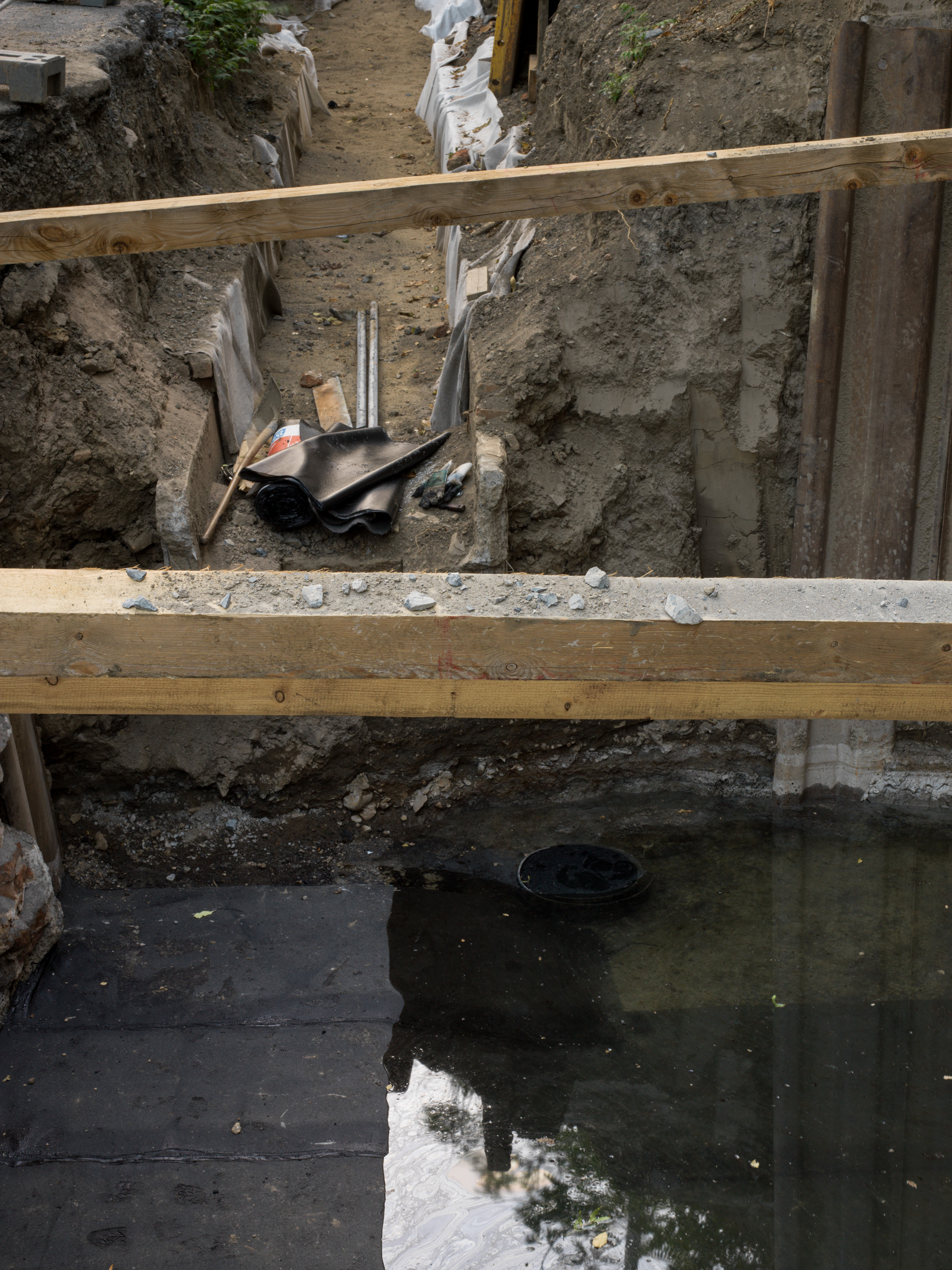
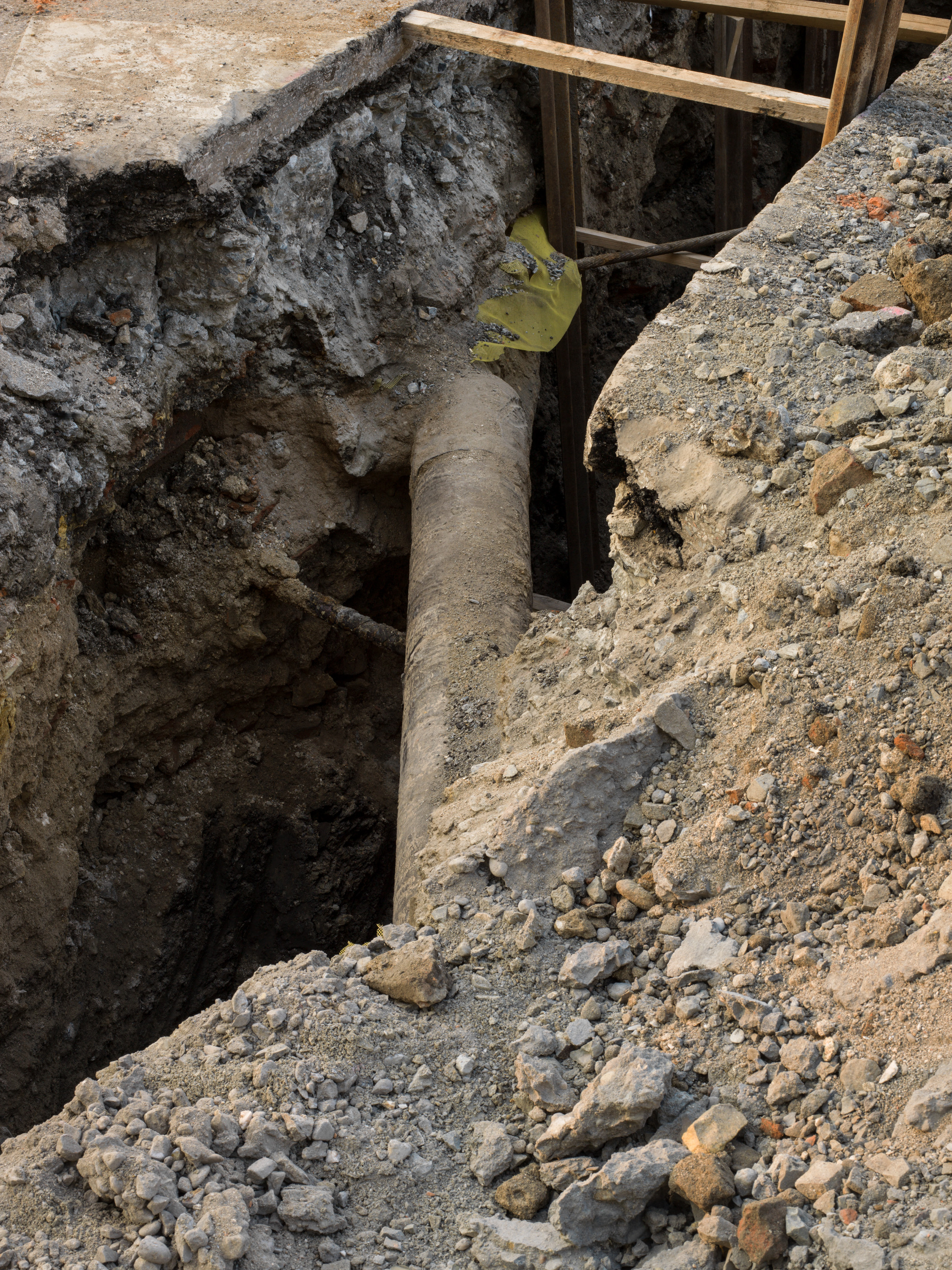
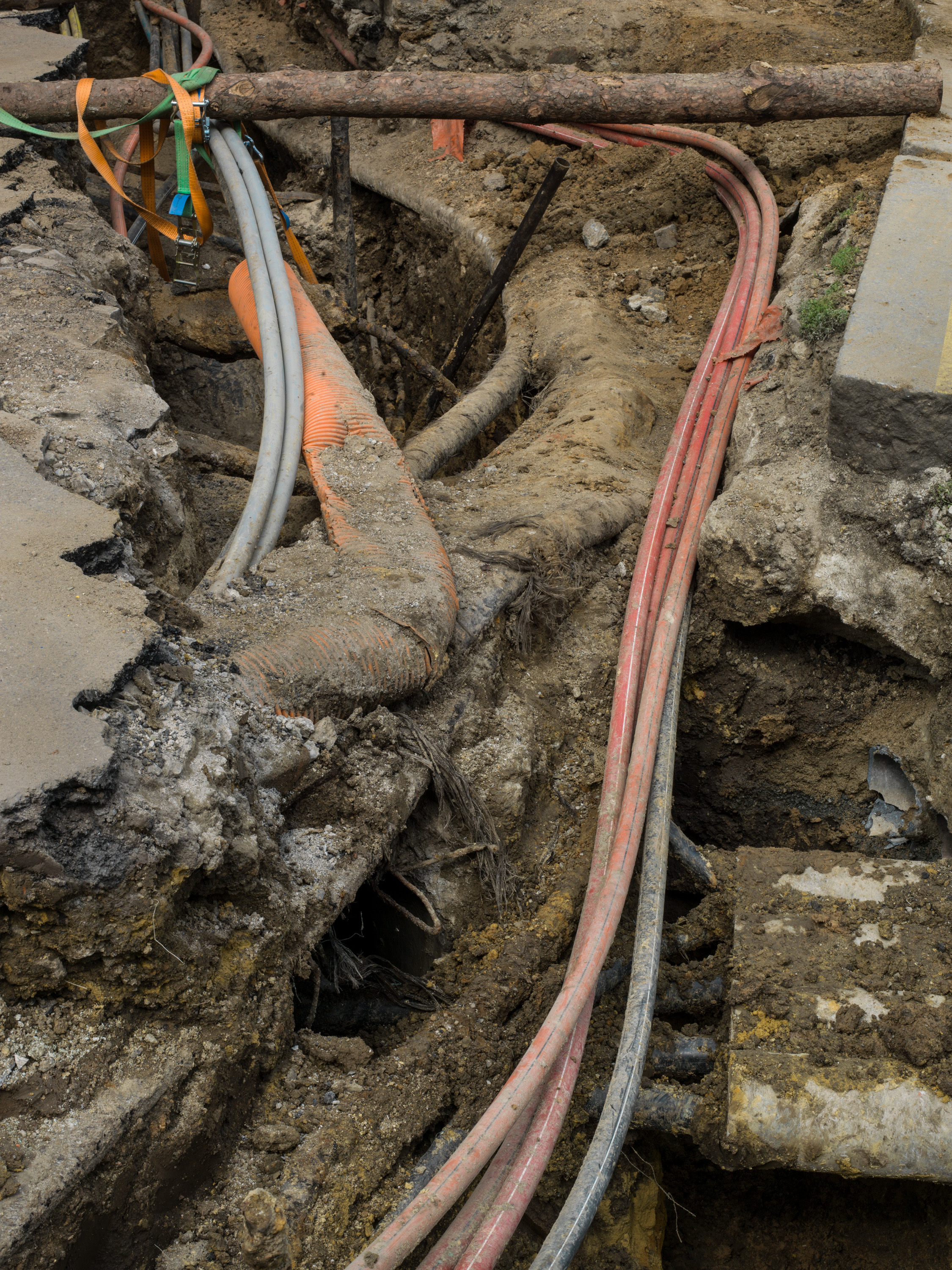
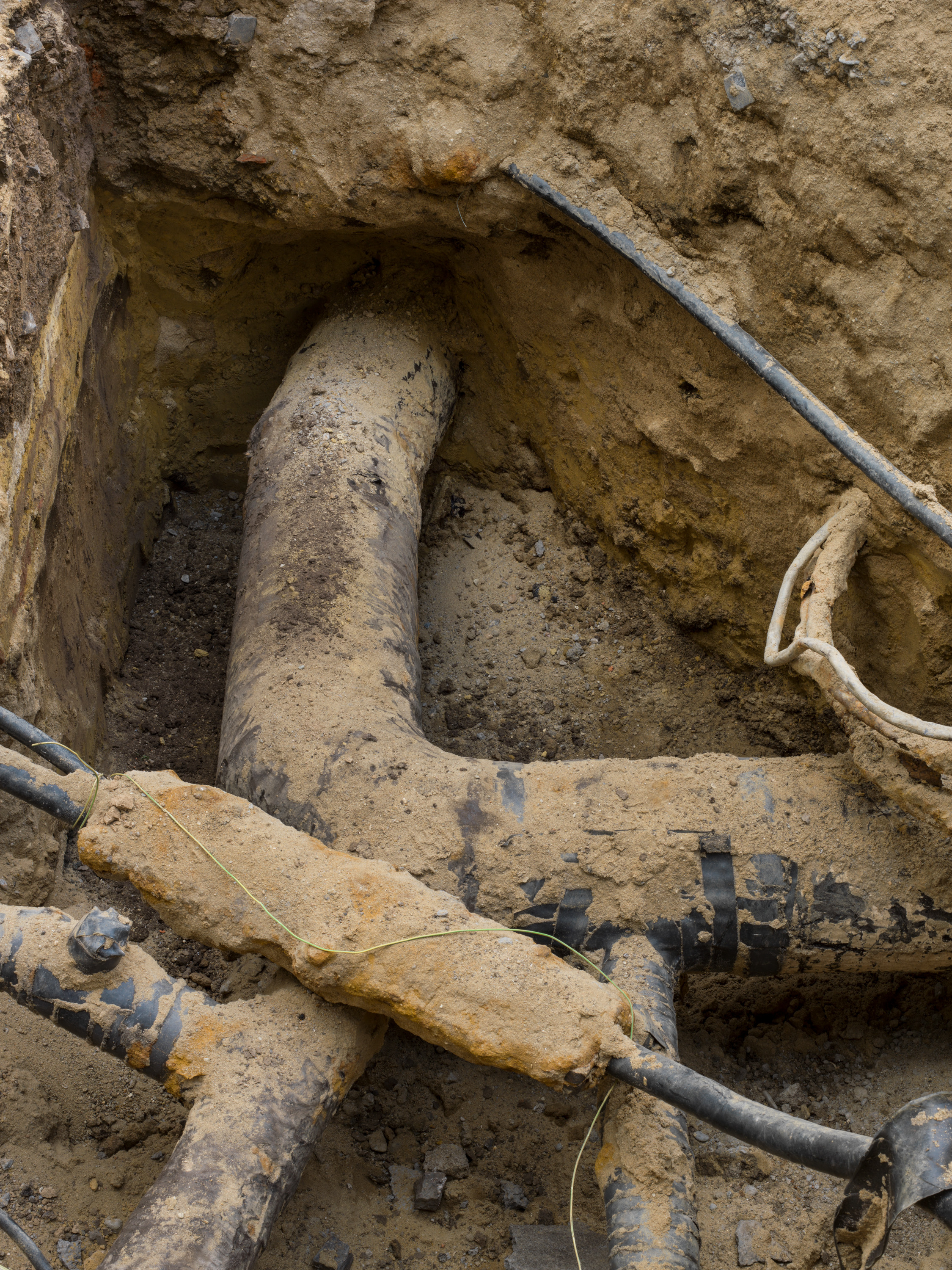
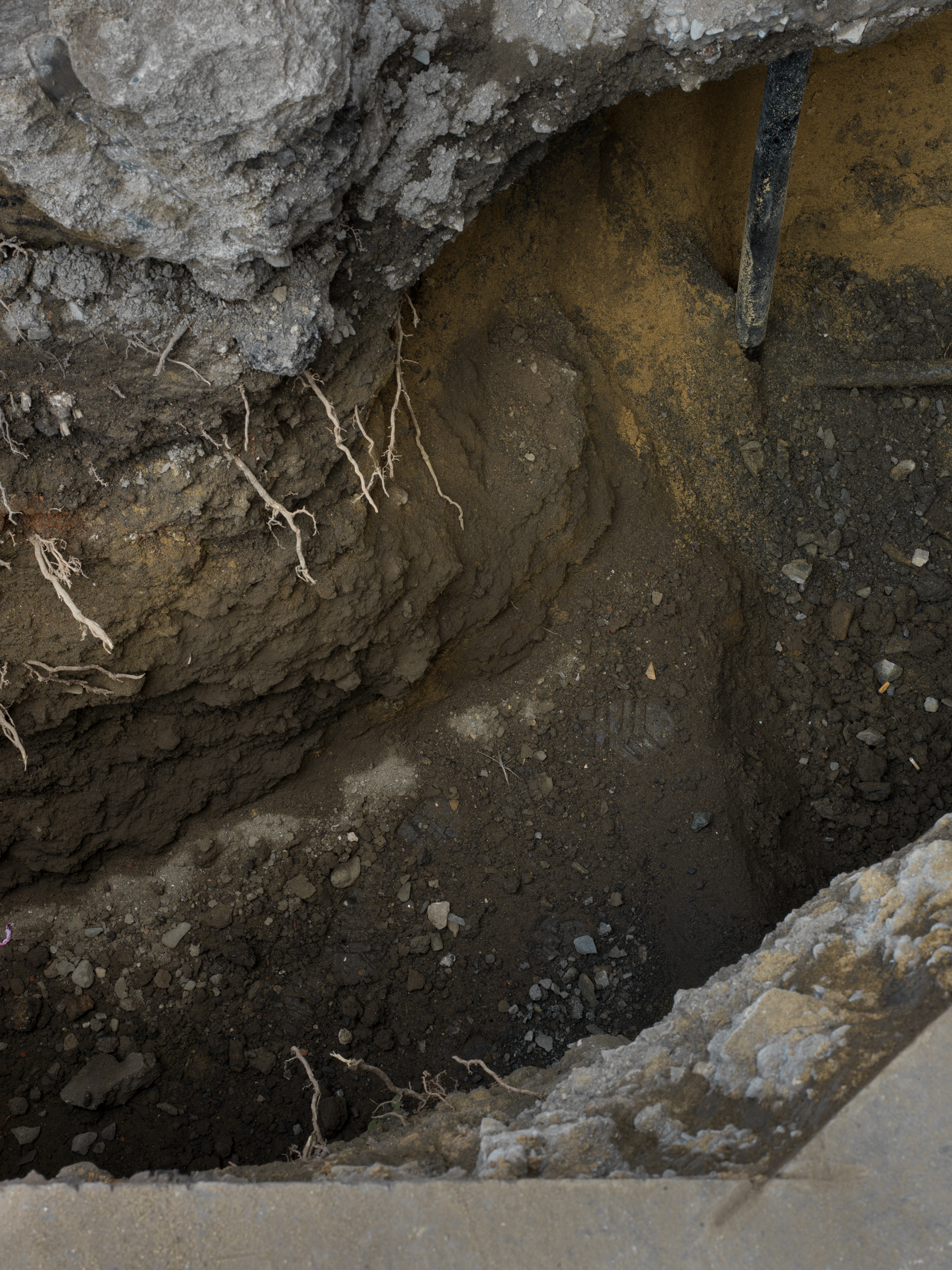
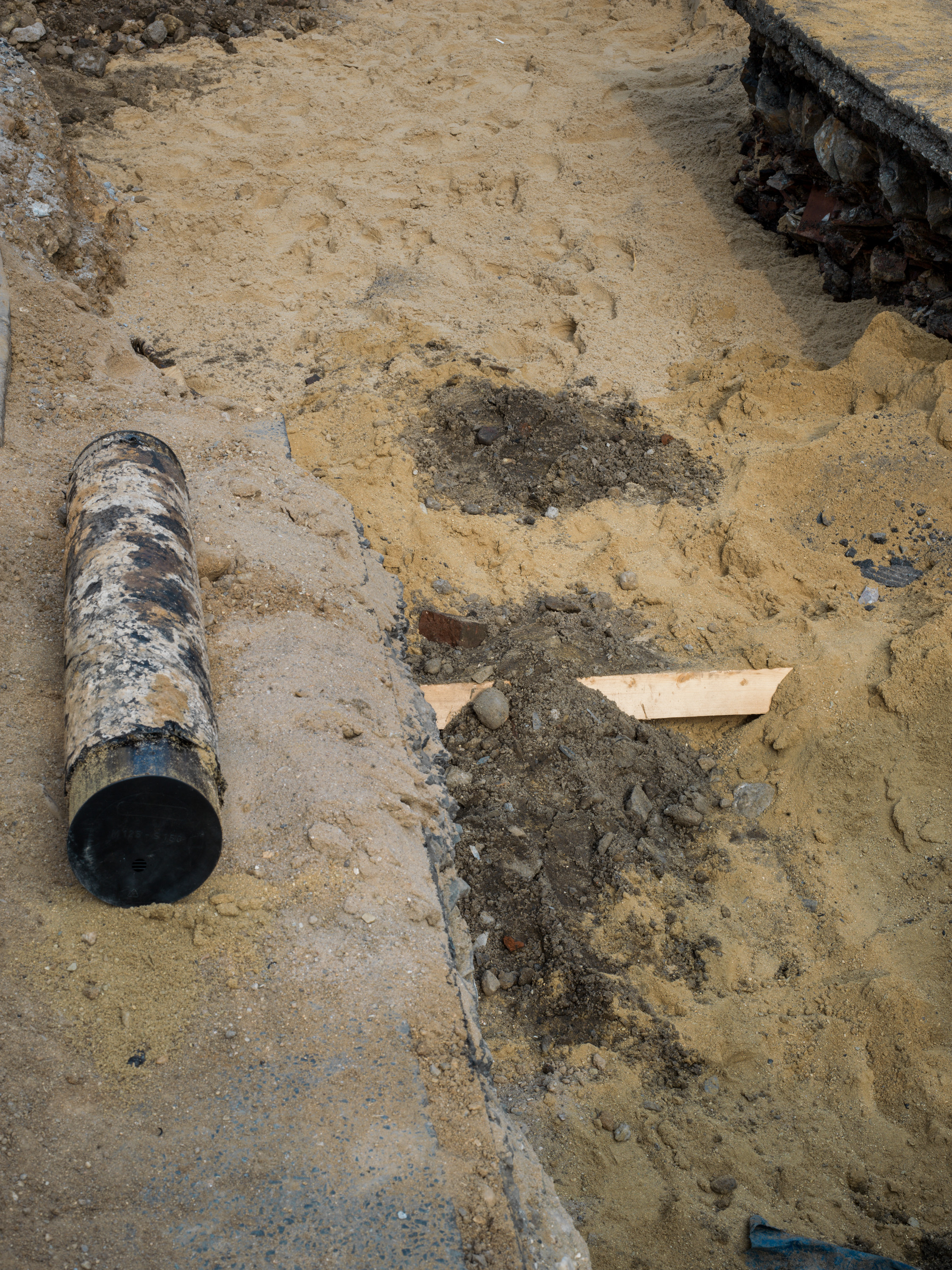
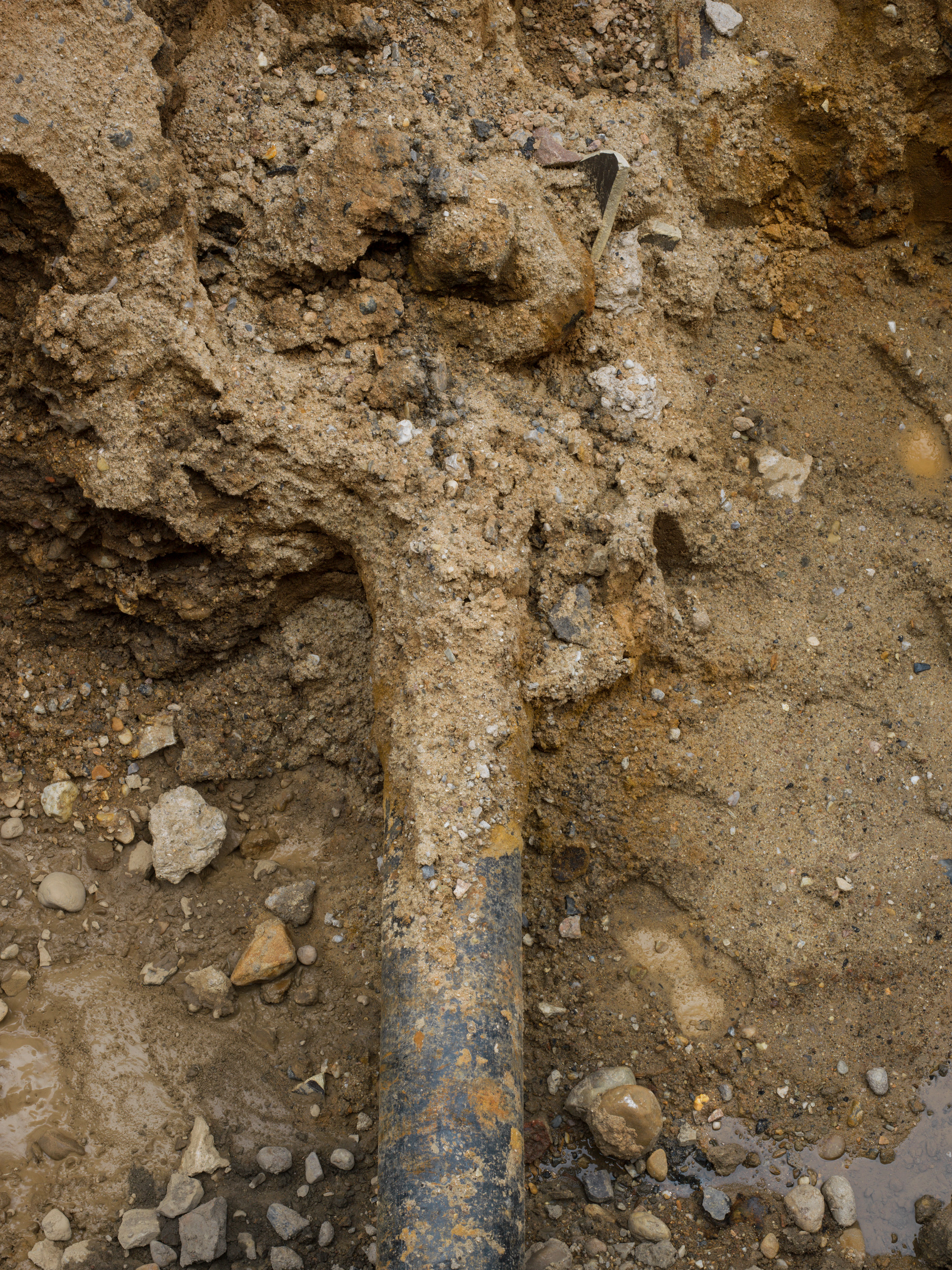
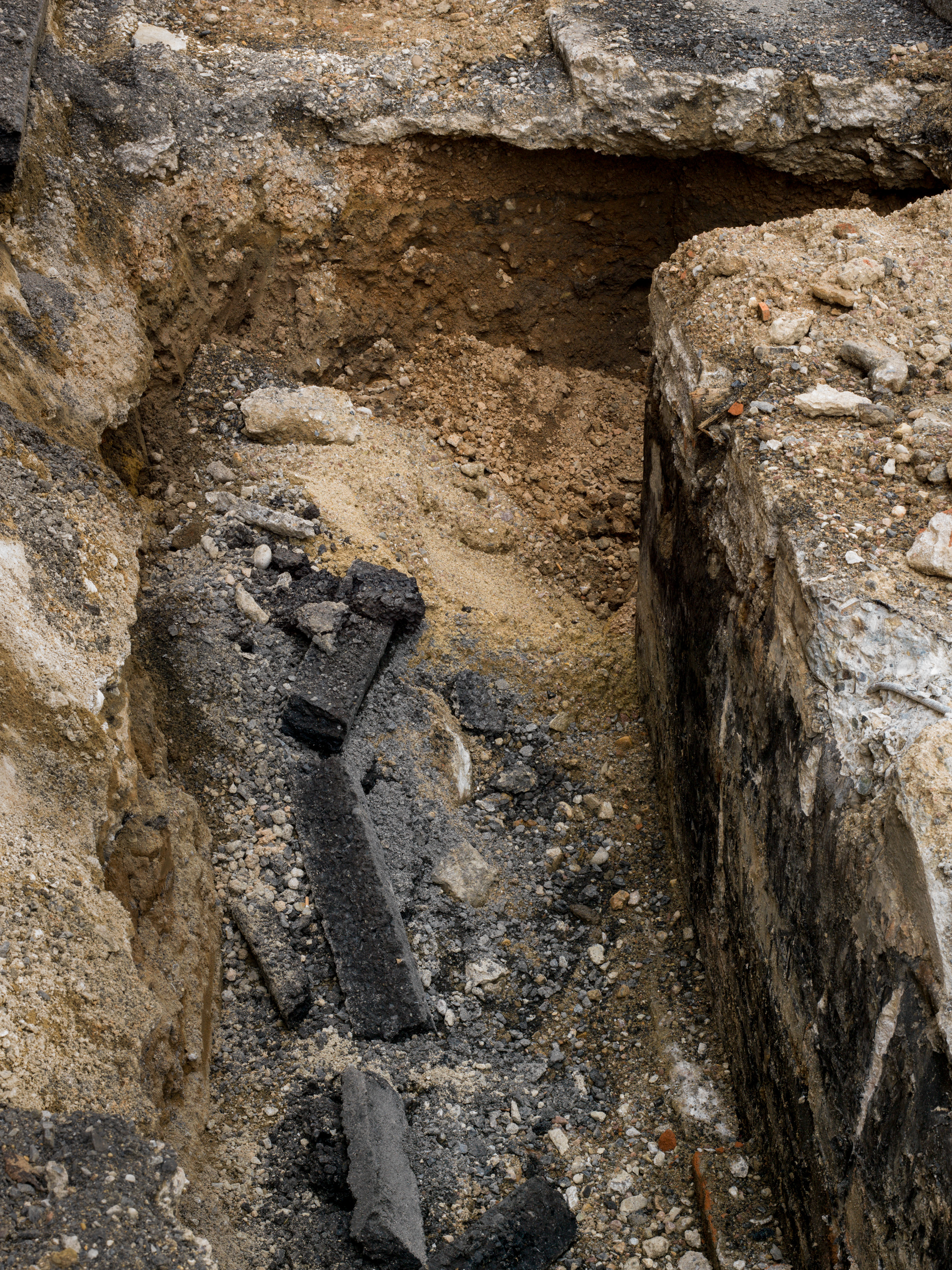
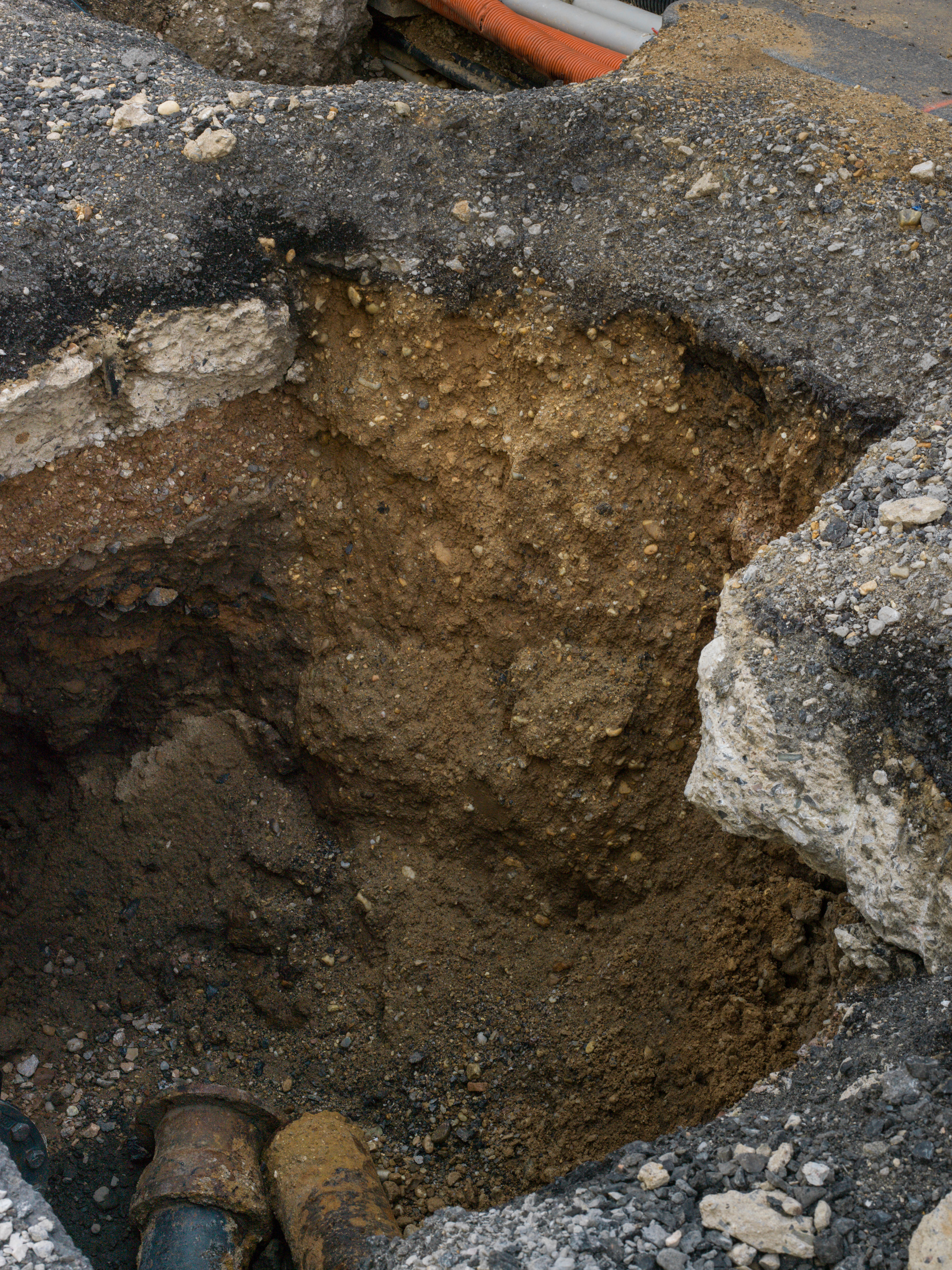
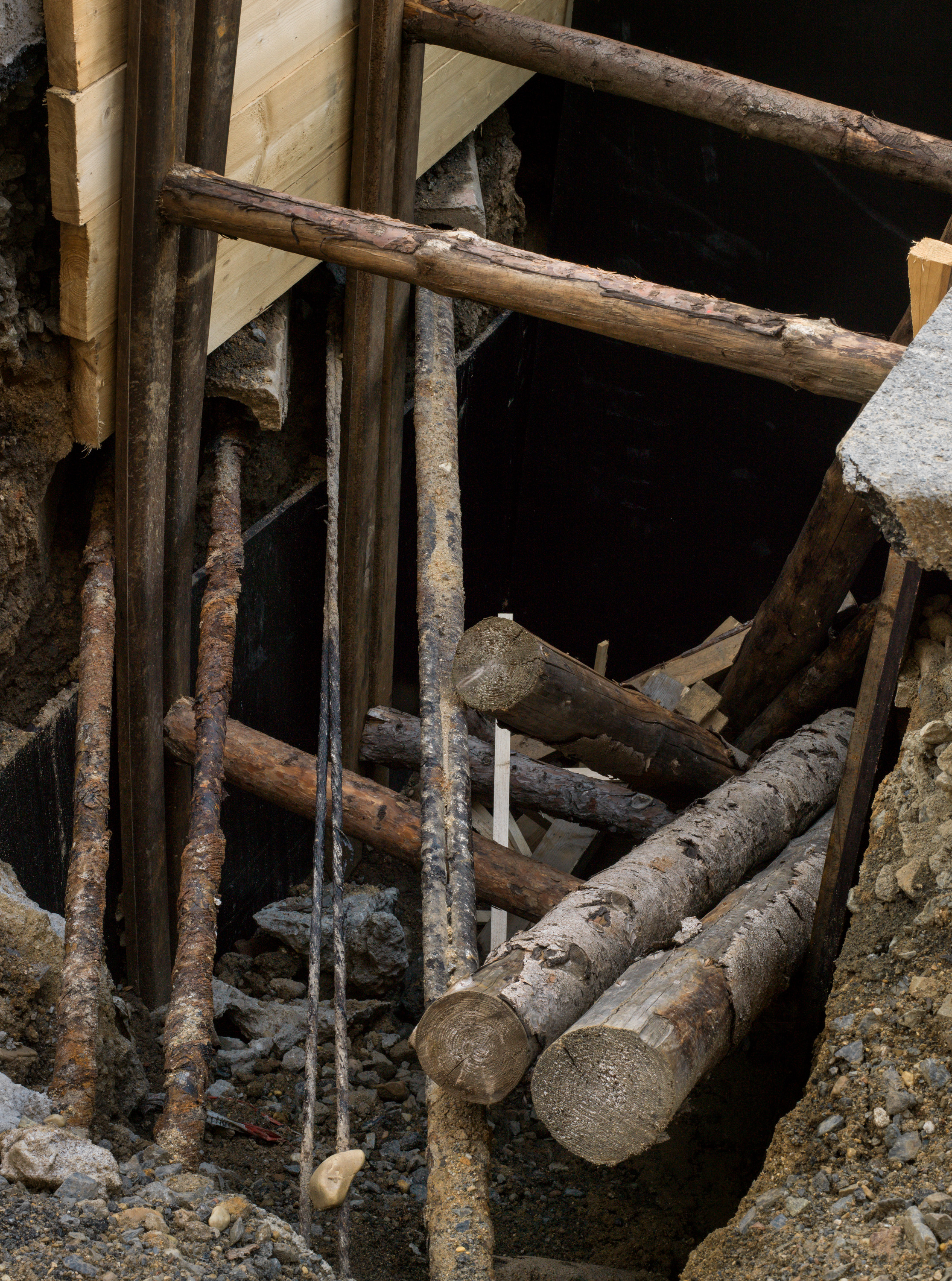
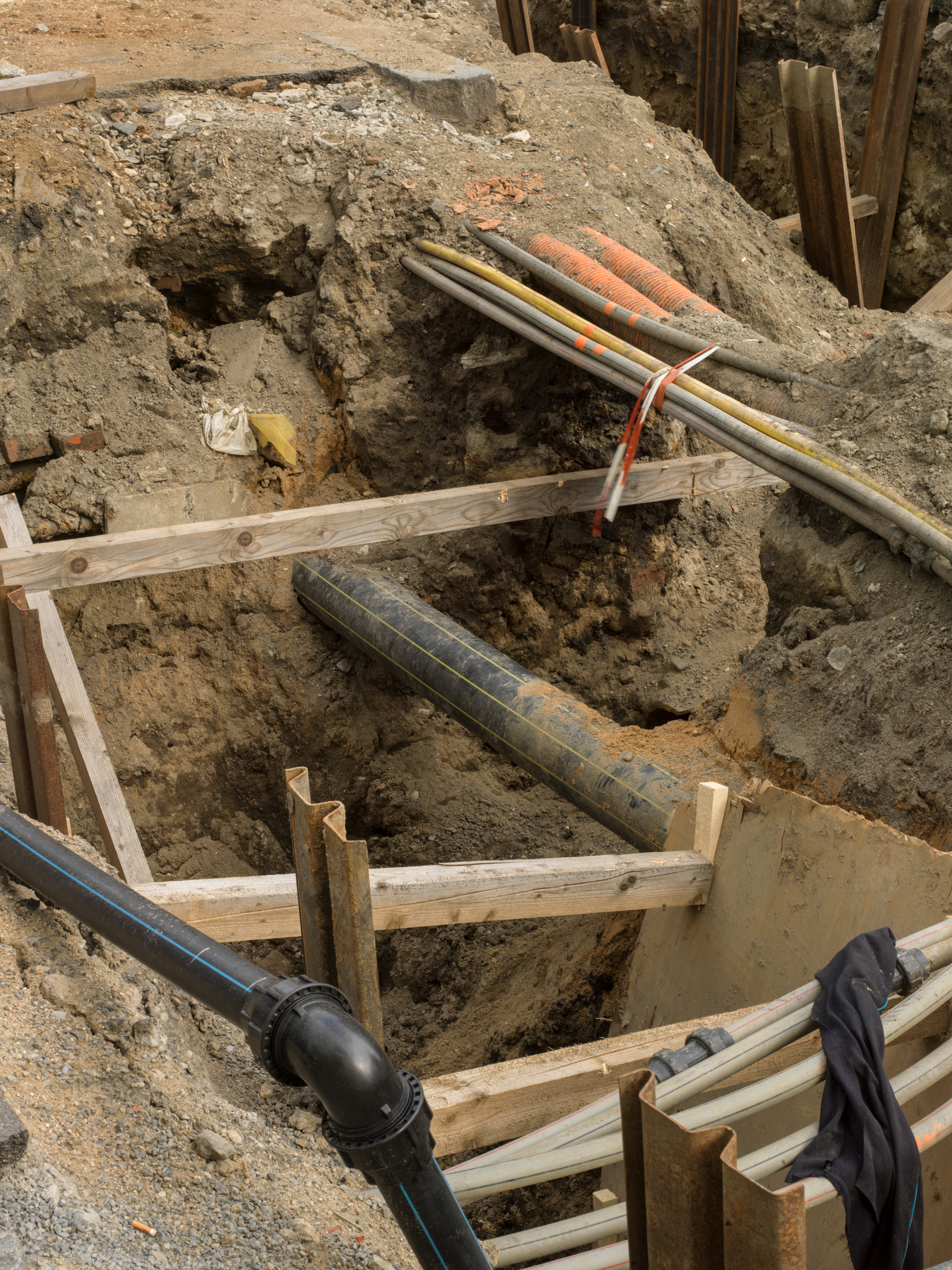
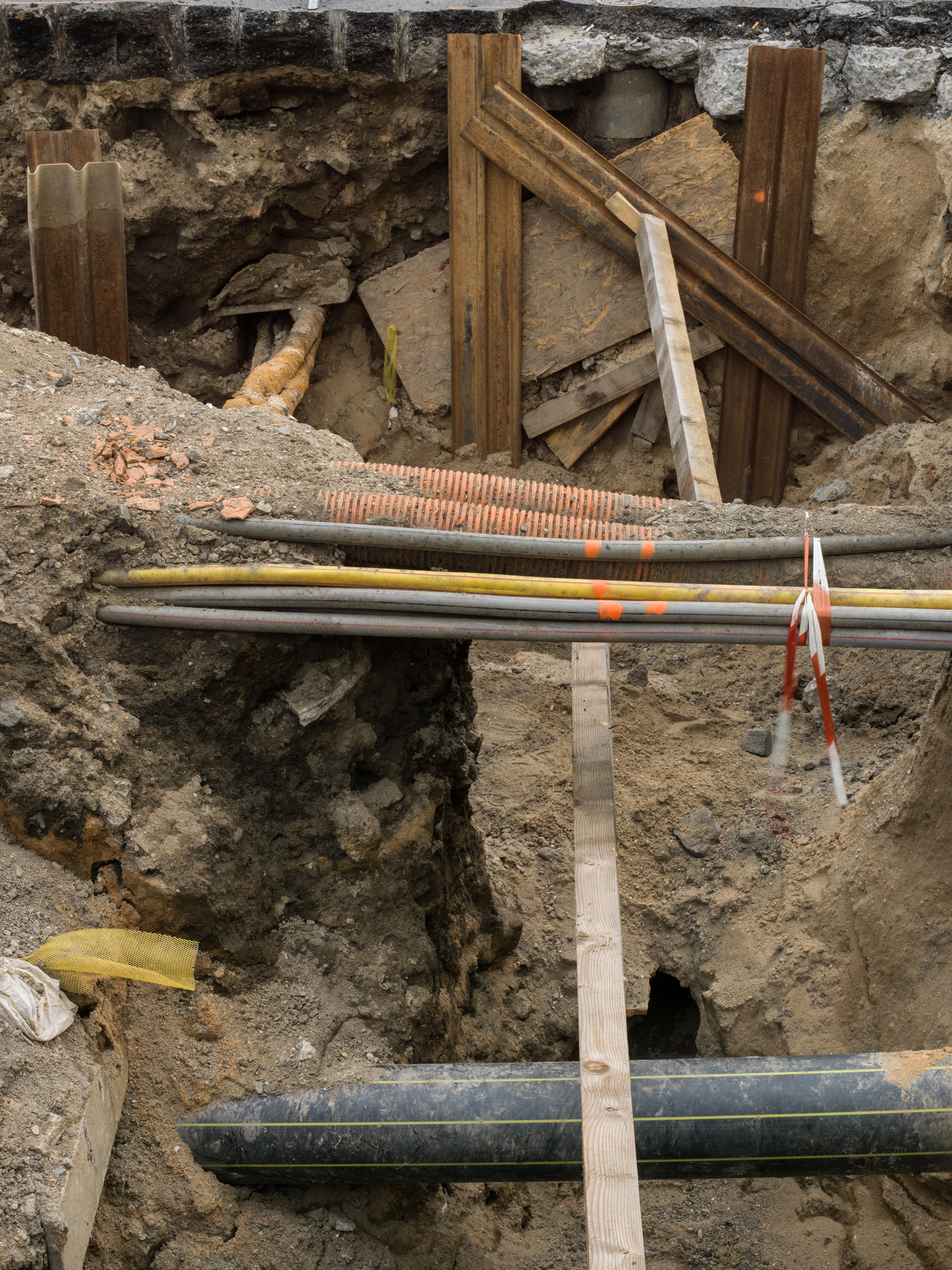
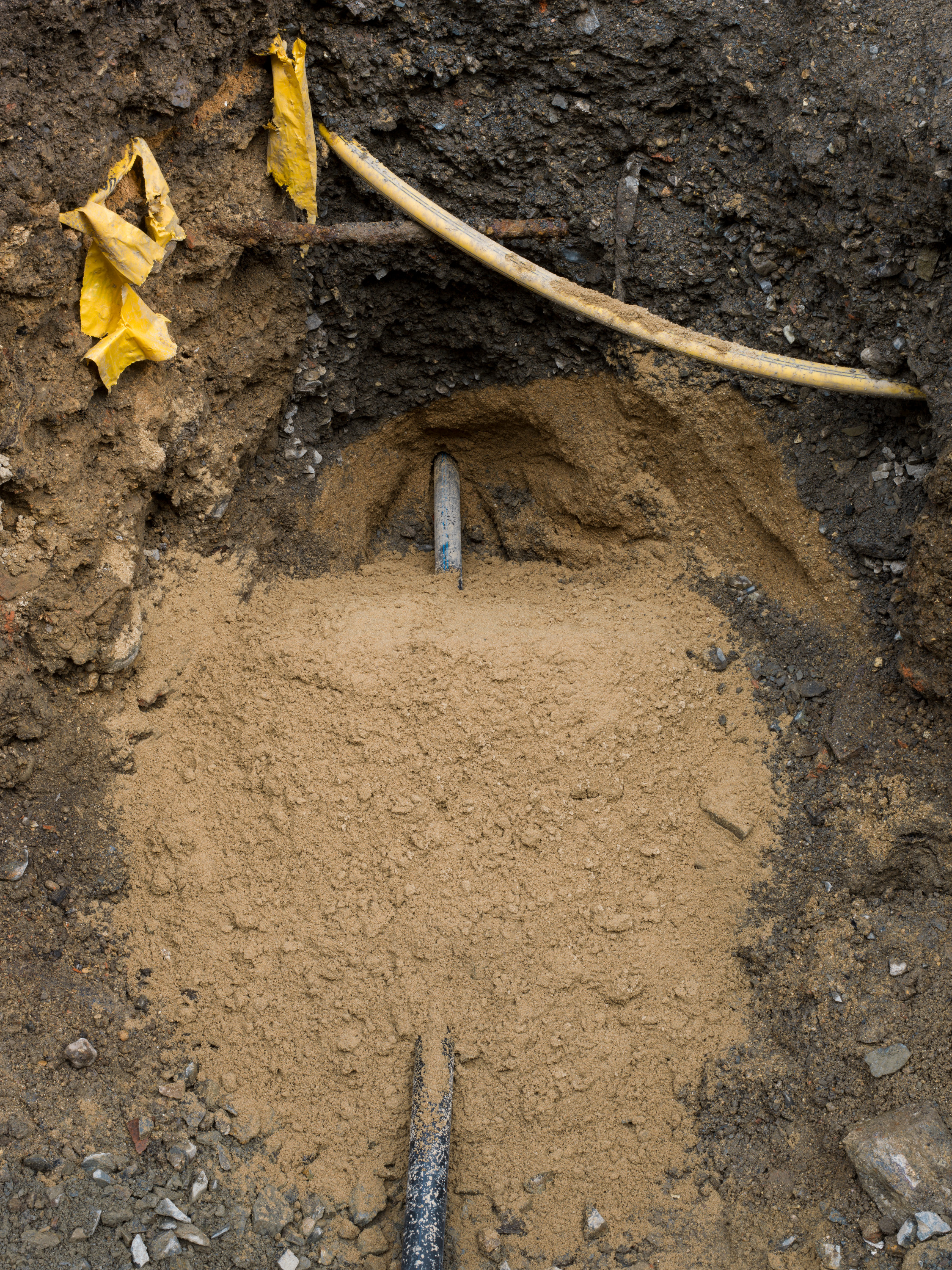
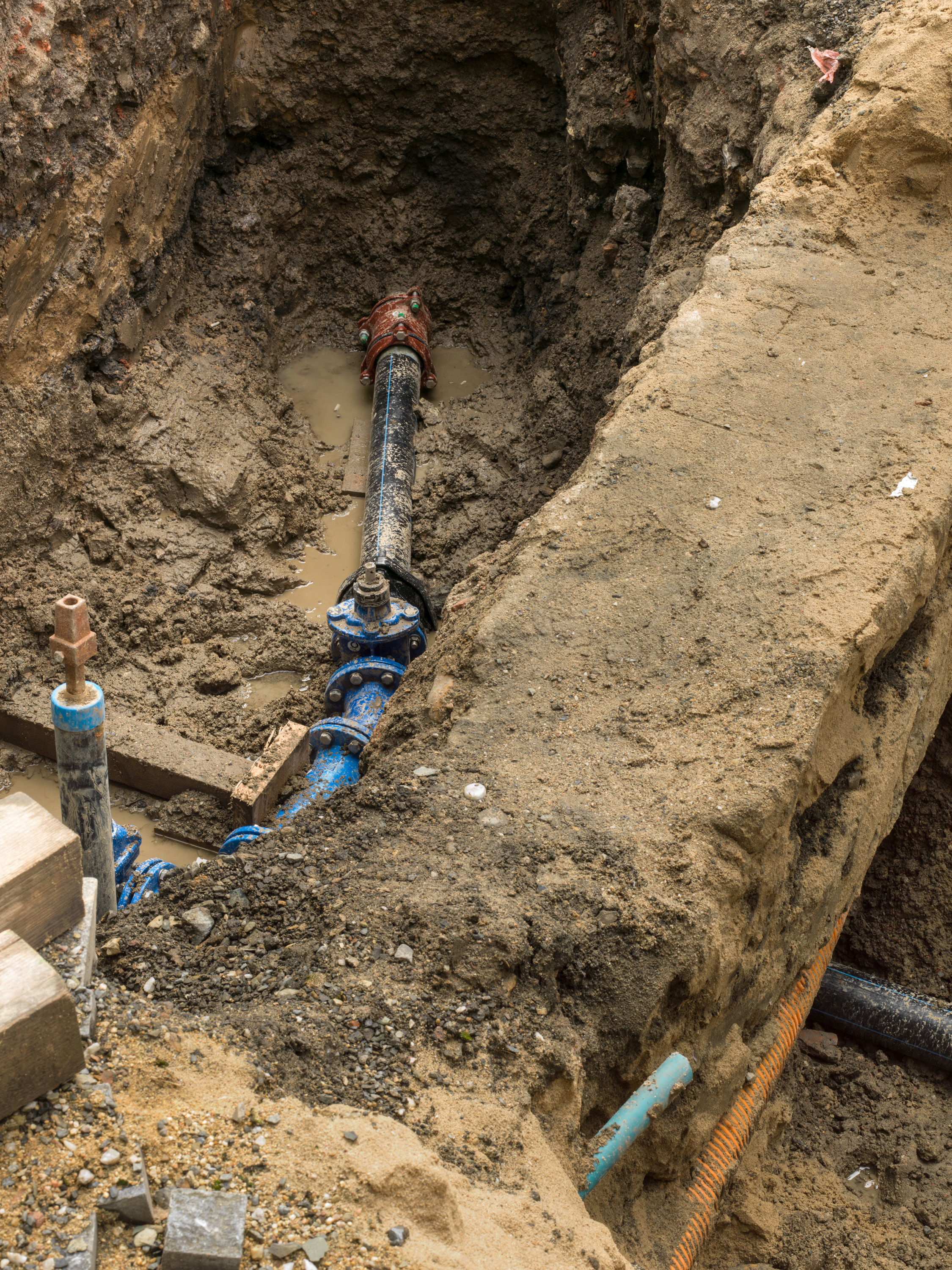
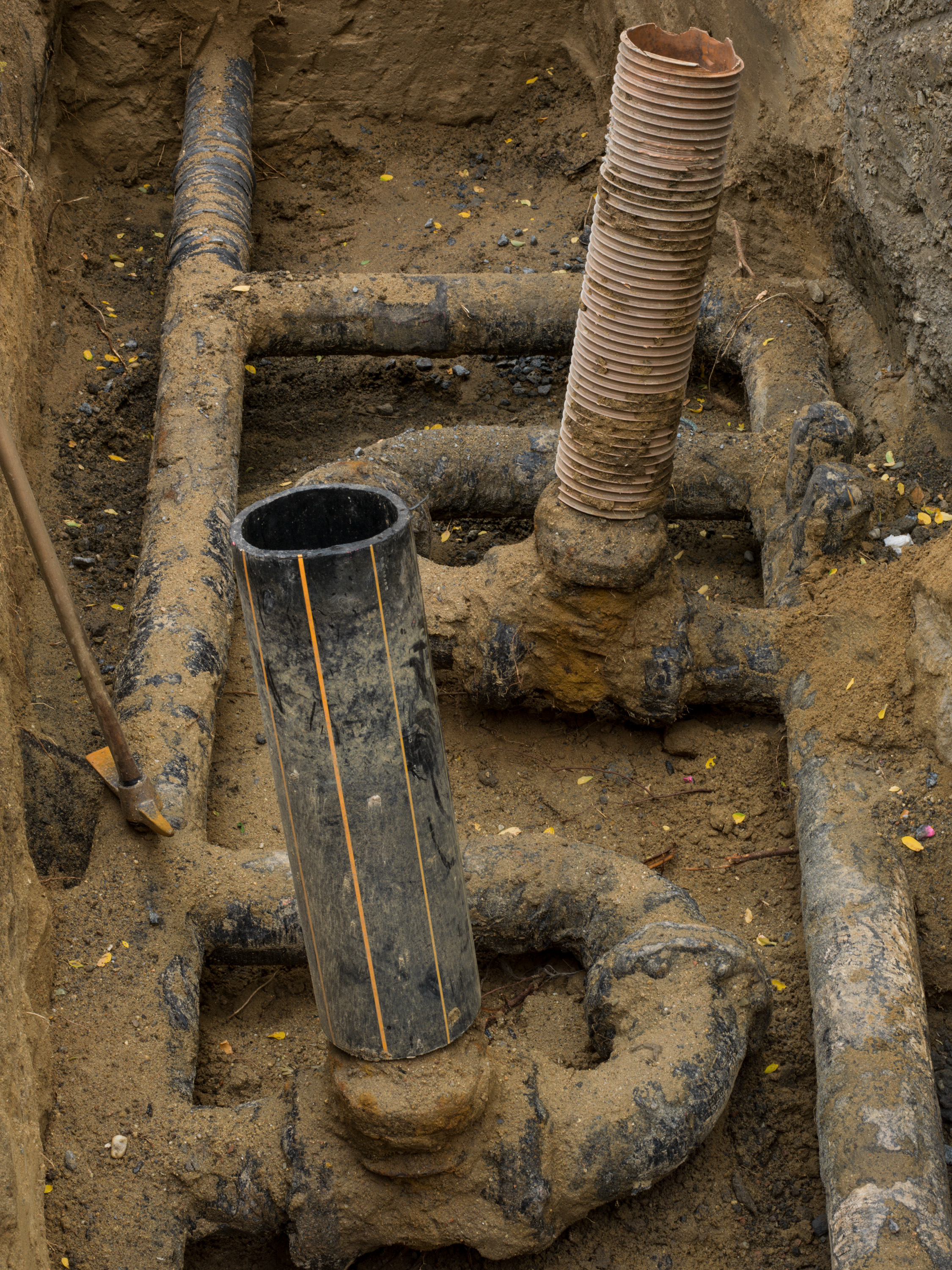
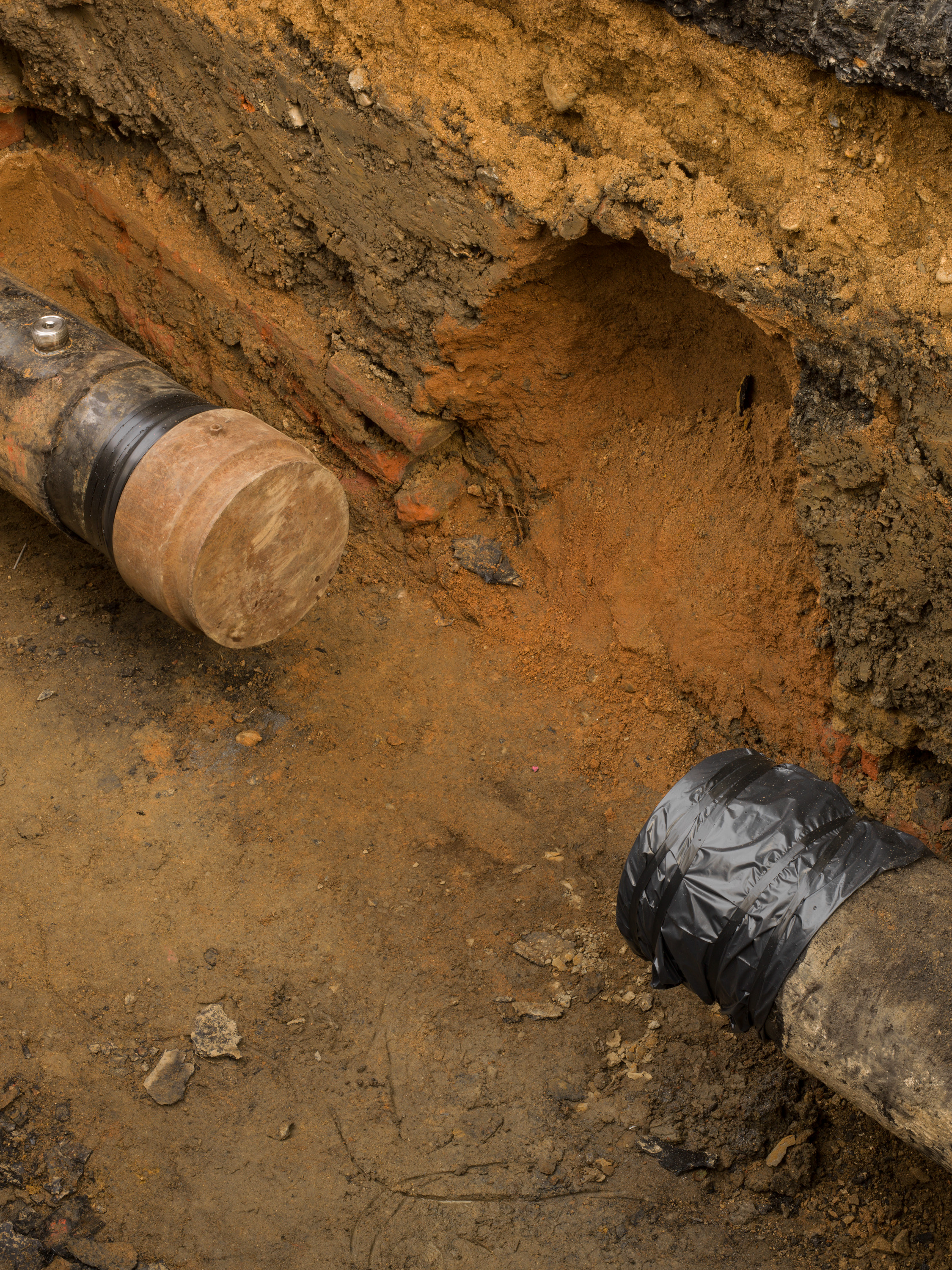
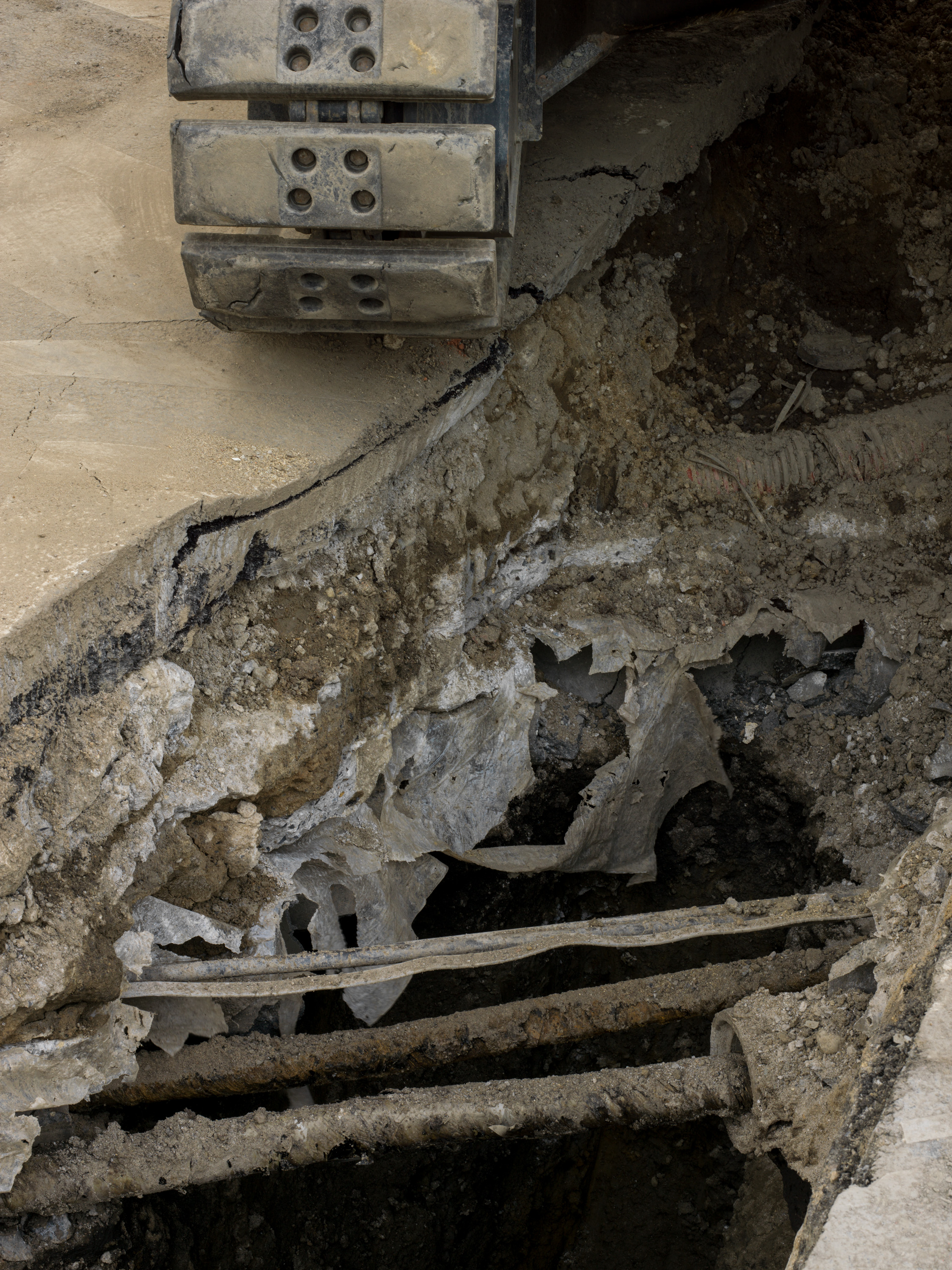
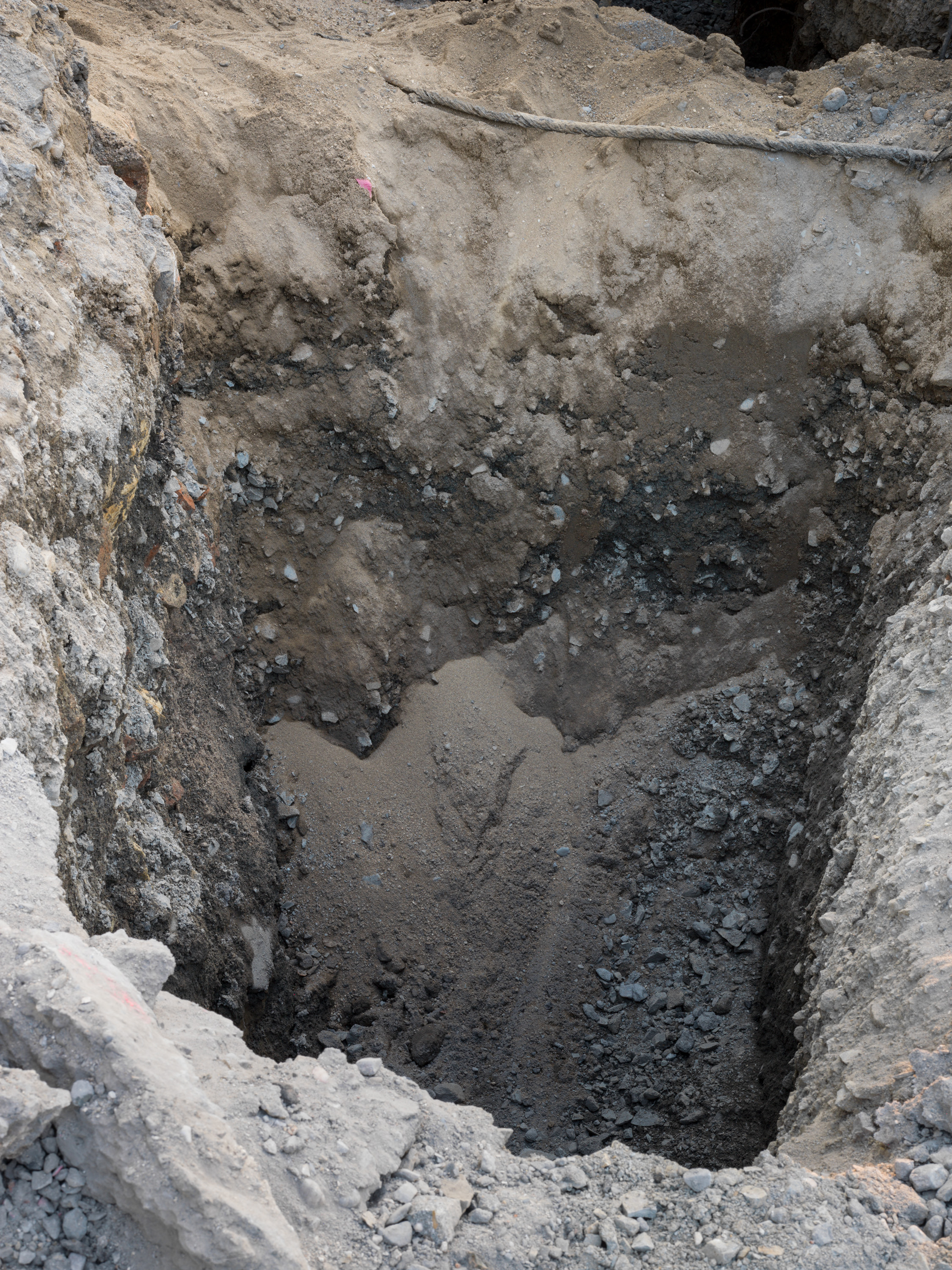
The Untitled (Infrastructures & the Beach) series lacks two essential elements: the human presence and the horizon. Or perhaps it would be better to say that it emphasises the intentional absence of both. It brings together anti-monumentalist tendencies and the loss of visible perspective and orientation, like a walk through an unfamiliar house, only to finally mirror and transform events below the surface onto the ground or walls of the exhibition space. It also represents a potential link between the life function of the human body and the body of the city. A look into the entrails of both is then something mysterious and enticing, a loose reference to Freud’s Das Unheimliche (The Uncanny, 1919) or Mark Fisher’s critique of Freud in The Weird and the Eerie (2016).
We can thus consider excavations as temporarily open wounds in the body of the city. Just as when a surgeon operates on a patient, excavations do not aim to create something new, only to sustain the old. A fascination with the ongoing incisions into the entrails of the city provokes an urge to look down with the full effect of the vertigo of Hitchcock’s eponymous film, temporarily losing one’s sense of normal horizontal orientation. The charm of surprise dissipates quickly and the quotidian nature of the scene, as if using a spirit level – no, rather a gyroscope – forces us to look straight ahead. We can find a similar psychological principle (an attraction to the unknown or the horrifying) in people’s attraction to horror films, adrenaline sports, and conspiracy theories, or in their tendency to interpret reality through the lens of radical right-wing media.
* * *
The parched surface veins of the urban city offer up the abstract potential of future streams of liquid while the subterranean streams flow on undisturbed. The plastic and metal of these infinite pipes are resistant to viruses, at most serving as untouchable carriers of waste, possible infection, or the residue of last night’s cocaine in today’s urine. The underground remains safely untouchable.
Etymologically, the term “infrastructure” comes from infra (under, below, the bottom side) and structure. Its natural counterpart is superstructure, wherein “super” signifies things raised vertically upwards, above the surface, on top. Marxist theory uses these terms to categorise social hierarchies, but we find ourselves, once again, closer to Christian eschatology and the idea of a layered heaven and hell in Dante’s Divine Comedy. The untouchability of both is analogous to the technical structures below the surface and high above us in the atmosphere. Things found literally “between heaven and earth” have no such protection, as attested to by the current conspiracy furore surrounding 5G, the radically accelerated internet of the future. According to some conspiracy theories, the entire pandemic is only a distraction to hasten the construction of this network, which will then go on to exterminate all of humanity. Others claim that the 5G signal is what set off the current pandemic, which is not in fact a result of the coronavirus respiratory infection but rather of contagion by a new, invisible digital nemesis. And so, while some take to the streets and follow on from de Chirico and Struth in capturing the emptiness of the city, others set fire to newly built 5G towers. Others still, at just the right time and under cover of darkness, leave their homes in order to watch the skies and the radiant construction of a new layer of technological infrastructure (or rather superstructure): the monumental web of Starlink satellites initiated by Tesla and Elon Musk. The aim of this commercial project is to bring high-speed internet connectivity to places that have not been connected through surface networks. After it starts operation, Starlink should allow Musk to finance his odyssey to Mars. New adventures in cosmic colonisation – like the dream of a child. The creation of new superstructures far beyond our horizon. Once again untouchable and romantically distant.
* * *
What authority was responsible for the selection of specific characters inhabiting Limbo? A simple question. The answer: Roman Catholic theologians who spent centuries thoroughly working out their conceptions and gradually transforming the appearance of Limbo. St Augustine and St Thomas Aquinas, for instance, had their own firm and partially contradictory visions of the order of things in Limbo. Artists and writers contributed too. According to Fra Angelico, Limbo was a dark and cold cavern, Dante set it in a forest grove, and Bosch depicted the entrance to hell as a poignant village fair on the banks of the river Styx.
The selection of every new inhabitant of Limbo, and every depiction, represents specific political, philosophical, and ideological convictions, even though these decisions might at first seem random – just like the choice of themes in this text. And what about the opening up of the urban underground? Is that random? Or could it also be an image of contemporary ideologies or a link to ideologies of the past? Although for a time we agreed with postmodernism (with an uncertain number of votes) on the fall of the modernist narrative of a bright tomorrow for a newly conceived humanity, this worldview is now back in full force. It resounds in the voices of technocrats like Elon Musk and others. The pandemic, however, might provide us with an opportunity to evoke it with more precision and knowledge.
So far, we have opened up the urban paving only as a form of maintaining the status quo, not considering other possibilities. Yet, fifty years ago, the visionary Situationists searched for sunny beaches beneath the tarmac. Now, when everything has stopped for a moment, non-places have quieted down, and only anti-monuments continue quietly humming their soft song of memory renewal, it seems an ideal time to begin dreaming anew, in spite of retrograde conspiracy theories and tendencies to return to imaginary “normality”. Opening up the body of the city can be an ideological act, an act of building and not simply patching up. Opening up bodies as a political manifesto. The inhabitants of all the cancelled limbos, and of planets that are no longer planets, all those temporarily left without homes, now fix their gaze far beyond the border of their own sidewalk, far beyond the nearest 5G tower or Starlink satellite. The mute invisibility of street excavations contains the potential for transformation into a colourful harmony of unending tonalities.
April 2020
Notes (English)
- 01 Dante Alighieri, The Vision of Hell, trans. by Henry Francis Cary (London: Cassell, 1892).
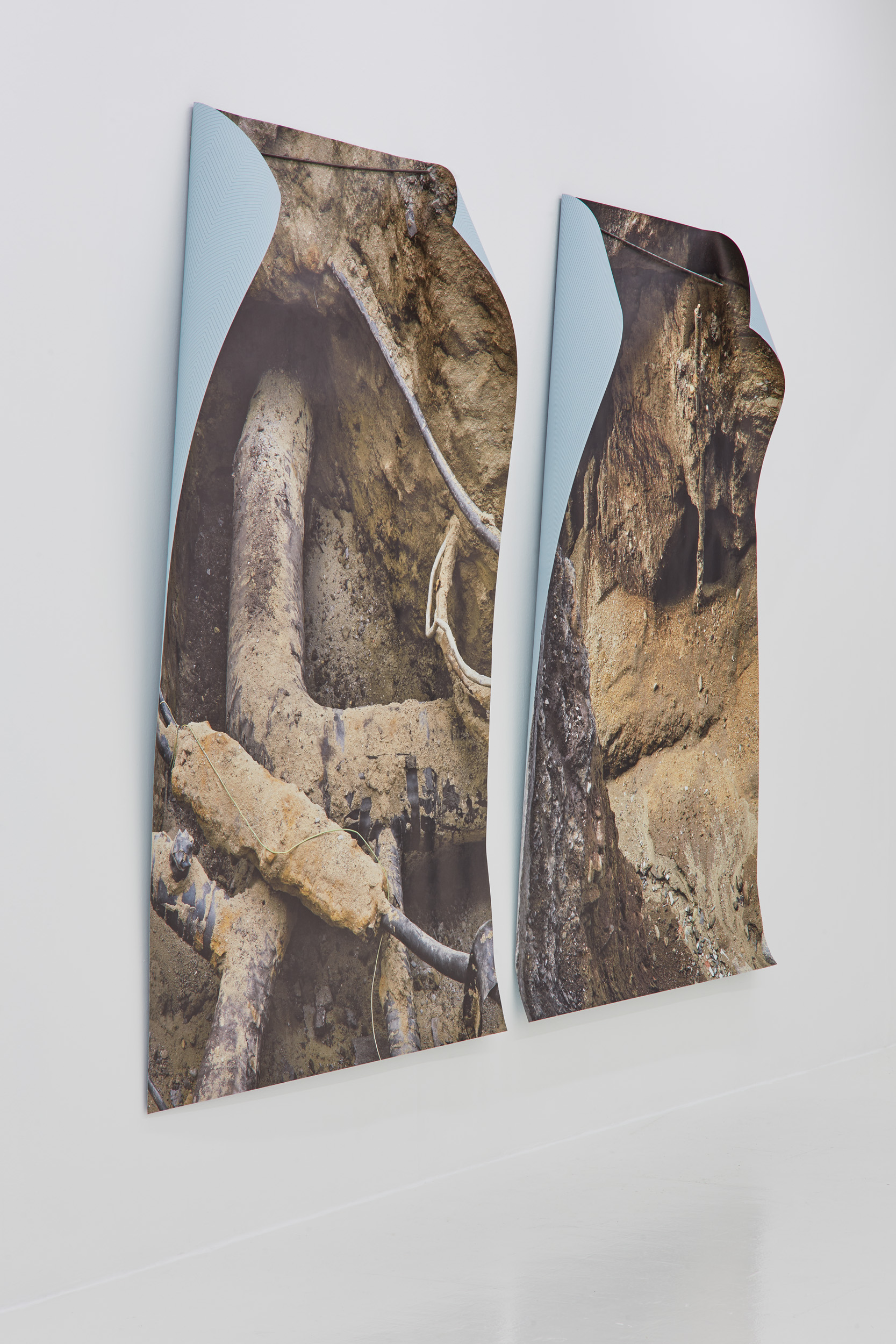
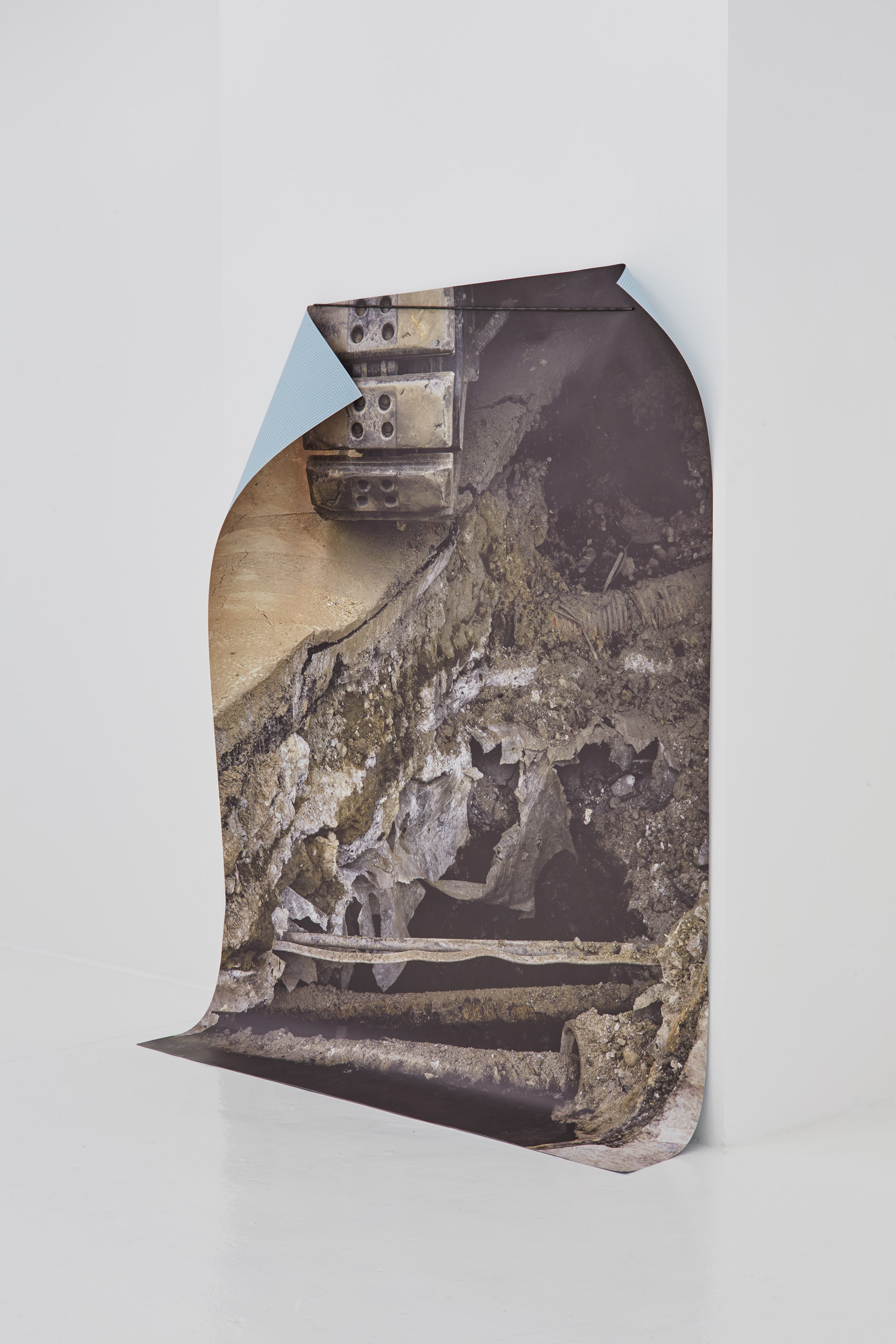
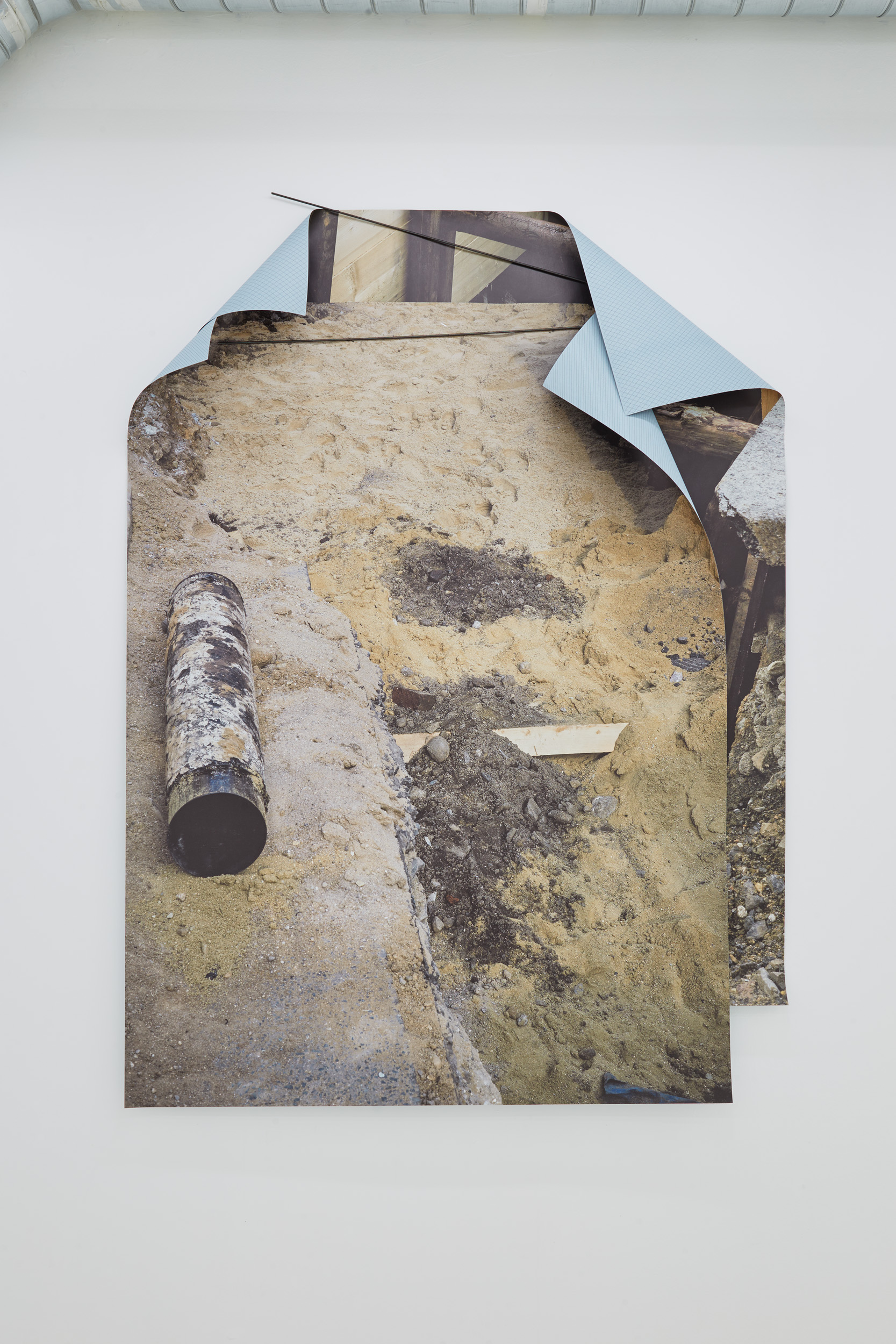
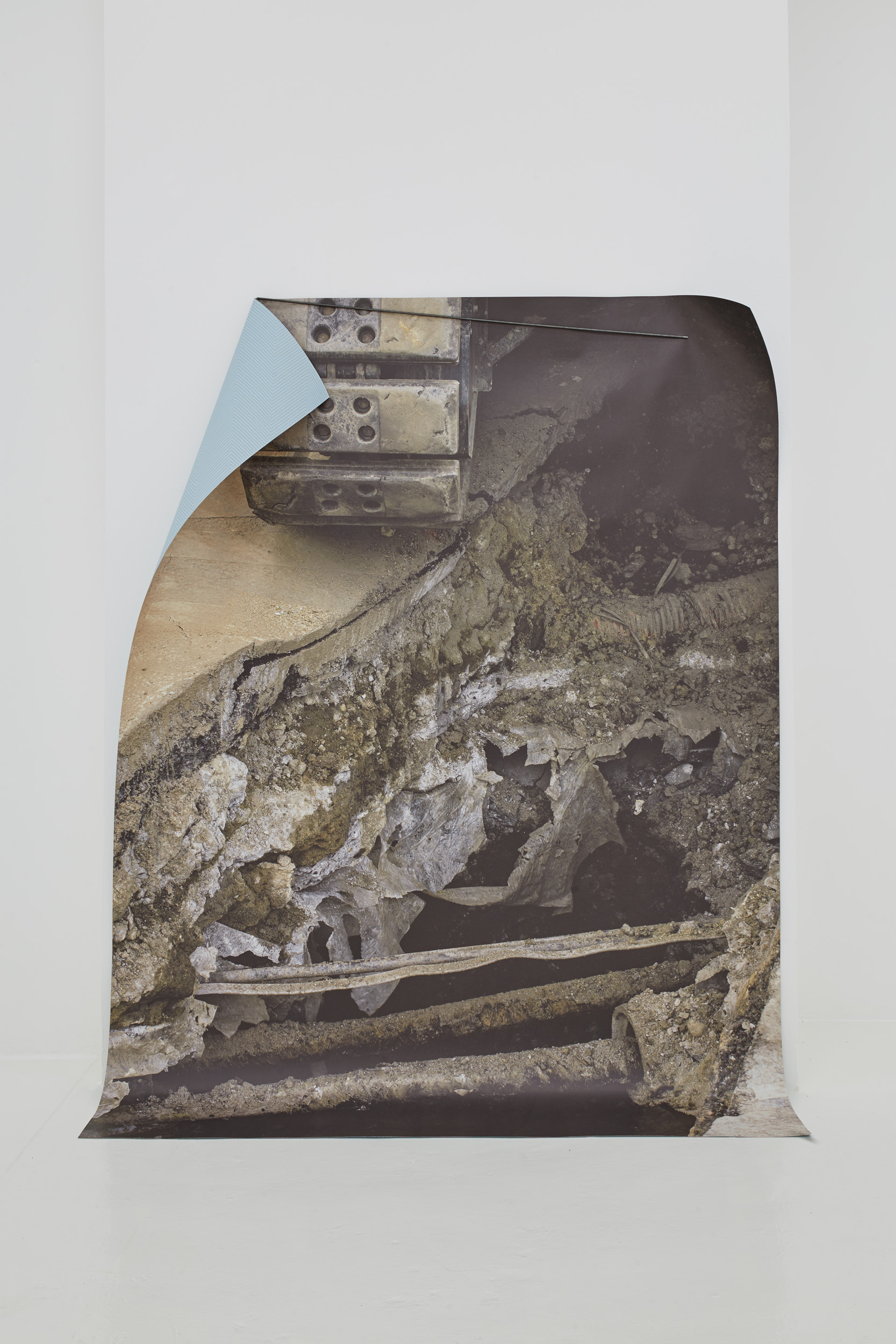
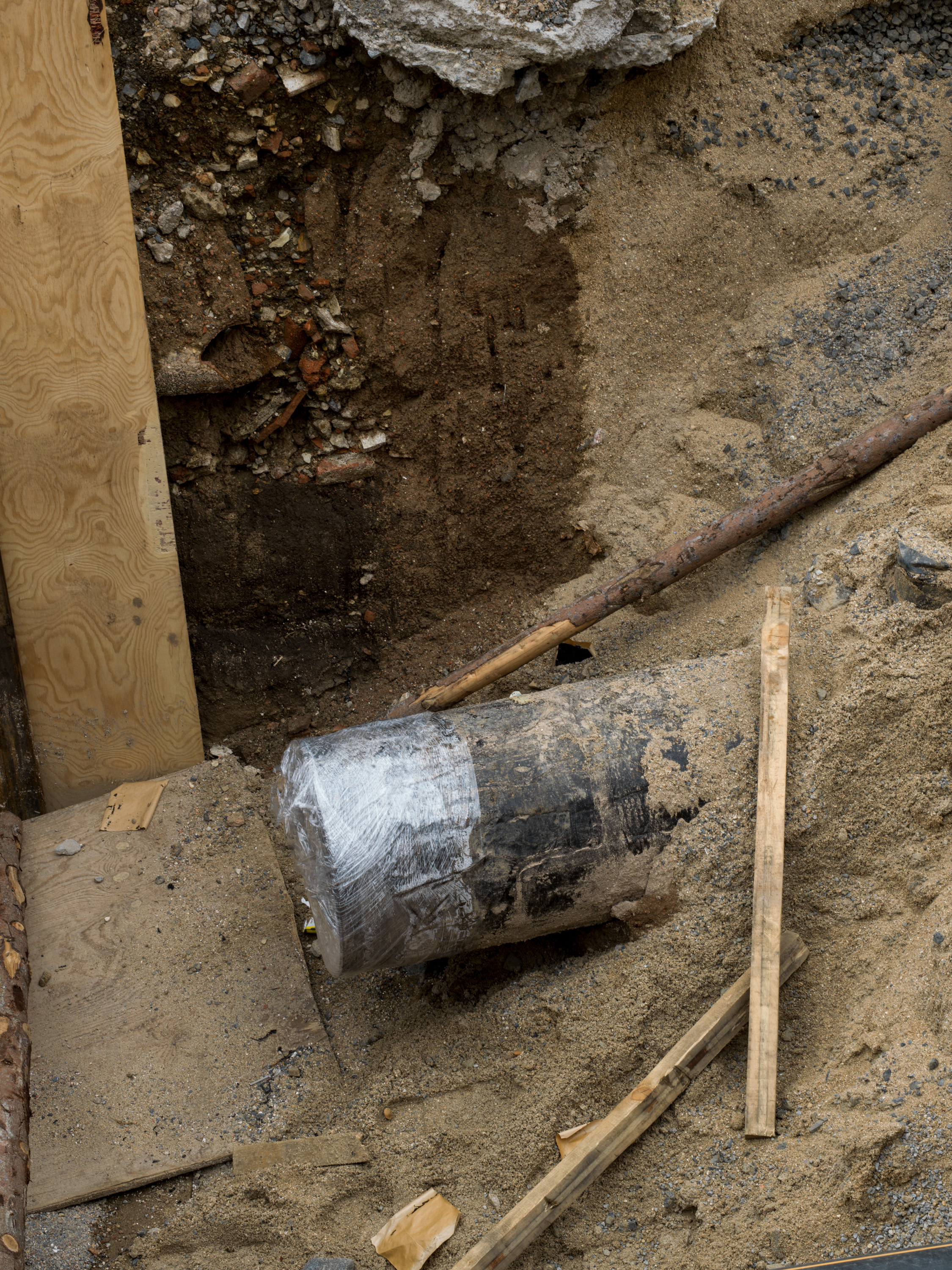
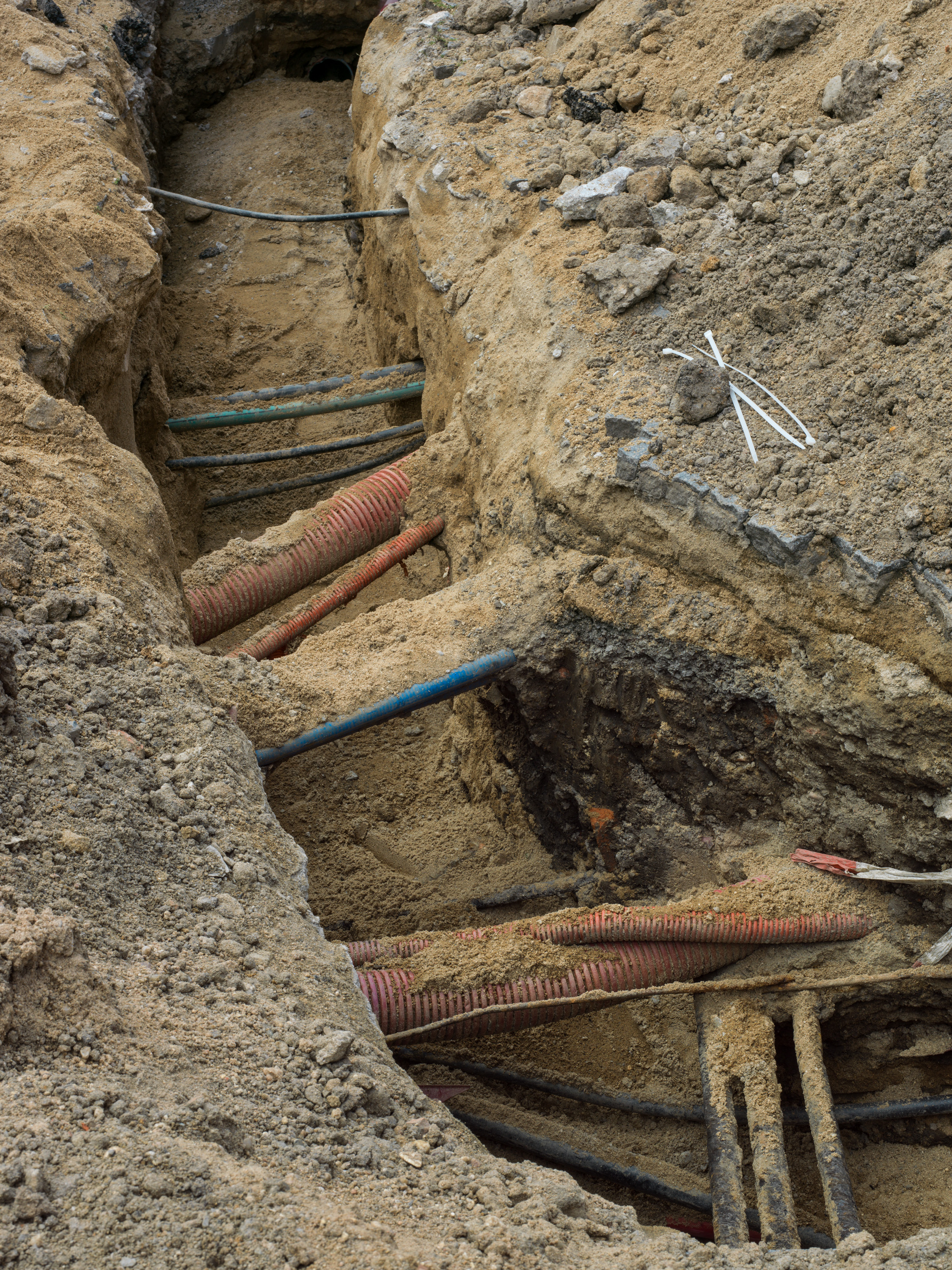
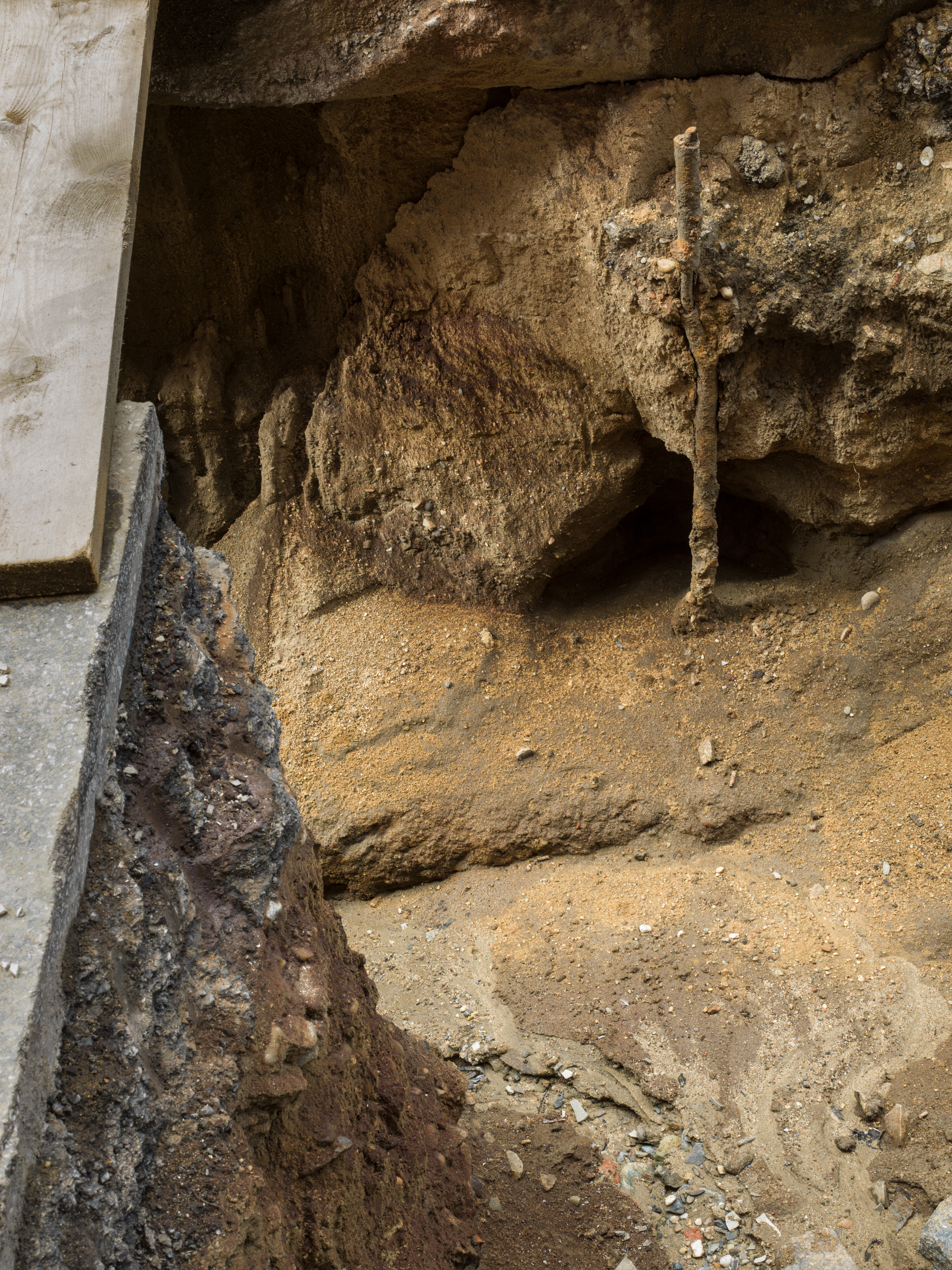
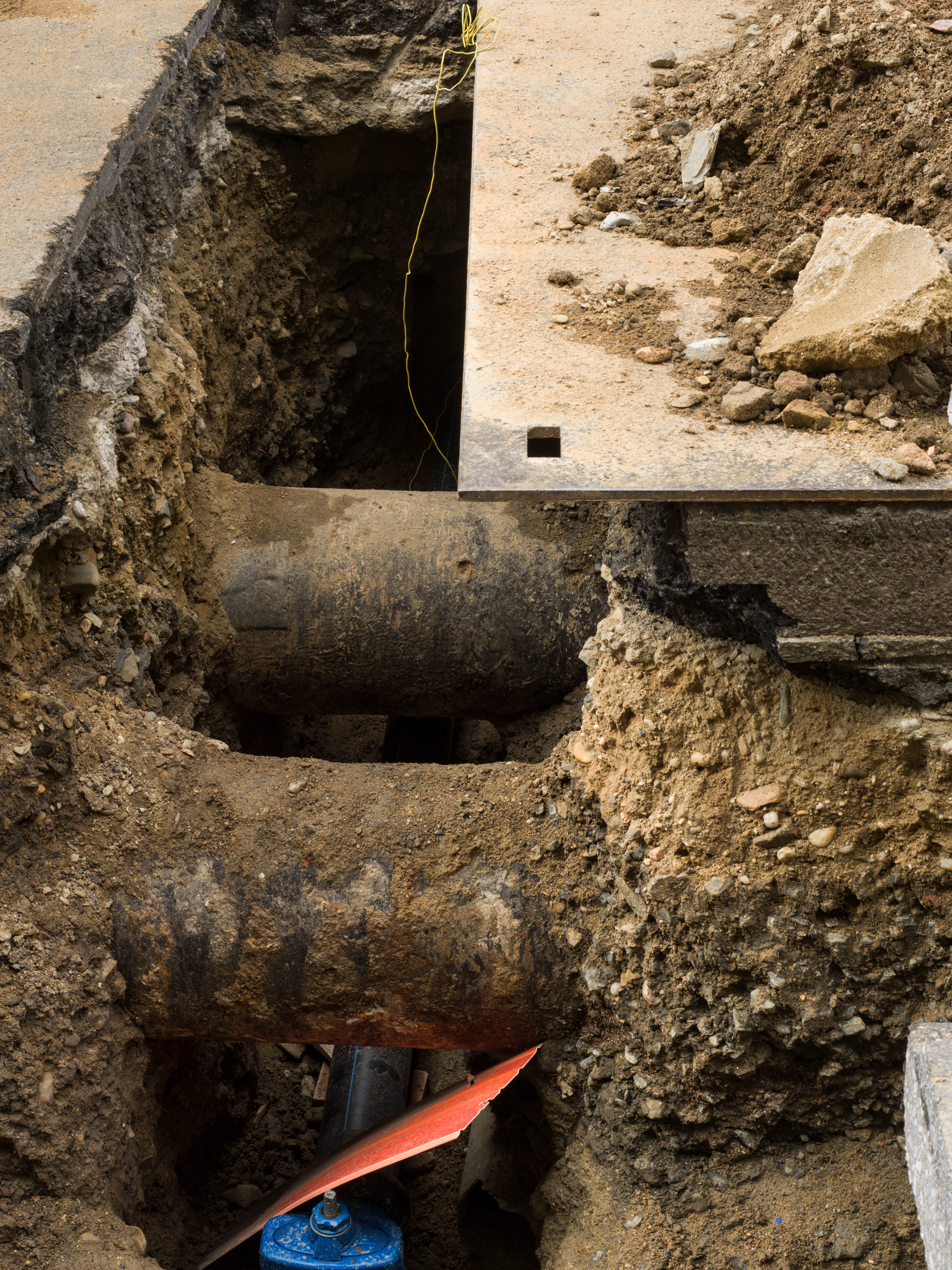
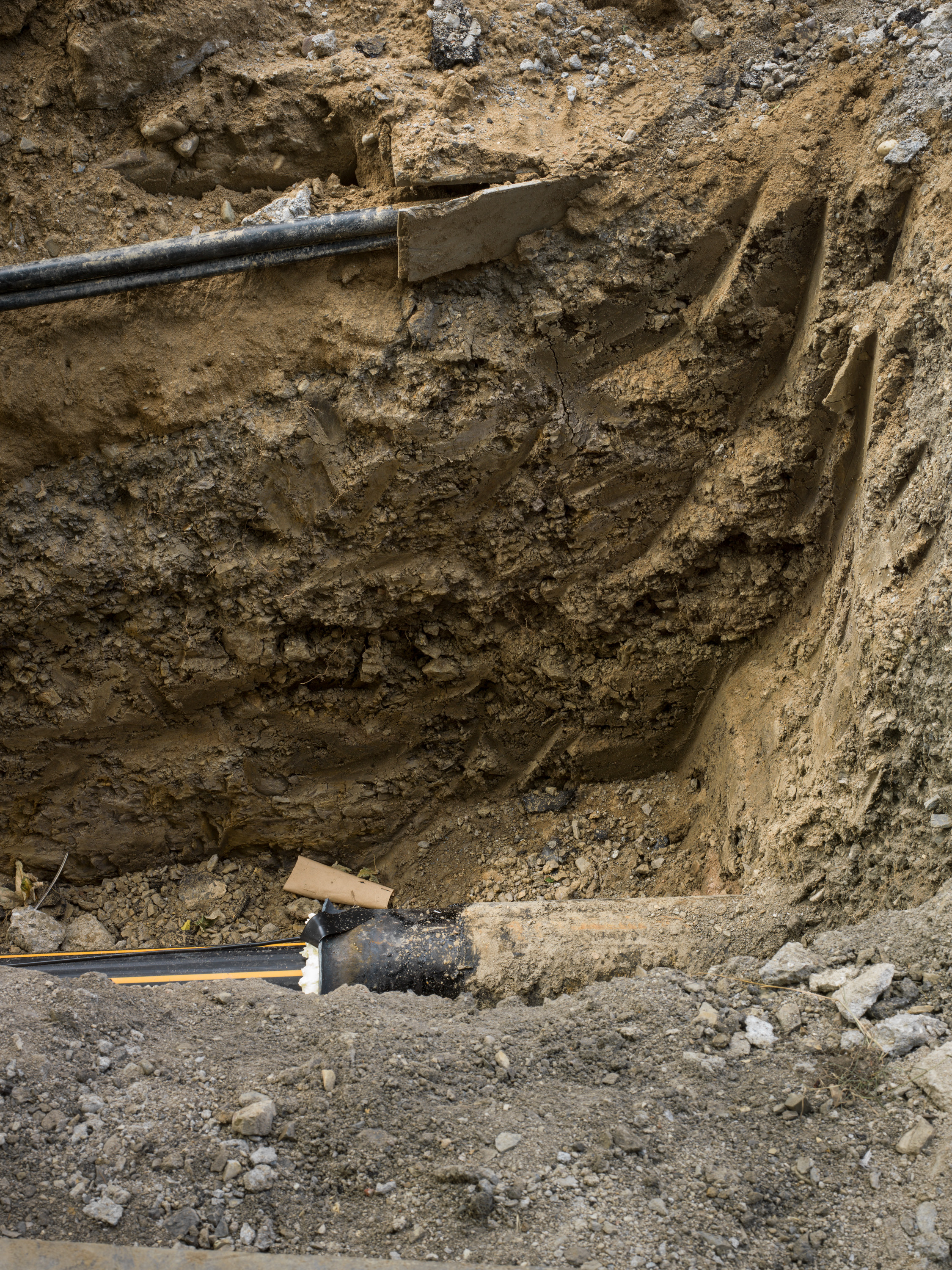
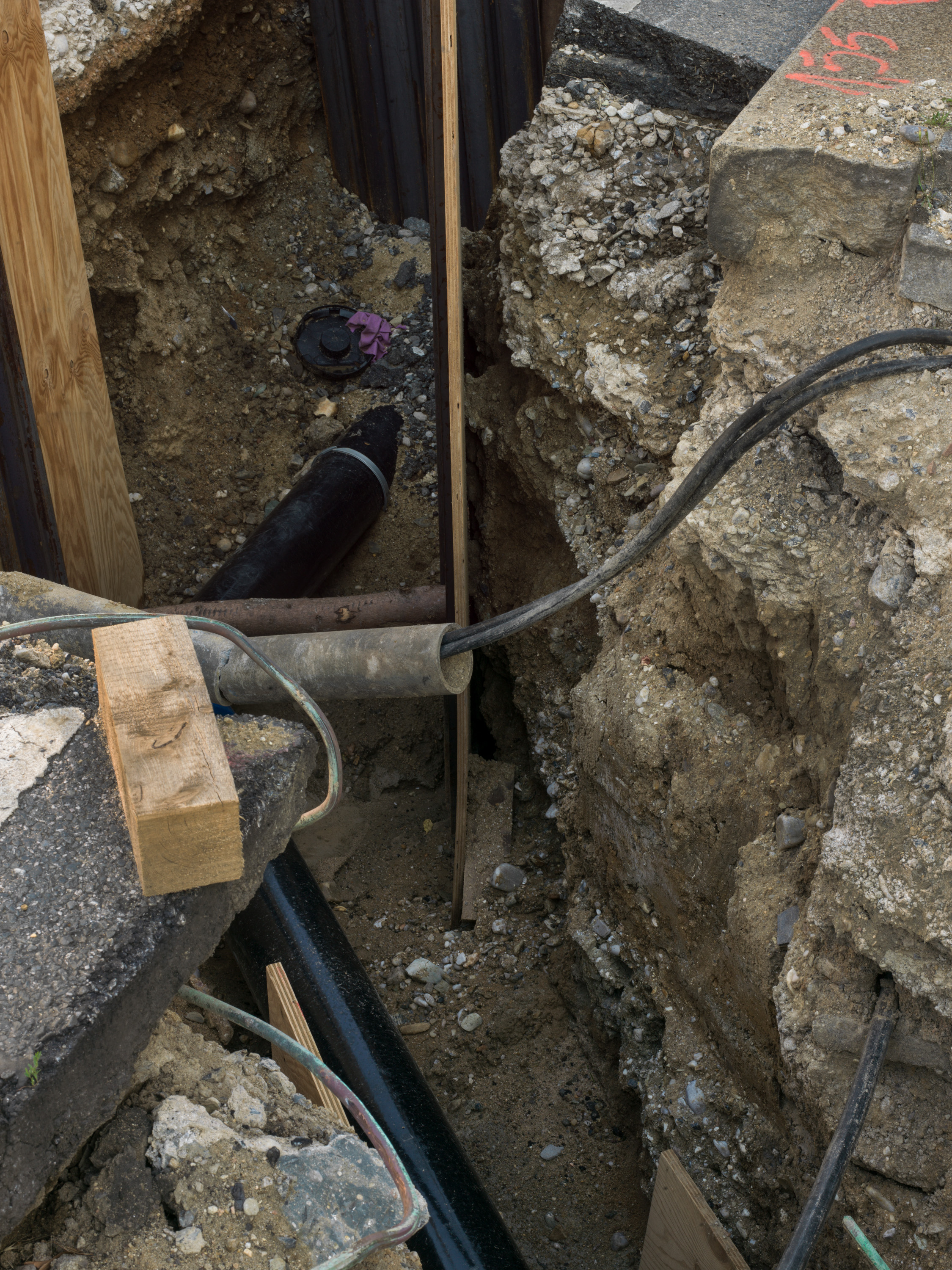
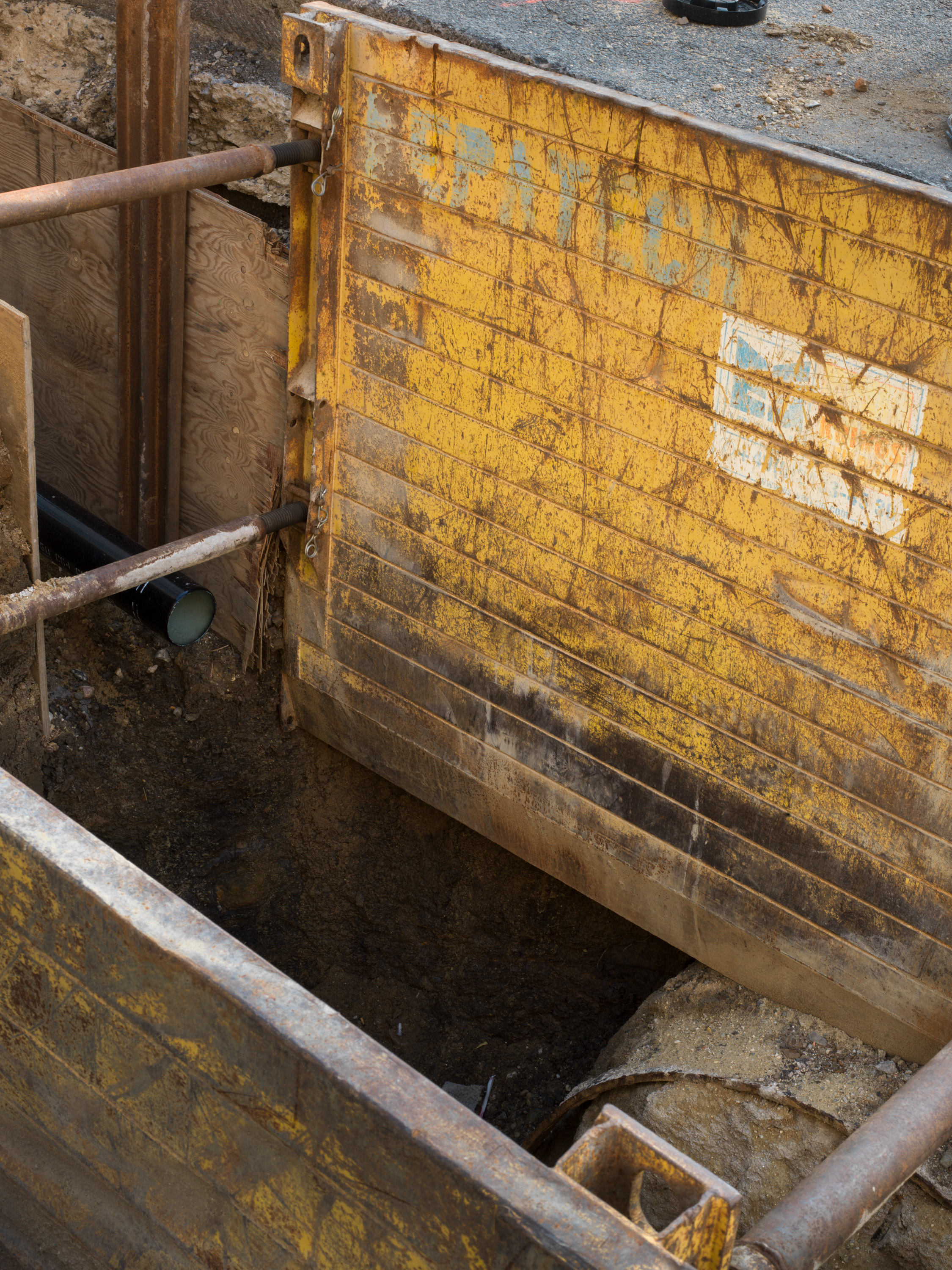
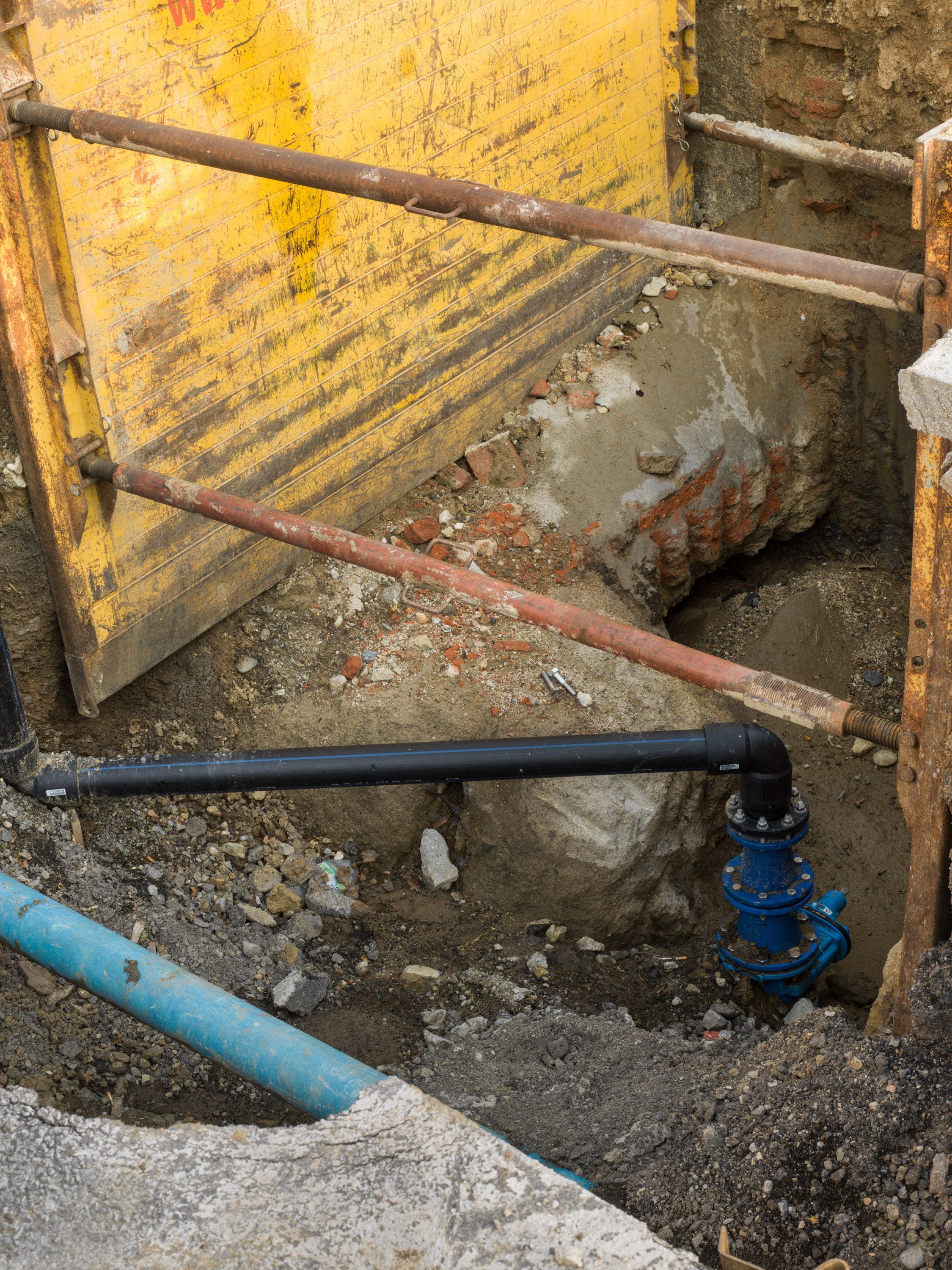
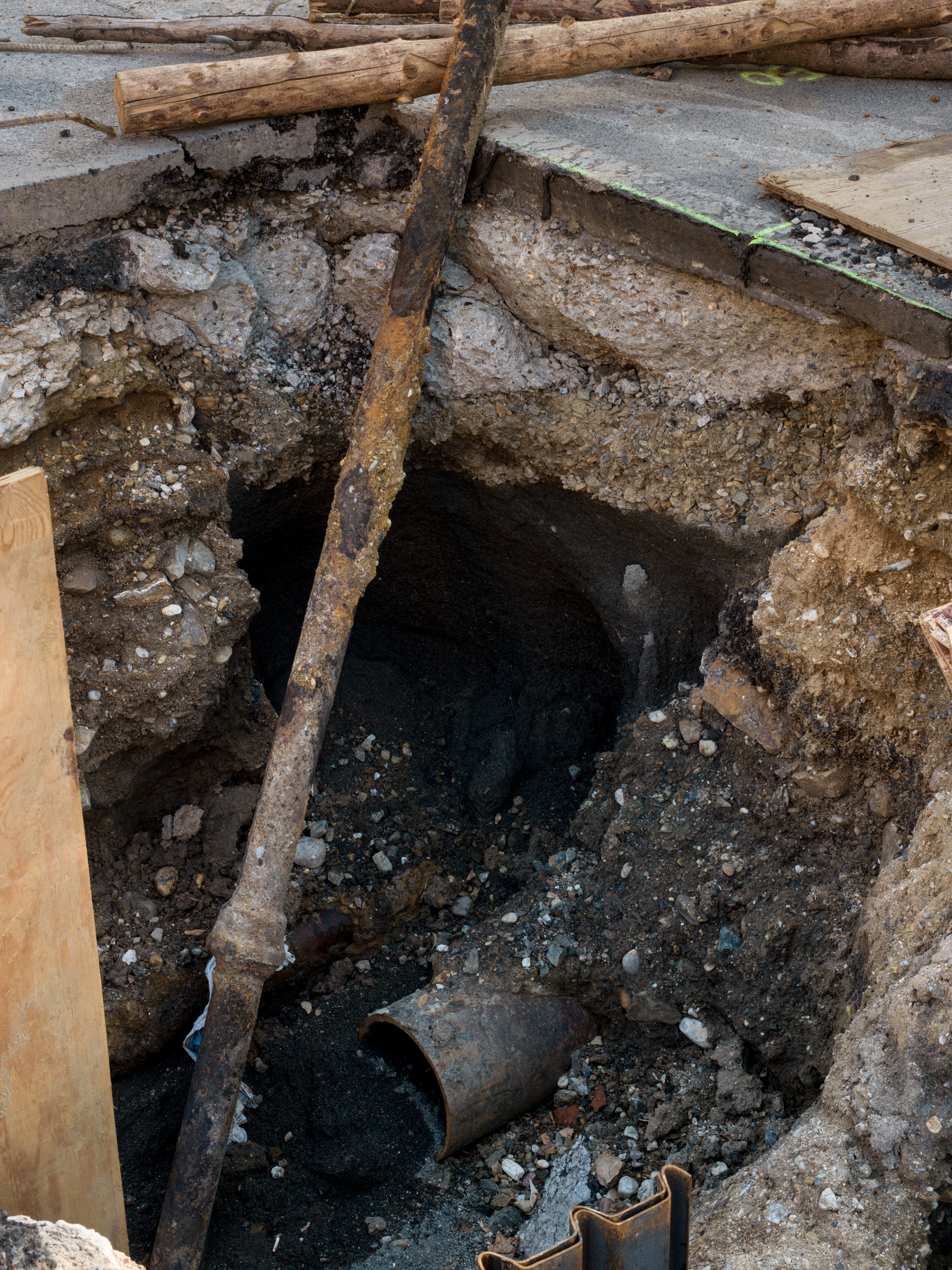
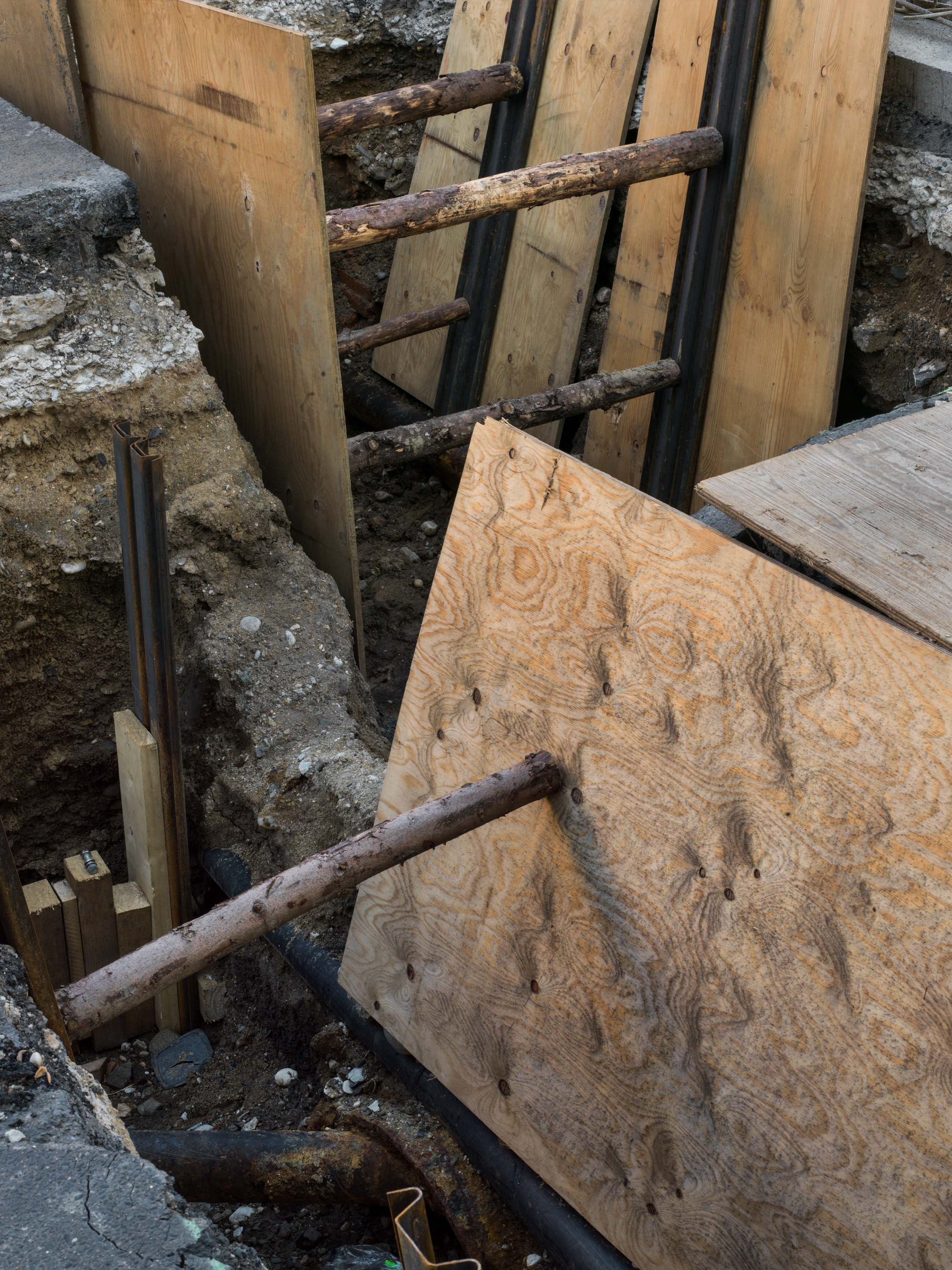
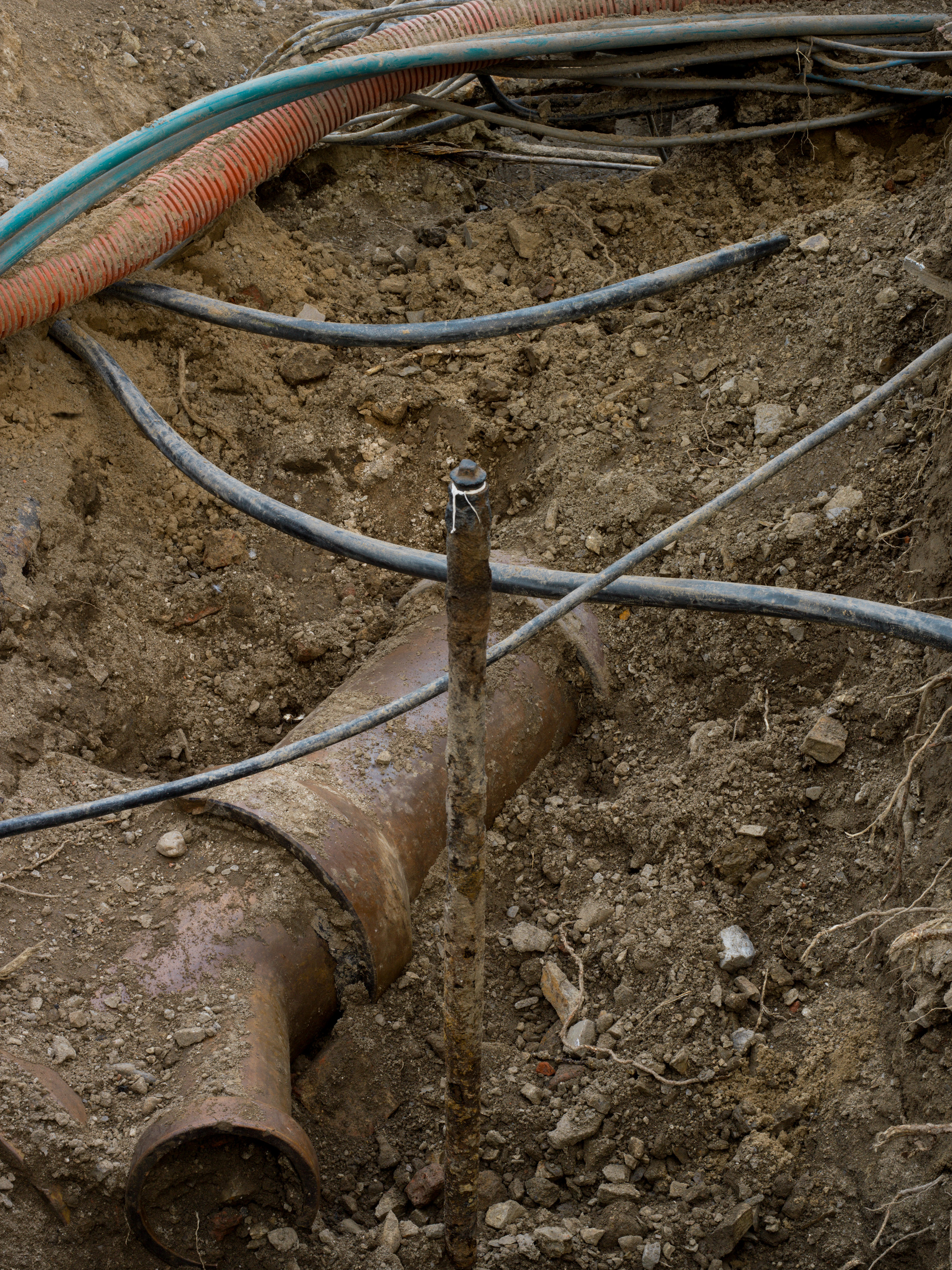
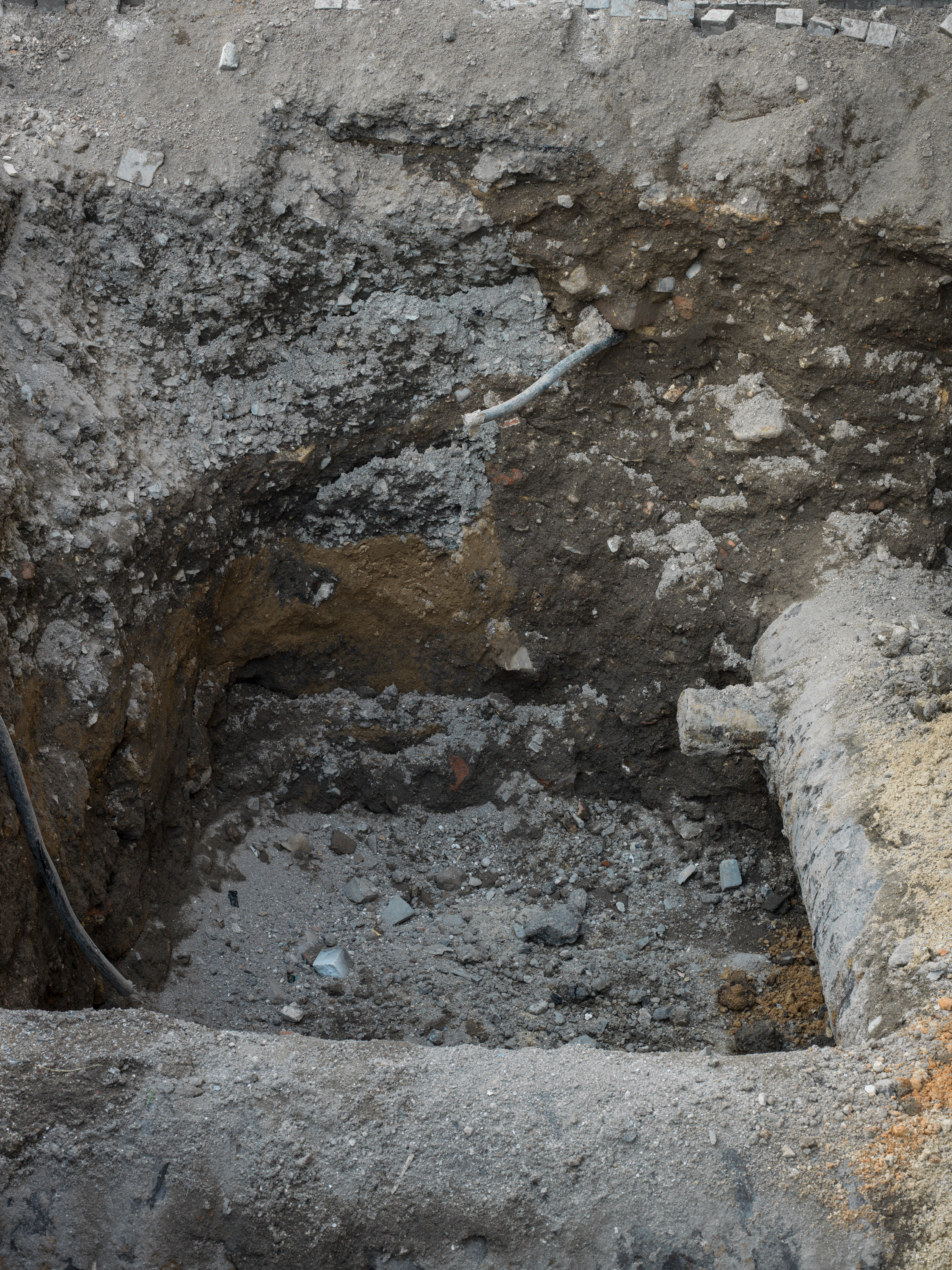
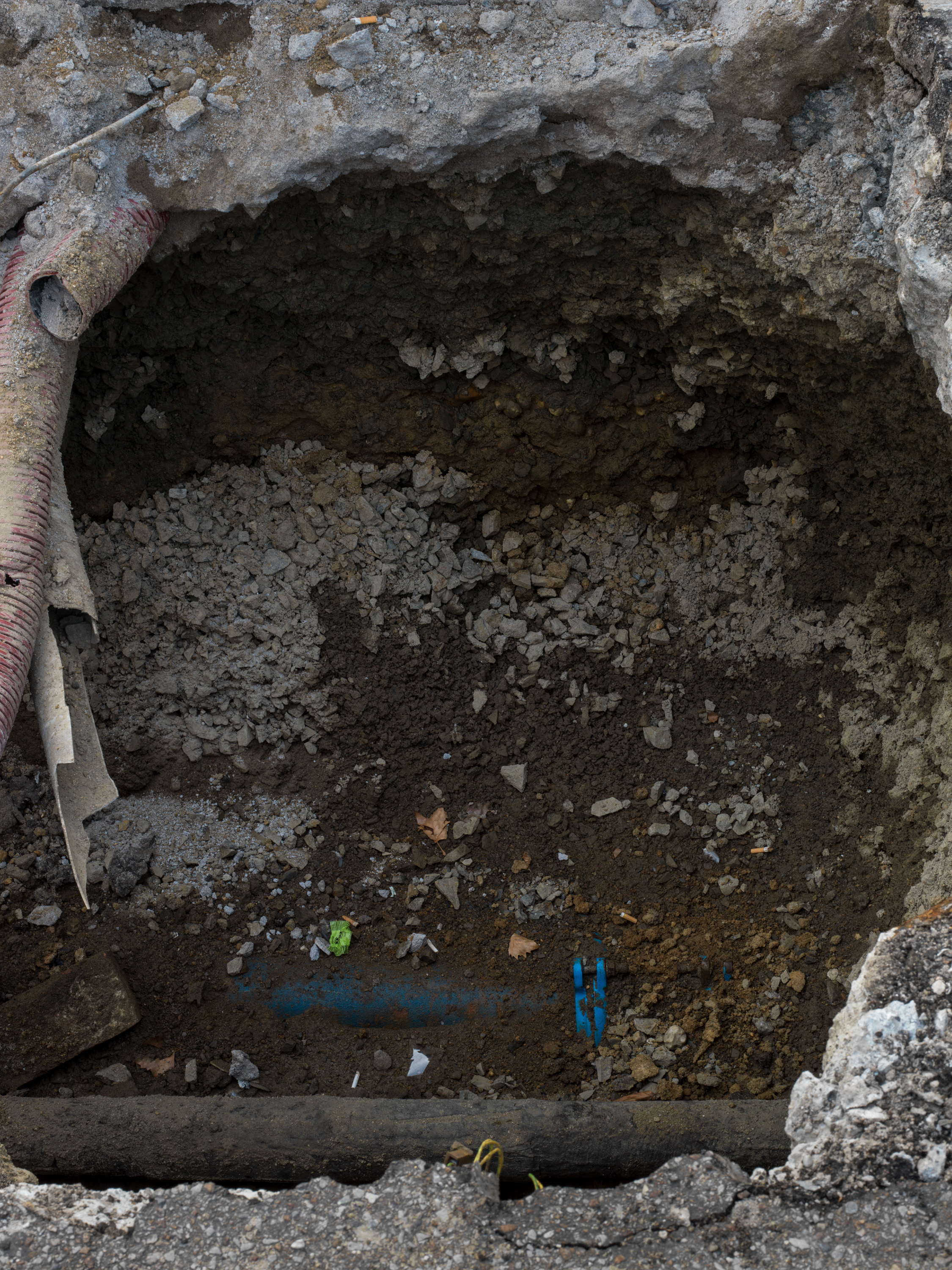
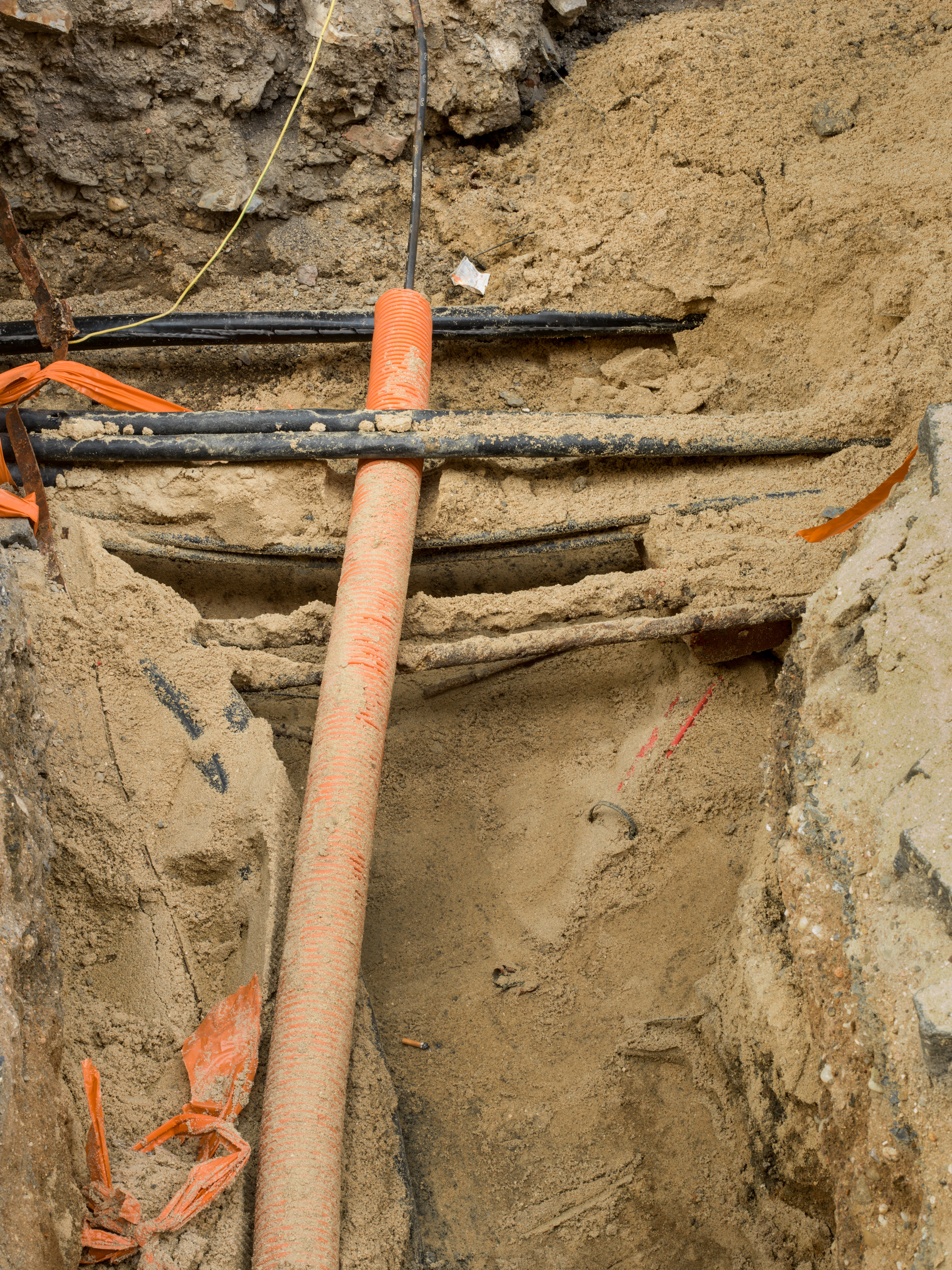
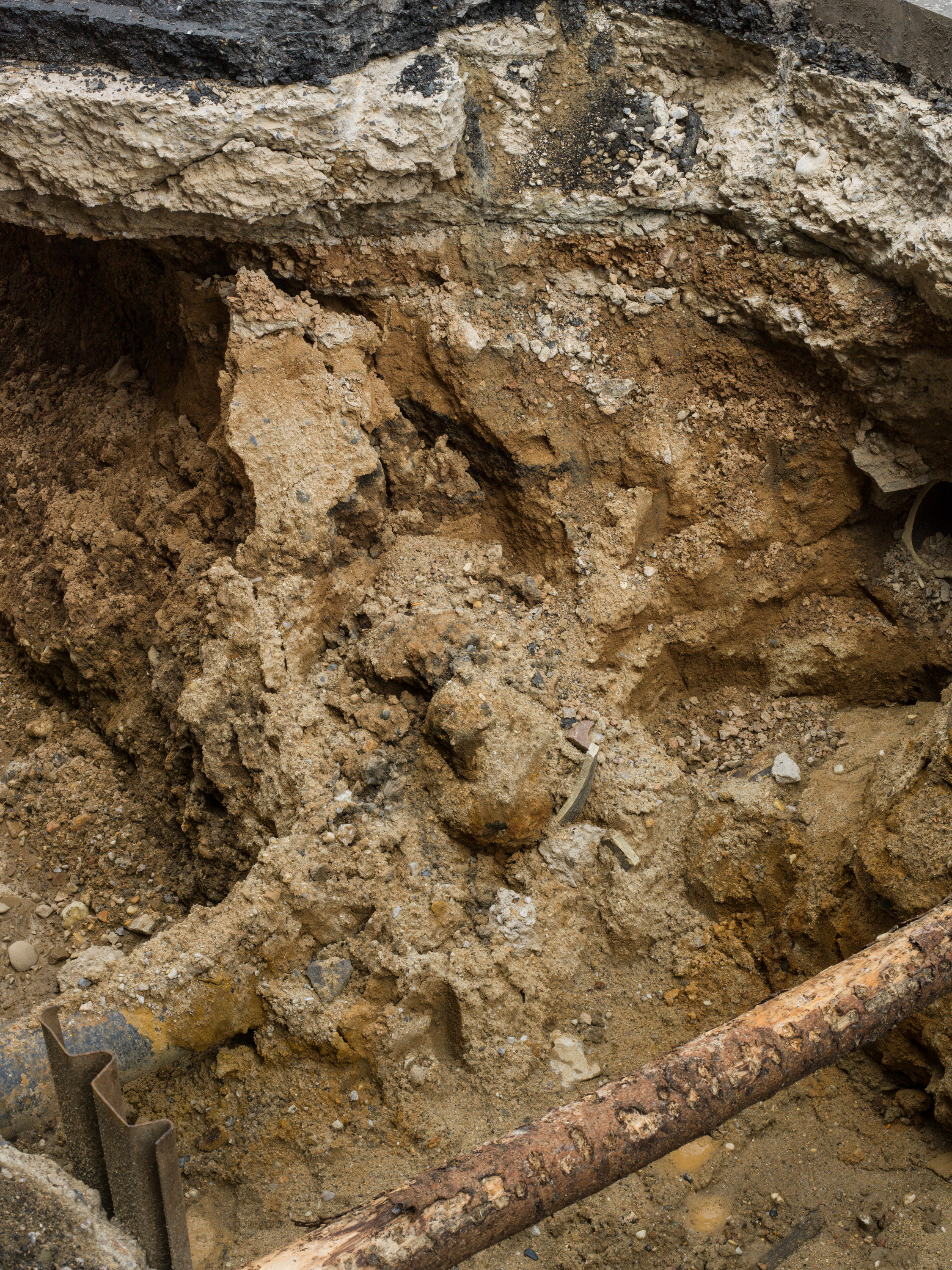
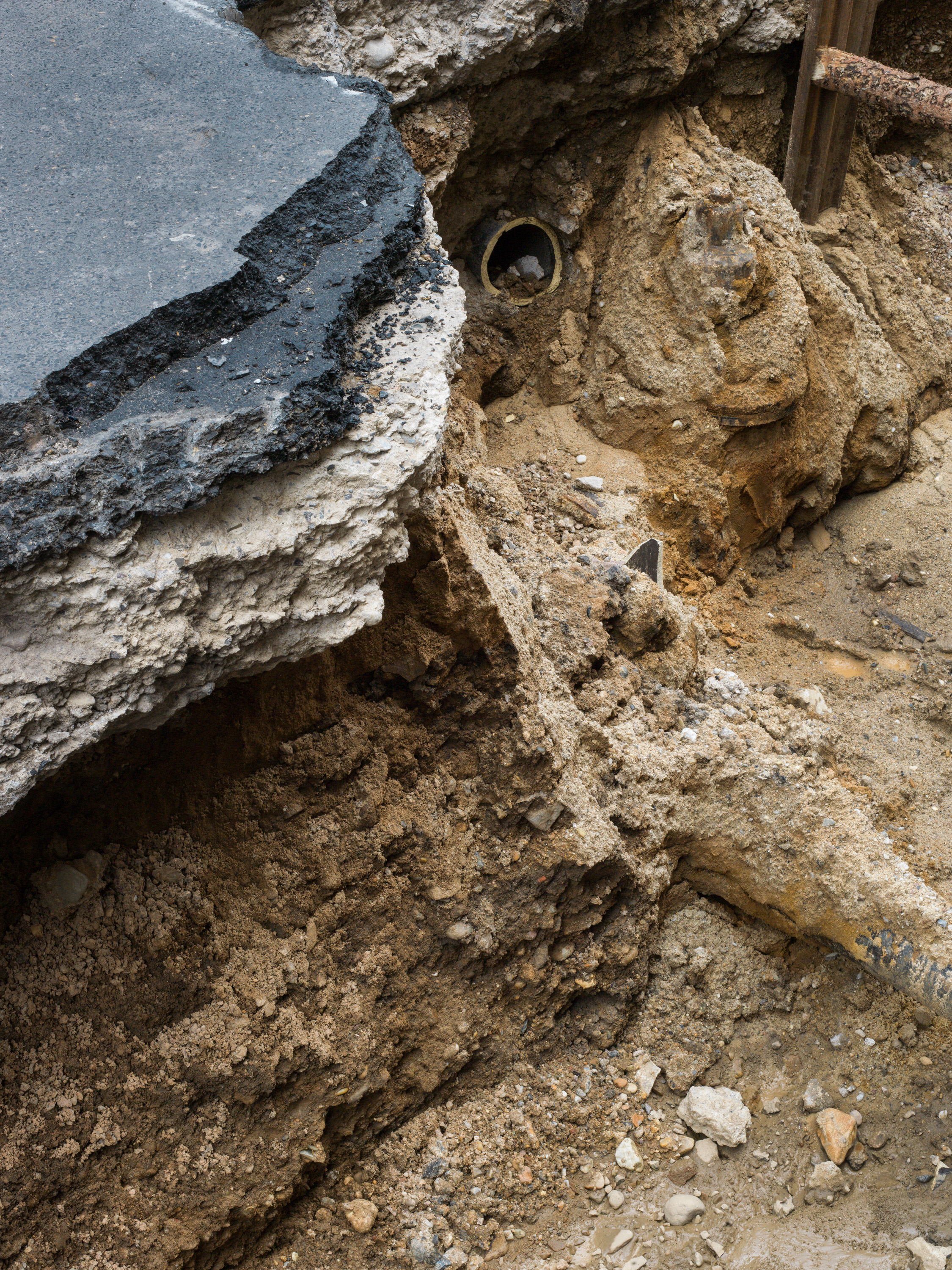
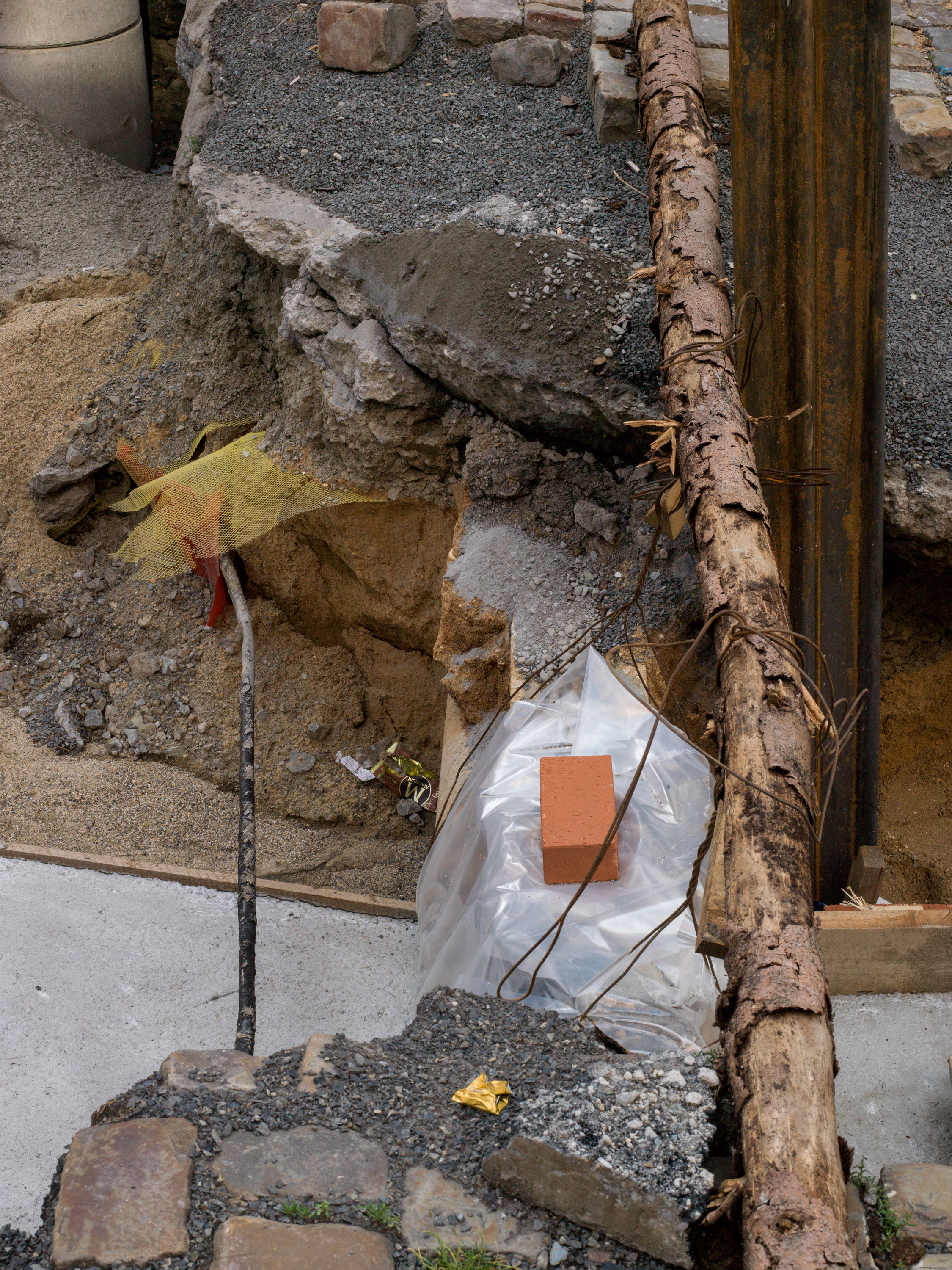
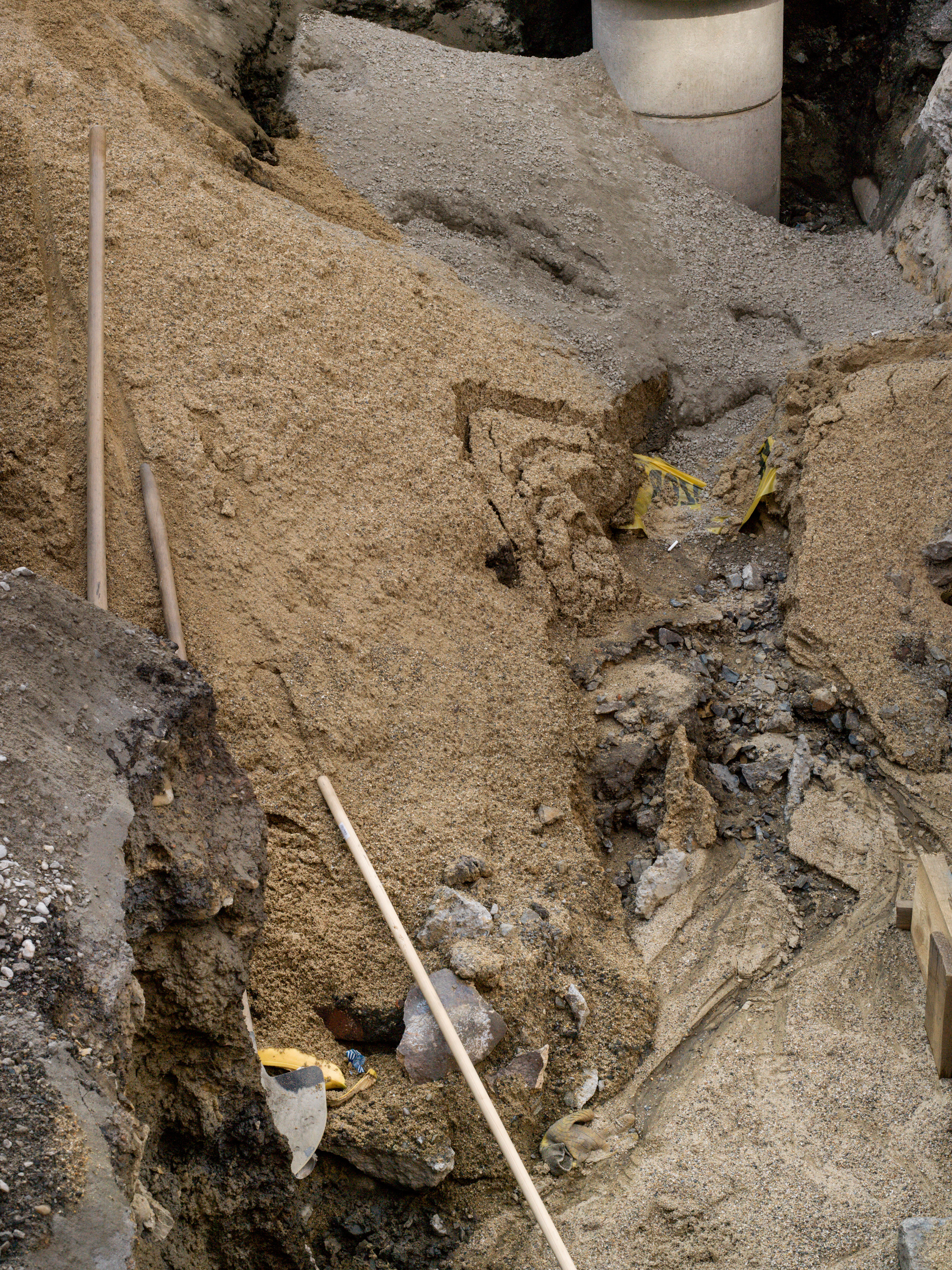
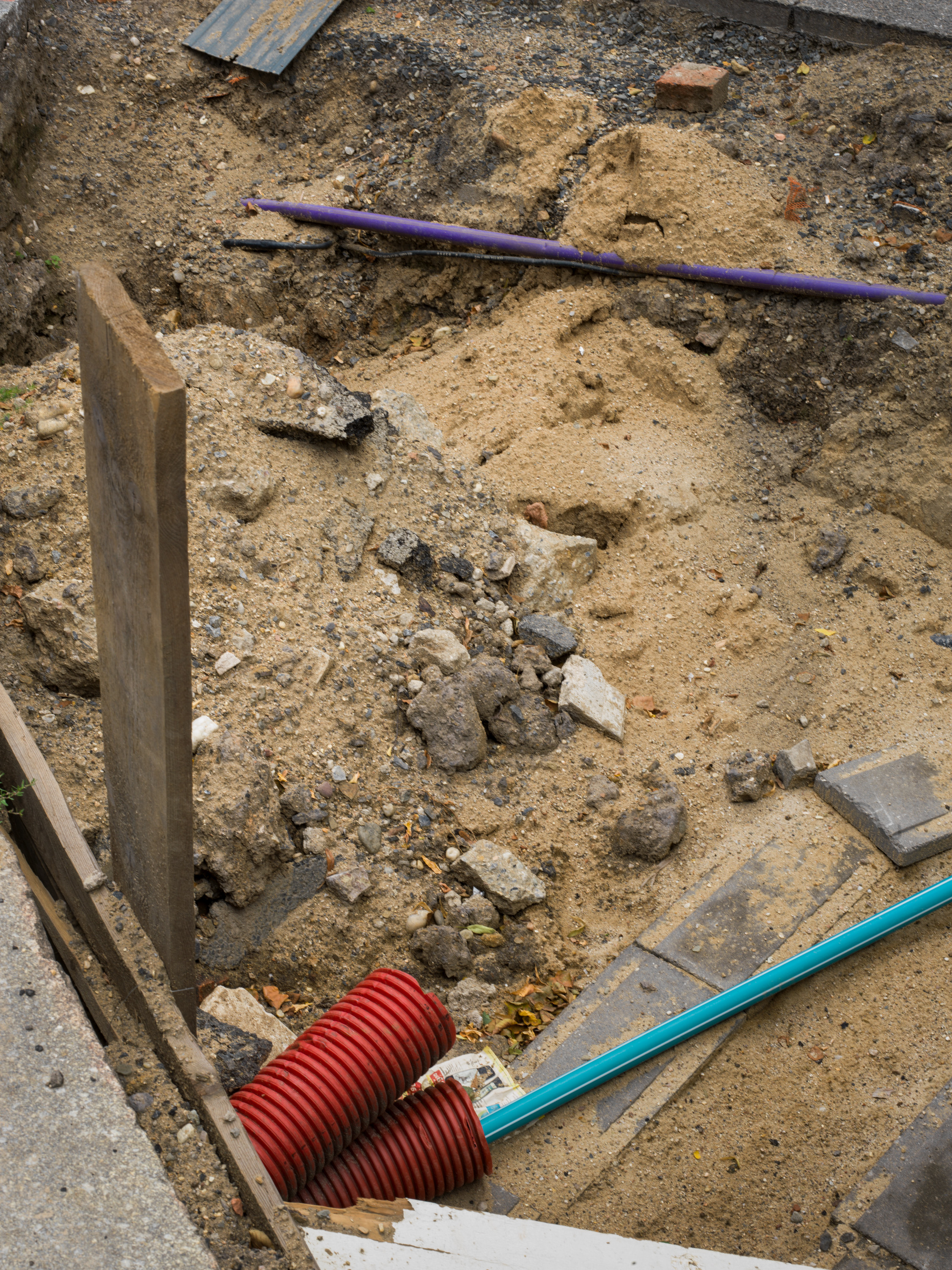
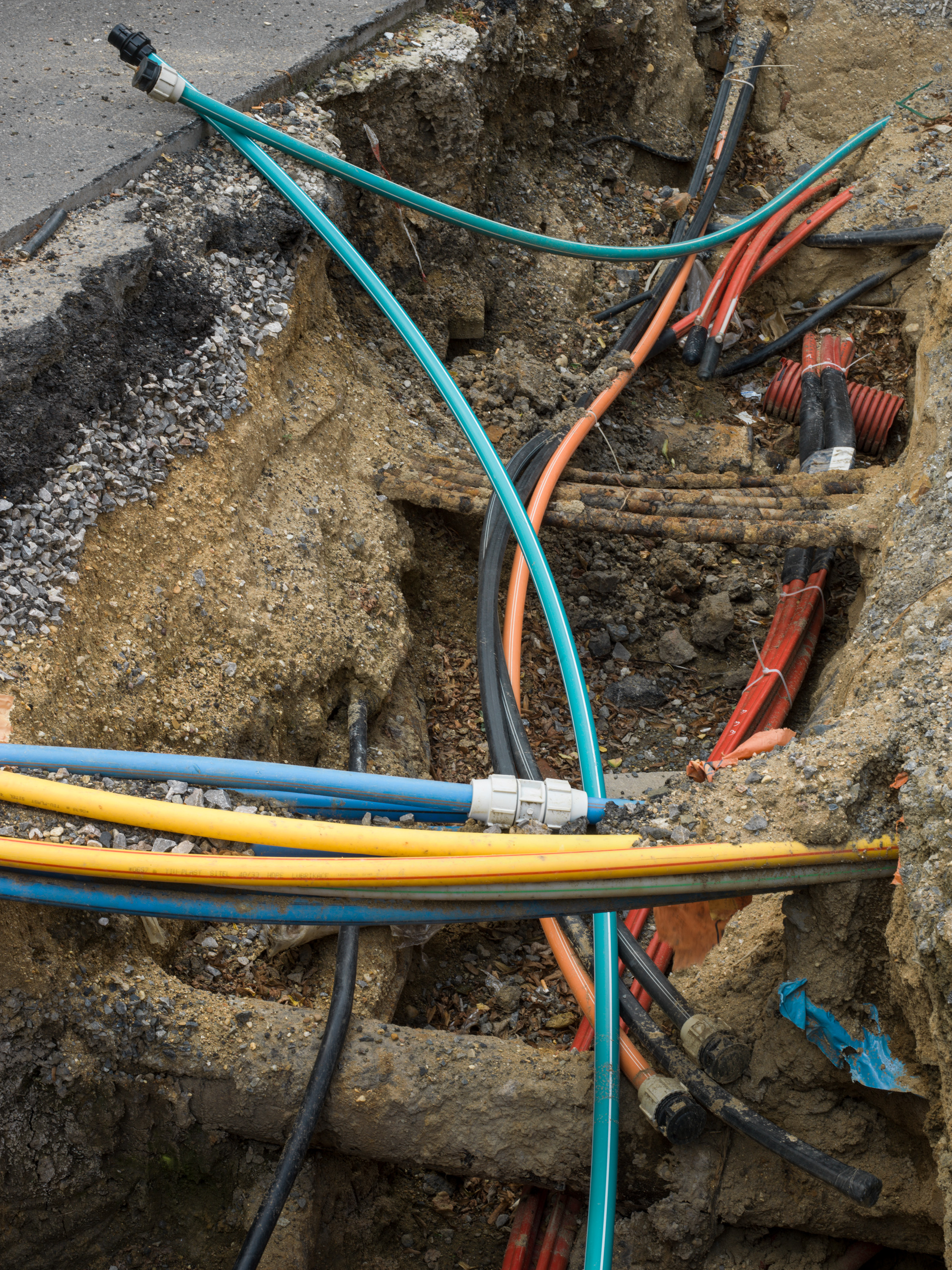
Àngels Miralda, From the Underground
Soil is undervalued because it is often mistaken for dirt, its zombie carcass. Dirt seems to be everywhere. Dirt is used to express the bottom of the value scale:
Dirt-cheap.
Poor as dirt.
They treat the workers like dirt.
— Claire Pentecost, Notes from the Underground 01 The hierarchy of height is one of our most basic principles of value. Whether it comes from the logical feat of elevating silos to conserve grain from vermin and the humid rot of the ground, or the abstract spirituality of the ziggurat and the Gothic cathedral – swirling spires reach to the sky, the heavens, the location of God. It is a basic conclusion of humanity, across geographies, religions, and cultures, that up is good and down is foul. In curatorial practice, the spiritual level of elevation has remained in the form of the plinth. The height of an artwork off the floor mimics the form of the altar. Like the structure of art presentation, history, mythology, and literature are all replete with references to this hierarchy of height and its association with the above and the below.
Bodies are buried under the ground. Soil is essentially made of decomposed vegetal and animal matter. Our material return to the soil might be the reason why the underworld is known as the place of demons, skeletons, and all sorts of goblins. When the Black Plague ravaged London it was believed that the disease was contracted by breathing “bad air”. 02 This noxious miasma wafted up through cracks in the ground from the pits of hell. Witch doctors filled their birdlike beaks with “posy” – a mixture of dried flowers and herbs that was assumed to filter out the pestilence. The implication was that a balance was tipped, that what belonged underground came up into the purity of the air, and that what was condemned to the underground must remain there. Although medieval apothecaries did not know the science behind infection, or that the plague was spread by an animal as insignificant as a flea, there is a connection to the open sewage that provided ideal conditions for the proliferation of the flea’s host animal – Rattus rattus. The stink of “bad air” did have an abstract connection to the quick-fire infections that would reduce the European population by up to 60 per cent. But, rather than coming up from the fires of hell, the bad air was produced by the abundance of rotting food and waste fed on by urban rat populations. It would take centuries, and involve further plagues, before piped sewerage was introduced.
Medieval urban populations were only sustained through migration from the countryside. Time and again, the working poor were ravaged by plagues caused by the poor sanitary infrastructure in cities. London’s main water supply was the River Thames, which was also its biggest open sewer. The cyclical consumption of water infected by human faeces produced devastating outbreaks of cholera. The city was structured with the royal palace and the residences of the nobility in the west, and the poor in the east, downstream from their lords and ladies. Even so, cholera outbreaks did not spare the wealthy, and eventually led to the construction of the public sanitation system as we know it. 03
Centuries earlier, one of the greatest achievements of Roman engineering was the construction of the Cloaca Maxima. This primordial sewer, started by the Etruscans, was a water system that drained the malarial swamps around Rome. It still functions, dumping excess water from the surrounding hills into the emerald waters of the Tiber. 04 The full Roman system included aqueducts to bring fresh water into towns and cities and cloacas to take away waste. The Pont du Gard in southern France and the aqueduct of Segovia in Spain are testament to the spread of these feats of engineering throughout the Roman world. These waterways were raised high above the ground, and used the principles of gravity and slight incline to deliver fresh running water. These arteries of the Roman world flowed into the public bathhouses, and their falling into disuse would mark a downturn in sanitation for centuries to come. At the time of the fall of the Roman Empire, many aqueducts were deliberately destroyed during wars in order to sabotage the water system of settlements. Combined with lack of maintenance, the system eventually fell into disrepair and out of use as populations returned to other forms of water distribution and waste disposal.
A contemporary example of visible piping still exists in Berlin, metropolis of the art world, where a system of raised blue- and pink-coloured pipes removes excess groundwater, to be drained into the sewerage system or directly into the River Spree – an engineering plan strikingly similar to that of the Etruscans. 05 This type of above-ground construction of pipes is usually meant to be temporary but sometimes becomes permanent for economic reasons. In the Soviet Union, gas lines painted yellow were placed above ground, as these were cheaper to construct and maintain, although it also made them vulnerable to sabotage. 06 The soil is protection; it hides and complicates attempts to destroy, thieve, and tinker. It can hide treasure for centuries or millennia, lying in wait to be discovered afresh.
In Alexandre Dumas’s The Count of Monte-cristo (1844), the main character, Edmond Dantès, is condemned to prison after being falsely accused of treason. While imprisoned in the Château d’If, on an island off Marseille, he meets the “mad priest” Abbé Faria, who inspires him to dig an escape route out of the prison and hands him a map to a long-lost buried treasure. The rest of the story follows Dantès as he enters Parisian society as a mysterious Count with inestimable wealth, and takes his revenge against his accusers. Buried treasure has long been popular in literature, for example Treasure Island by Robert Louis Stevenson. The mystery of what lies buried in the soil is a literary trope, but it also occurs in reality. Accounts of buried treasure include Pablo Escobar’s suitcases of money that were buried all over Colombia, and the Treasure of Lima, supposedly buried on Cocos Island. These Western mythologies of buried treasure and piracy weave together the common subconscious conception of the underground as a place of wealth and potential, combined with secrecy, betrayal, and intrigue. But underground treasures are also a game of mirrors, as is told in the moral of the myth of El Dorado.
The Spanish conquistadors who made their way through the dense Colombian jungles were motivated by their search for El Dorado – a place rumoured to be filled with gold and riches beyond their imagination. It was said that a tribe who lived high in the Colombian Andes covered their leader in gold and threw offerings into Lake Guatavita as gifts to the gods. When the Spaniards found Guatavita, they attempted to drain it in order to access the gold at the bottom. Yet, when the local people heard that the strangers believed that the offerings were El Dorado, they said no. Pointing at the soil, the valley, the fertile jungle, and the trees hanging with ripe fruit all around them, they said, “This is El Dorado.”
A schism in the earth reveals the arterial network that binds us into one human-organic compound; the “humus” or soil made of decomposed vegetal and animal matter is our only lifeline. It is true that a treasure lies buried in the ground, but it is not gold; it is filth, it is our subsistence, our survival, and our mutual dependence. We continue to live according to a deranged value scale, distorted by a society that values gold above ground, and that has tipped the balance by extracting what lies below in order to burn it and release it into the fragile atmosphere.
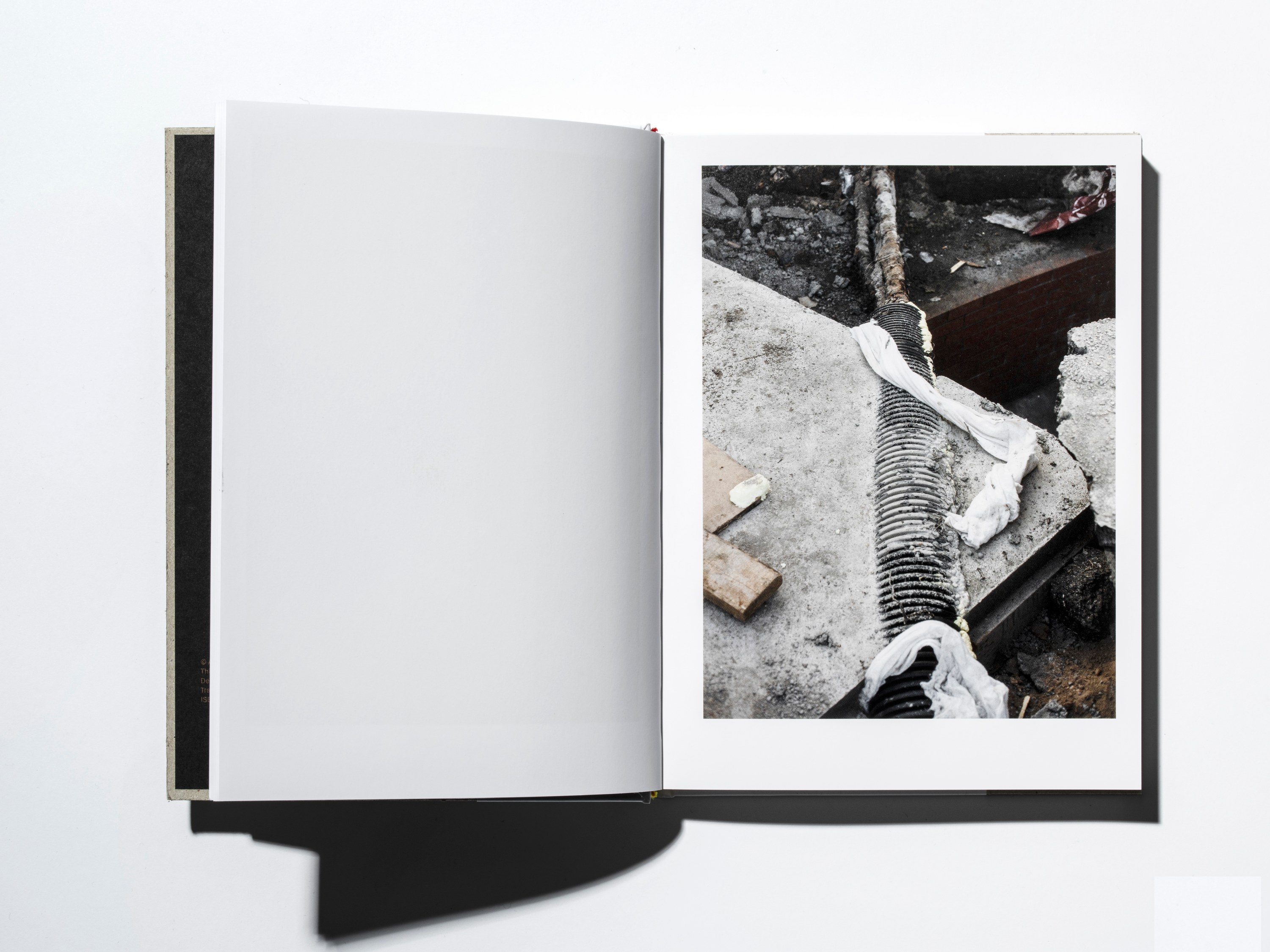
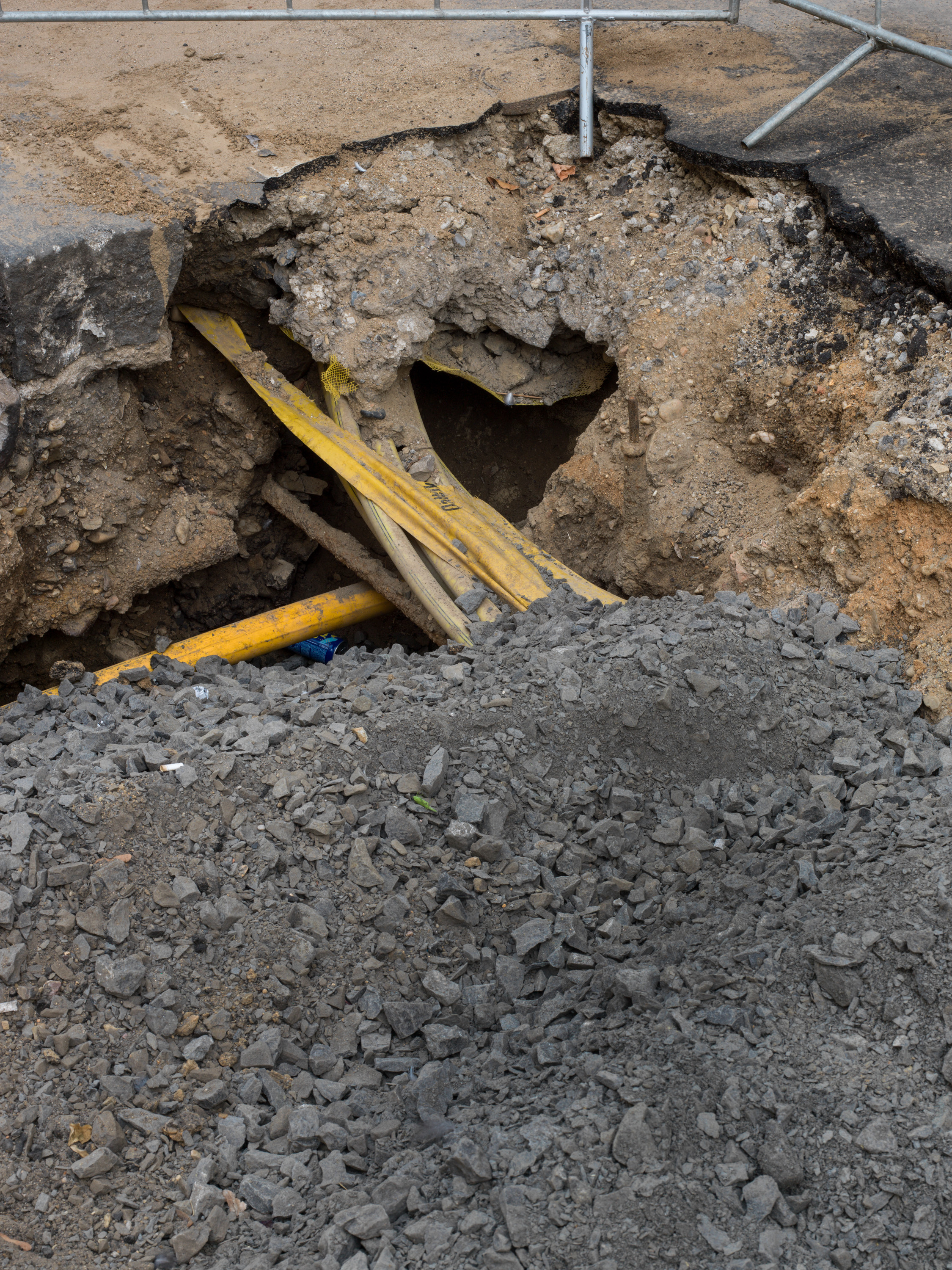
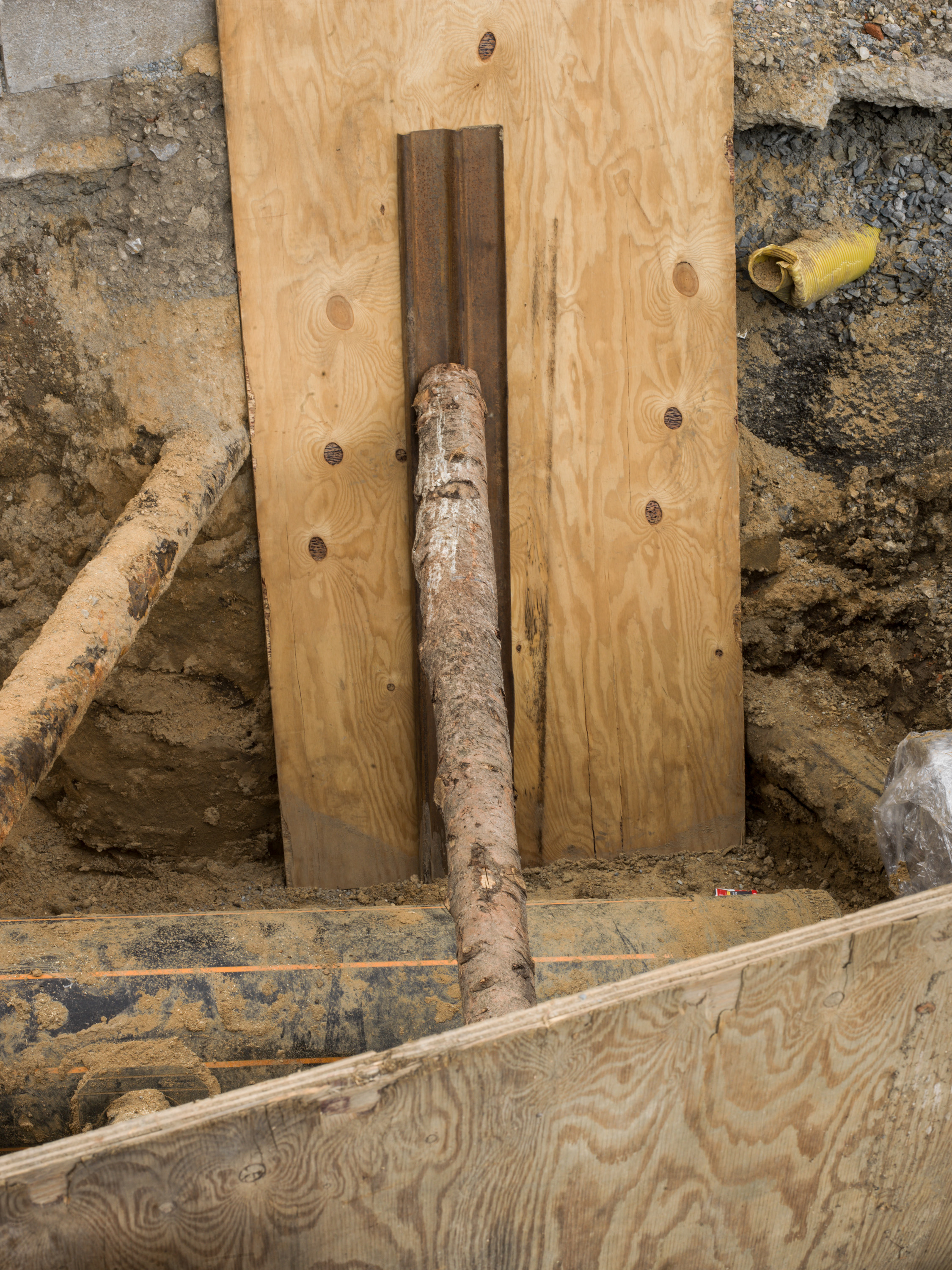
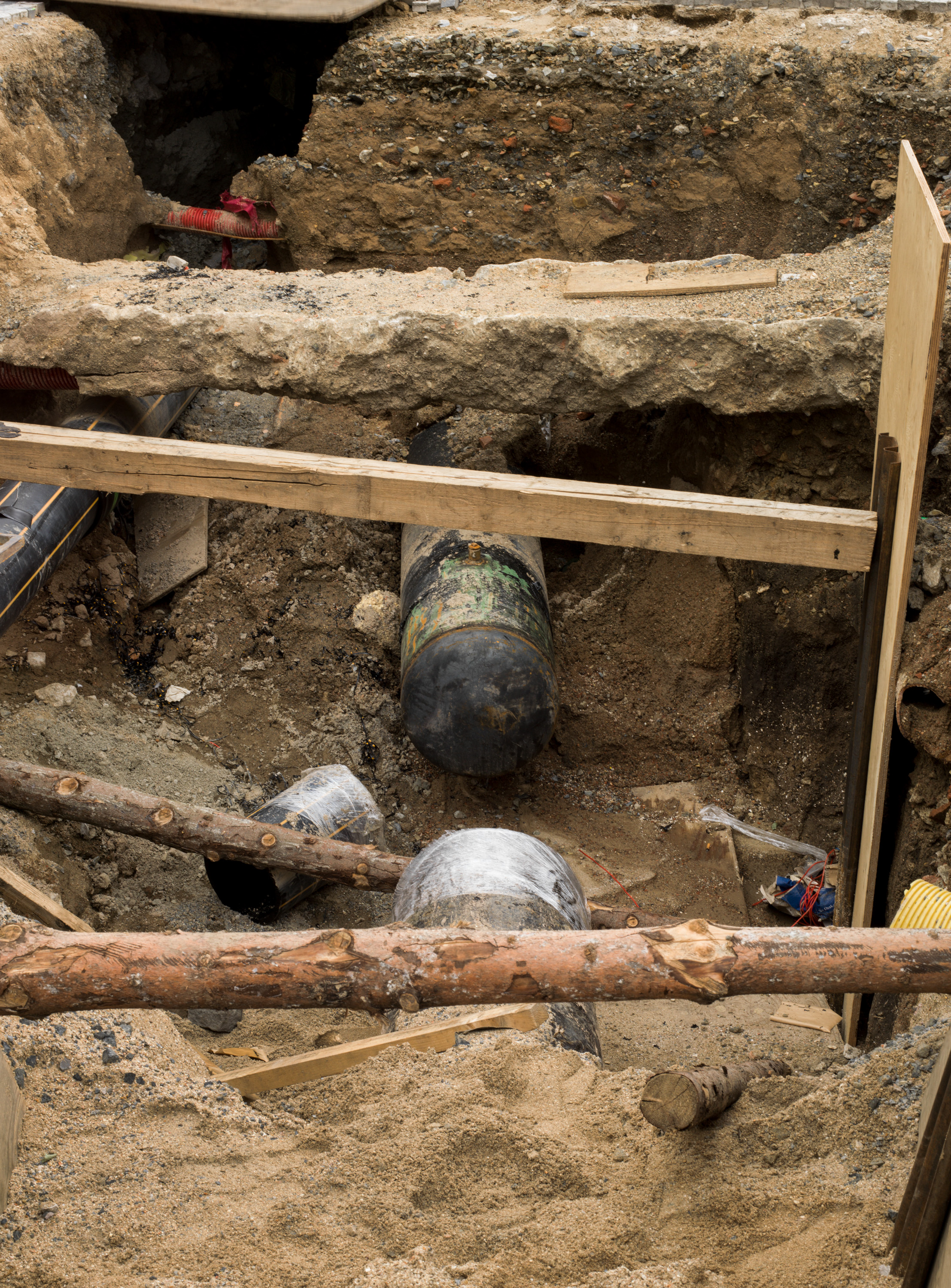
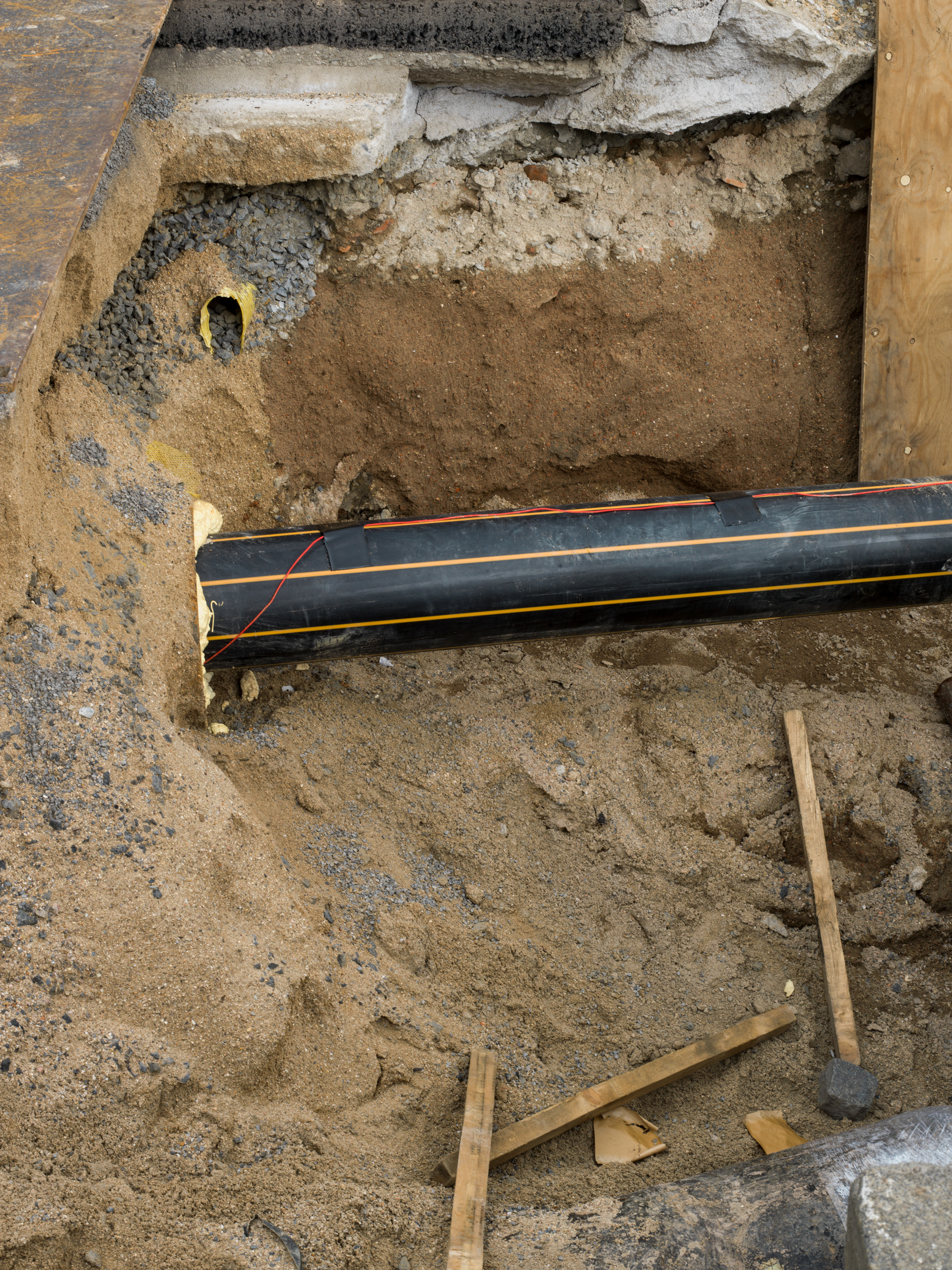
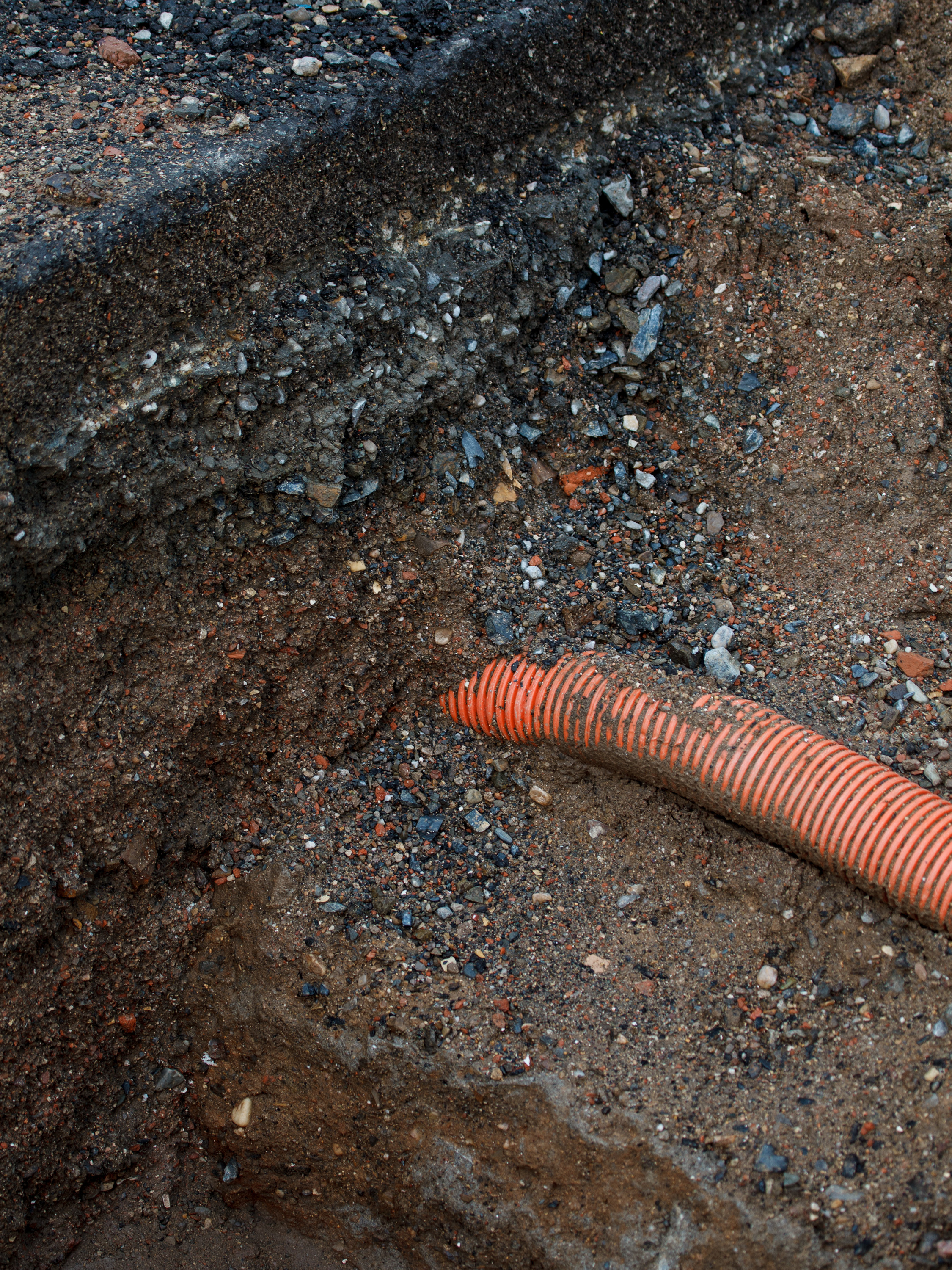
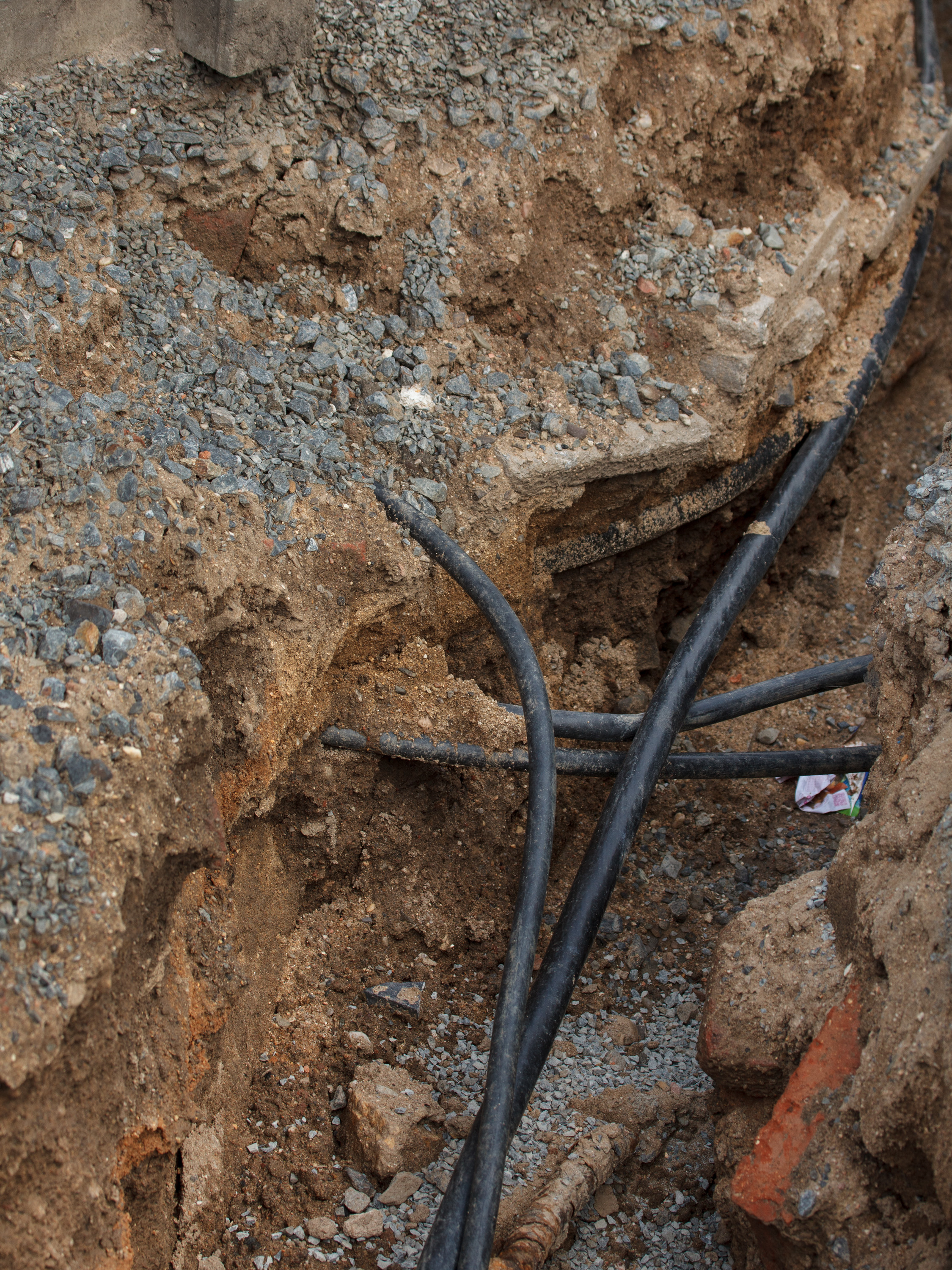
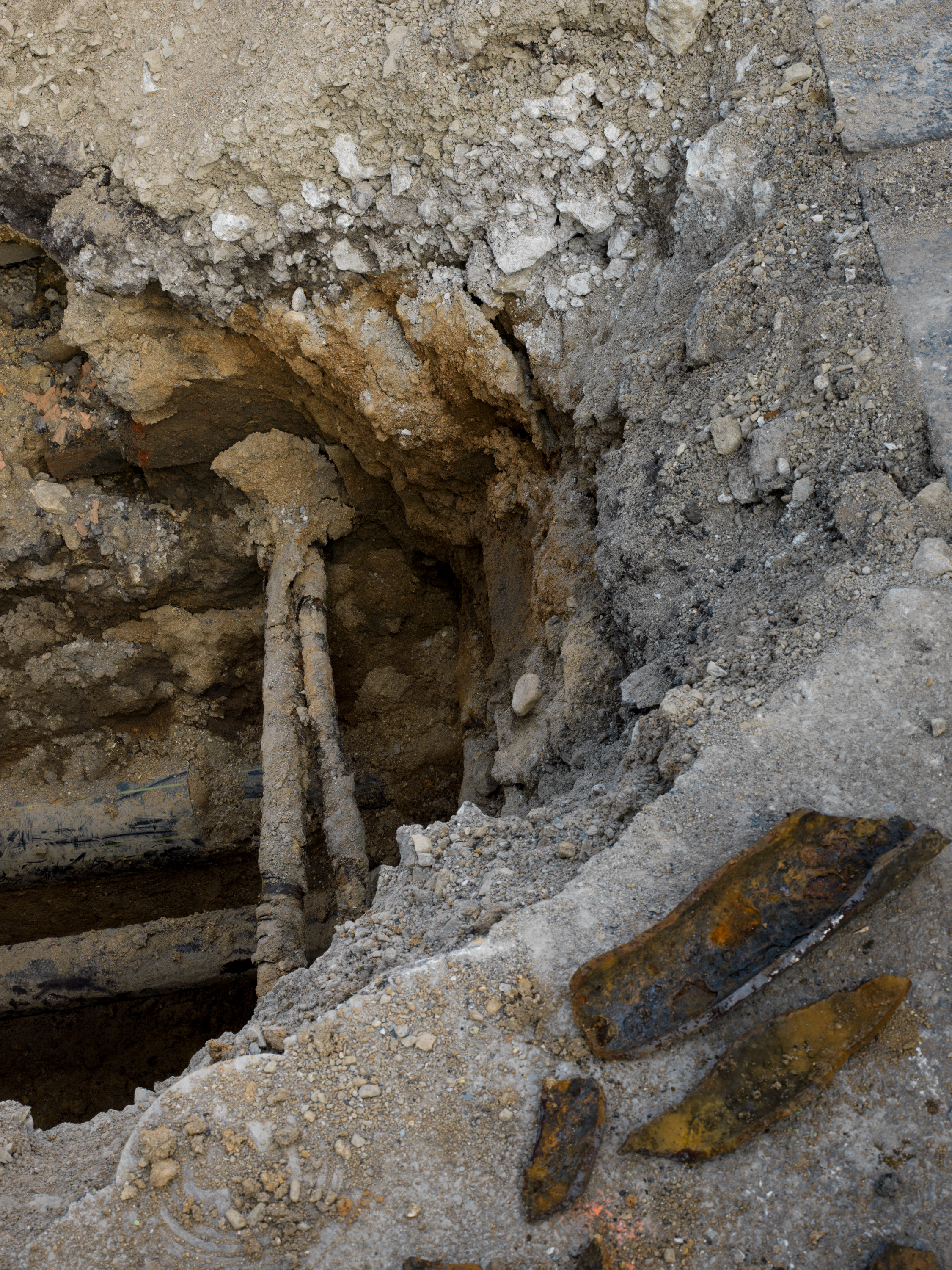
What we have found here is a buried treasure; these pipes keep us clean and healthy. In a society focused on a game of appearances, the underfunded and ill-equipped infrastructure of hospitals and morgues has exploded in the face of a self-aggrandising “modern” European society, a society that values the appearance of wealth on altars rather than the sustainable balance of preserving what lies below. Hynek Alt’s Beach Book reveals the hidden intestines of an urban Leviathan. Biological connections between community members run deep through the ground. The oddly positioned and often precarious-looking materials of our underground sewerage system are momentarily revealed as the arterial flow of our lifeblood – flushing out pestilential mass and providing fresh running water. The sudden opening of the ground reveals not the gates of hell, but the under-appreciated workers, engineers, and mechanics who provide the sanitary basis of our drinking and washing water each and every day.
The soil might be made of dead organic matter, but we rely on it for our lives and sustenance. It is our safety net. What lies beneath it – the unsightly, the perverse – is what keeps us alive. In our contemporary game of mirrors, a capitalism that looks for quick-fix solutions, we have yet to overcome our aversion to the matter that sustains us, that which keeps us alive and is hidden from the frames of the city. This book serves as a portion of its elevation into that which is framed, elevated, and presented far away from its hidden subterranean holes. It is an aesthetic framing of that which was never meant to be opened, but is nevertheless an integral whole.
March 2020
Notes (English)
- 01 Claire Pentecost, Notes from the Underground: 100 Notes, 100 Thoughts: Documenta Series 061 (Documenta (13) (Berlin: Hatje Cantz, 2012).
- 02 The miasmatic medical theory would persist right up to the 20th century, with people believing that the inhalation of foul odours from rotting corpses or vegetation was the cause of illness. See Stephen Halliday, “Death and miasma in Victorian London”, British Medical Journal, 323(7327) (2001): 1469–1471, https://www.ncbi.nlm.nih.gov/pmc/articles/PMC1121911/.
- 03 David Harvey, “Anti-Capitalist Politics in the Time of COVID-19”, Jacobin,
- 20 March 2020, https://jacobinmag.com/2020/03/ david-harvey-coronavirus-political-economy-disruptions.
- 04 “Cloaca”, UPenn Classics, Myth Dictionary, accessed 9 July 2020, http://www.classics. upenn.edu/myth/php/tools/dictionary. php?regexp=CLOACA+MAXIMA.&method=standard.
- 05 Stephen Evans and Suraj Patel, “Berlin’s Pink Pipes”, BBC News, 3 November 2013, https://www.bbc.com/news/av/ magazine-24773752/berlin-s-pink-pipes-what-are-they.
- 06 “Gas Lines”, Walking Almaty, accessed 9 July 2020, http://www.walkingalmaty.com/gas-lines.html.
Gianfranco Sanguinetti, The Topography of the Invisible and a Journey Through Time
The ancient philosopher Anaxagoras, a friend of Pericles, said that “visible things are the part that is seen of the things that are not seen”. Reality resembles an iceberg, whose visible part is no more than a tenth of what remains hidden underwater. This applies to everything, to politics, to the economy, to people, etc.
Normally, the photographer’s subject is that part of reality that can be seen. The art lies in knowing how to choose, and to fix on film, that precise moment of a certain image, a shape, an expression, that others could have seen but only the photographer noticed and captured, stopping time. The encounter between the photographer, the chosen image, the hundredth of a second, and the chosen frame results in a kind of serendipity that becomes a piece of work, a photograph. 01
The originality of Hynek Alt’s approach is to photograph what no one will ever see again, because it is at the bottom of a pit that is set to be refilled with earth. Alt fixes forever a fleeting moment of something that will then exist forever but that no one will ever be able to see again. His photograph thus becomes the only incontrovertible record of something that can no longer be visibly proven to exist.
We always walk on the past. All past civilisations went through the cycle of birth, growth, and decline. And successive civilisations have always been curious to study those that preceded them. Historians, archaeologists, and scholars research and develop theories supported by the study of artefacts and vestiges of past civilisations. Their research always involves working below the surface, investigating tombs and artefacts found underground at various sites, as what was built above the ground has often been destroyed.
Thus, a large part of our history has been conserved, covered over by earth, that stepmother who creates and preserves everything. Of ourselves there will remain nothing except what we do not see. The time that has passed, but also a part of the present, is layered below our feet. We walk on our past. To journey through time, we must go below ground.
This appears to be the lesson to be learnt from Hynek Alt’s art. But it is not the only one.
In dealing with the present of our world, it seems necessary here to make an important addition to the “Topography of the Invisible”. The purpose of any totalitarian power, by which its effectiveness and its success will be judged in the future, is to subjugate and control its population in order to use it in wars, through which every power strives to grow. Indeed, the superpowers of today’s world compete with each other in their ability to subjugate and control. The systems of control and domination must necessarily remain invisible and secret. I will be brief and concise here.
The two main systems facing each other in the 21st century are, on the one side, the ancient Eastern despotism for millennia embodied by China, and on the other, the new Western despotism being constructed by America to fight it as an equal. Despotism, as a system of government and subjugation of peoples, is based on controlling everything that flows. The ancient Chinese despots controlled the flow of irrigation water to cause drought and bring to ruin regions that were not subject to their absolute power; they also controlled the roads and communication routes, the flow of goods, the post, and information – in short, everything that moved.
The modern leaders of the new Western despotism have learnt from China, and their purpose is the absolute control of everything that flows on the earth, on the sea and underwater, through the clouds, in cyberspace. And so they control the flow of money, oil, and goods (using sanctions against countries deemed “enemies”), the flow of information and data, the climate, earthquakes, tsunamis, epidemics, terrorism, the movement of migrants, and, through transatlantic cables, the internet, stock markets, currency exchange rates, etc.
A new control experiment is currently under way in the Western world, involving billions of citizens, imprisoned in their homes on the pretext of the ongoing pandemic. Very soon, thanks to the introduction of mandatory vaccinations, this control will get also under our skin, through the injection of microchips.
With this perspective, the photographic work of Hynek Alt, although limited to what takes place underground, assumes another meaning, extremely disturbing and current, because it helps to highlight a hidden part of the immense iceberg of the new Leviathan.
For this reason, it would be useful to add, as an appendix to this presentation, a very recent text of mine entitled “Western Despotism”, which has already been translated and published in the main languages of Europe and America. People must become aware as soon as possible of the epochal change that is taking place. Nobody would accept it if they knew the consequences. But despotism does not ask for anyone’s consent. And soon it will be too late. May 2020
Notes (English)
- 01 See Gianfranco Sanguinetti, Miroslav Tichy – Podoby Pravdy (Les Formes du vrai/Forms of Truth) (Praha: Kant 2010), 14.
Jussi Parikka, The Holey City
0) Introduction
With the bag of tricks, methods, perceptions, and concepts of years of cultural theory, art practices, architecture, and engineering, we already know quite well how to approach the city. The Situationists famously contributed their part by drifting and mapping experiences of urban capitalism, but so did many other practitioners and theorists of space – from the artistic avant-garde and symphonies of the city to the theorists of space and its multiple modes of segregation. In everyday life, too, we have been trained even if we don’t necessarily express our training in words of theory. We have been trained to see and unsee cities so as to successfully enjoy the pleasantness and unpleasantness of living in them. For example, China Miéville’s novel The City & the City is actually a story of this, and only this: how to learn to unsee things so as to survive the city. This skill is hard-wired into the soft systems that coordinate our eyes, hands, and feet. We walk across cities bound not to notice their mundane aspects, especially in those cities familiar to us.
Part of the art of living in a city is automatic, and part of it is automated. This includes the automatic sense of habit of how we orient ourselves by means of a system of cues, as well as how cities are read (unconsciously), and how infrastructural systems have developed, from navigation using maps to navigation being done for us (Google Maps and the like). Somnambulism is the mode of description that speaks to this way of understanding the primacy of automation. 01
In the context of spring 2020, cities turned from sites of proximity, at times uncomfortably crowded, to observing of distance – two metres or more, and often with only a quarantine view through a living-room window. It is a reminder of a different set of ways the city can open up after its routines are so suddenly mixed up. Olga Tokarczuk describes it in the short story “A New World Through My Window”:
From my window, I can see a white mulberry, a tree I’m fascinated by – one of the reasons I decided to live where I live. The mulberry is a generous plant – all spring and all summer it offers dozens of avian families its sweet and healthful fruits. Right now, the mulberry hasn’t got back its leaves, and so I see a stretch of quiet street, rarely traversed by people on their way to the park. The weather in Wrocław is almost summery: a blinding sun, blue sky, clean air. Today, as I was walking my dog, I saw two magpies chasing an owl from their nest. At a remove of just a couple of feet, the owl and I gazed into each other’s eyes. Animals, too, seem to be waiting expectantly, wondering what’s going to happen next. 02
The mundane description of what is out there, through a distance mediated by a window, highlights a different city that is taking shape. It’s not even an allegory, really. While we can read such scenes as proxies for all kinds of massive changes taking place across cities everywhere, it is also exactly what it says: a transformation of what we observe and what is observed, what is seen and what comes to the fore. The city and its automatic routines are exposed in a totally new way, like a planetary-scale experiment in urbanism – which part of it fails, which needs to be further emphasised. 03
Inspired by Hynek Alt’s series of photographs that map the city of pipes, holes, digs, and excavations, we observe the city that continues its life beneath the abandoned street surfaces. Besides a response to this series of images, I want to describe a couple of possible methodological and conceptual avenues to read such images, from digging to infrascapes. When James Elkins quite aptly dedicated a chapter to “the Pavement” in his book How to Use Your Eyes, 04 he described the banality of asphalt with a lovely fondness for the dynamic reality of its cracks and crumbling. The pavement and roads became aesthetic objects revealed at the moments of their breaking down (cue Heidegger, cue infrastructure theorists), but we can dig deeper (the puns are deep and endless) so as to appreciate that under the crack lie the pipelines.
1) Photography for the Underworld
Cities are made of pipes and wires inside walls, of plumbing and cabling under the pavement. Forget the people for a moment, as there would be none without the life-support system of pipes that carry shit and water, electricity and information. This is the work of infrastructure. Scholars such as Susan Leigh Star exhort us “to study boring things”. 05 Of course, Star does not merely refer to hard-surfaced things and what lurks inside them, but rather to the infrastructure of administration, lists, classification, and categories. But we should still realise the value of photographing boring things as an extended assay in contemporary urbanism, and as part of the seriality of modern photography. It is, after all, to echo Allan Sekula, not a question of a singular photograph, with its own commodified value, but rather of sequences, relations, and series. Or, if you have seen one gaping hole, you have not seen them all.
Star’s ethnography of infrastructure includes multiple angles of scholarly study that are relevant in considering Alt’s photographic practice. Infrastructure is defined not only by embeddedness, transparency, and expert knowledge but also by the moments when it breaks down. While this trope has been used – overused, some would say – in contemporary writing and scholarship to describe our infrastructural surroundings, including in cities, it is nonetheless pretty much on the money when it comes to realising the importance of cracks in the everyday life of surfaces. Thus is revealed the layer of modern history that began with the downward vertical construction of the city, which intensified from the 19th century through the building of various life-support systems: sewerage, underground transport, and the variety of pipes and cables that fill the city as its underground design aspect.
The city is a big gaping hole, or a multitude of holes opening up and closing down. It is constantly maintained in order to function, whether this be the infrastructural pipes and systems or the pavements themselves. Infrastructural breakdown calls for specialist labour cordoned off from pedestrians and vehicles with signs warning of possible open holes. “Manhole” is the quirky everyday term for this opening, which gives access to the underneath, the closed-off world of public utilities. A pothole is an issue of bumps and transport. A hole for each function and dysfunction.
And if the city was not just a big gaping hole to be maintained, then surely it is a sewer. In more eloquent terms, this infrastructure of modern order was articulated by Dominique Laporte (2000) in his wonderful study History of Shit – basically a book about order and how to build it into a city:
Surely, the State is the Sewer. Not just because it spews divine law from its ravenous mouth, but because it reigns as the law of cleanliness above its sewers. Cleanliness, order, and beauty, defined by Freud as the cornerstones of civilization, are elevated to new heights when embodied by the State. “Civilization,” says Lacan, “is the spoils: the cloaca maxima.” 06
To which we might add that someone cleans up the systems at regular intervals, ensuring that the city, the state, civilisation is a big operation involved in how to ensure that fluids are running, pipes are maintained, and holes are covered.
2) Infrascapes
But we are not in the business of waste management; we are in the business of images and photography. They present their own layer of images and media across the city that is already an existing media ecology. One concept that feels apt in the context of Alt’s photography is that of the infrascape. With Samir Bhowmik, we use this to refer to urban and rural landscapes as they unfold in relation to energy infrastructure. But the photographic method of site-specific visual investigations can also be used to understand such things as the holey city in Alt’s series.
Infrascapes are those infrastructural landscapes that are of interest as much to media studies as to landscape architects and geographers. They open up as visual investigations in practices of photography that become part of the lure of the city as a visual, material surface to be studied. The term “infrascape” acknowledges that even before being photographed, urban landscapes are already inscribed in multiple materials and technologies. Such infrastructure defines the city through their own material inscriptions: they leave a mark in the city, under and inside their walls, sometimes even on the surfaces as signs of their existence.
Infrascapes track how cities and landscapes are already inscribed as technologies. The knowledge that emerges from realising the centrality of the infrascape folds back how we read cities – rewriting our sense of automated seeing and navigating of the city – and their naturalised sites. According to the assumptions that nature stands as a primary ground, infrastructure in urban societies is equally a candidate for the “ground”, however artificial or mundane. Hence it has become clear that the concept of what constitutes the “environment”, or “nature” itself, needs to be rethought to include technology as a constituent, productive, and dynamic part.
Of course, to add a further twist, photographic digging into the depths of the city is also one form of a media-archaeological excavation. Could there be even a typology of holes, in the way philosophers Roberto Casati and Achille Varzi (1995) argue, pointing to three: superficial hollows, perforating tunnels, and internal cavities. And what other typologies of holes and their bespoke surfaces could one map in the more specific archaeology of a city? In Shannon Mattern’s words, this concerns “urban media histories [that] are cyclical, entangled, a messy mix of discourses and dirt, imaginaries and I-beams, sketches and sensors” 07 – and, we might add, pipes and holes.
3) Urban Dig
In the context of the series of photographs on the aesthetics of holes and their infrastructural allies of pipes and cables, one is led on a rather wild, down-the-rabbit-hole trip, in the way Alice was on the way to Wonderland. The hole’s aesthetic and imaginary status has been well documented in various literary contexts over the centuries. It has been emptied of its possible connotations to such an extent that it would seem that only grandiose things, such as photographs of black holes, would be enough to make them interesting again. Yet, not unlike Alice on her descent into other worlds, the task has more than aesthetic or imaginary value. As part of series of infrascapes, the holey city of infrastructures opens up a way to understand what multiple realities hide inside surfaces we don’t immediately see through. As for the practice of opening up, it has also similar connotations.
The archaeological dig is a central trope of modern knowledge about material sites and unearthing the realities of past times, but so too is the urban dig. Archaeology shifted early on from the remnants of ancient civilisations to the city (Walter Benjamin and the ruins of urban capitalism) and the psyche (Sigmund Freud). Thus, the urban dig, as suggested by Laporte, combines such aspects like a Klein bottle: the birth of the modern subject and the birth of the modern sewerage system both deal with how to keep things in order and how to prevent the crap from surfacing too violently.
Furthermore, could the urban dig be considered in some way as a method, or part of a methodology, that relates to material activities but implies a scaffolding for a systematic way of knowing, paving the path to knowledge about materials, cities, habits, perceptions, and forms of seeing and unseeing? A rather flimsy-sounding suggestion, perhaps, but one with a certain depth in its connotations. The material, even bodily activity of digging becomes one of knowledge about surfaces, of opening up visibilities, of distributing a new sense of the infrastructural underground that underpins the surface of what we take for granted and as a subject of everyday experience.
And they are specific. Holes are always this particular hole on this particular surface. As Casati and Varzi argue in their analytical take on the metaphysics of holes: “[T]he hole depends for its existence on the existence of a wall, and of that particular wall. The borders of the hole mark an interruption in the surface of the wall. A discontinuity breaks in, and you can imagine how to restore the natural continuity of the surface so as to make the hole disappear. Thus, it is by perceiving a discontinuity in the surface of the wall that you seem to perceive the hole. Surfaces are the major character here.” 08
Digging through the holey city exposes the multiple historical realities where material infrastructures are layered, revealing different “distinctive temporalities and evolutionary paths”. 09 Digging opens the different temporalities that are all the time stacked in the infrastructure of cities, in media-technological objects, and in everyday habits. It resonates with media-archaeological methods that have emphasised the multiple connotations of excavation. However, this method does not venture into the archive of documents, but instead reads the city itself as a way of uncovering earlier forgotten paths of media history 10 and as site-specific work on abandoned technologies and infrastructures, sharing a ground with methods of contemporary archaeology. 11
To pick up on Hynek Alt’s photographic series of holes and pipelines is then to combine the multiple worlds of the aesthetics of surfaces and the gaping holes both as meaningful objects of investigation in the infrastructural sense and as alternative maps through which we realise what makes the city function as an automation – both underground and above the ground, including how we observe the city surfaces.
April 2020
Notes (English)
- 01 See Tony Sampson, A Sleepwalker’s Guide to Social Media (Cambridge: Polity, 2020).
- 02 Olga Tokarczuk, “A New World Through My Window”, The New Yorker, 8 April 2020, https:// www.newyorker.com/books/page-turner/a-new-world-through-my-window.
- 03 Benjamin Bratton, “18 Lessons of Quarantine Urbanism”, Strelka Mag, 3 April 2020, https://strelkamag.com/en/ article/18-lessons-from-quarantine-urbanism.
- 04 James Elkins, How to Use Your Eyes (London: Routledge, 2000).
- 05 Susan Leigh Star, “The Ethnography of Infrastructure”, American Behavioral Scientist 43(3) (1999): 377.
- 06 Dominique Laporte, History of Shit, trans. by Rodolphe el-Khoury (Cambridge, MA: The MIT Press, 2000), 56.
- 07 Shannon Mattern, Code + Clay, Data + Dirt: Five Thousand Years of Urban Media (Minneapolis: University of Minnesota Press, 2017), xx.
- 08 Roberto Casati and Achille Varzi, Holes and Other Superficialities (Cambridge, MA: The MIT Press, 1995), 9.
- 09 Mattern, Code + Clay, xxviii.
- 10 Jussi Parikka, Geologie médií, trans. by Jan Petříček (Praha: Karolinum Press, 2020).
- 11 Angela Piccini (ed.), ‘Media Archaeology – special section’, The Journal of Contemporary Archaeology 2(1) (2015).
Gianfranco Sanguinetti, Western Despotism
The conversion of Western representative democracies into a completely new despotism has taken, because of the coronavirus, the legal form of “force majeure” (a force majeure is a well-known clause used in contracts to free the parties from liability). So the new virus is the catalyst of the event and at the same time a way to distract the masses by fear. 01
Even though I have posited many hypotheses since the publication of my book On Terrorism and the State (1979) regarding the way in which this conversion, inevitable in my eyes, of formal democracy into real despotism would occur, I admit that I had never imagined it could happen under the pretext of a virus. And yet, the Lord really works in an infinite number of ways, which also include the Hegelian cunning of reason.
We can say that the only reference, as prophetic as it is disturbing, is the one I found in an article that Jacques Attali, a former president of the European Bank for Reconstruction and Development, wrote for L’Express during the 2009 H1N1 epidemic:
“If the epidemic is a bit more serious, which is possible because it is transmitted from human to human, it will have truly global consequences: economic (the models suggest that it could cause a loss of $3 trillion, i.e. a 5% drop in global GDP) and political (due in contagion and its risks …). Because of this, we will have to introduce a global police, a global storage of supplies, and therefore also global taxes. And so we will, much faster than it would have been allowed by economic reason alone, set up the foundations of a truly global government.” 02
Thus the pandemic was not out of the picture – large insurance companies had conducted so many simulations! And state protection agencies as well. In March 2020, Gordon Brown, the former British prime minister, spoke about the need for a global government: “Gordon Brown has urged world leaders to create a temporary form of global government to tackle the twin medical and economic crises caused by the COVID-19 pandemic.” 03
We can just add that if such an opportunity is to be seized or created does not change much in this matter. Once the intention is there and the strategy is drawn up, the only thing
needed is to find a pretext and then act accordingly. None of the heads of state were caught off-guard, or only at the very beginning, due to their stupidity. Then, be it Giuseppe Conte or Viktor Orbán, Boris Johnson or Donald Trump, or others, all these politicians, however boorish they might be, understood quickly what the virus was allowing them to do with old constitutions, rules, and laws. A state of emergency excuses all illegality.
Once terrorism, which was, as we can agree, misused a little too much, had exhausted most of its potential, so well tested everywhere during the first fifteen years of the new century, the moment came to move to the next stage, which I have been announcing since 2011 when my text Du Terrorisme au Despotisme (From Terrorism to Despotism) was published.
By the way, the counterinsurgency approach adopted immediately and everywhere by what is very improperly called “the war against the virus” confirms the underlying intention of the “humanitarian” operations of this war, which is not waged against the virus but clearly against all the rules, rights, guarantees, institutions, and nations of the old world – I mean the world and the institutions that were established by the French Revolution and which have been disappearing right in front of our eyes over the last several months, as quickly as the Soviet Union. The epidemic will end, but all the measures, possibilities, and consequences which it triggered and which we are currently experiencing will not. We are in pain giving birth to a new world.
We are witnessing the decomposition and the end of a world and a civilisation – a civilisation of bourgeois democracy with its parliaments, rights, powers, and counterpowers, which are from now on completely useless because coercive laws and measures are being dictated by the executive without immediate ratification by parliaments, and the judicial power, as well as the power of freedom of speech, are losing all seeming independence, i.e. their function as counterweights.
This is how nations are adapted – suddenly and traumatically (as Machiavelli stated, “injuries ought to be done all at one time, so that, being tasted less, they offend less”): the citizen had already disappeared a long time ago, replaced by the consumer, and the latter is now being reduced to the role of a simple patient over whom we have the power of life or death, to whom we might administer any treatment or even decide to eliminate them based on their age (productive or non-productive) or based on any other criterion decided, arbitrarily and without the right to appeal, at the discretion of the treating person or others. Once they are imprisoned at home or in the hospital, what can they do against coercion, abuse, arbitrariness?
In Italy, for instance, the Constitution was suspended, but no objections were raised, not even from President Mattarella, the “guarantor” of the institutions. The subjects who have become simple anonymous and isolated monads don’t have any “equality” or any rights to claim anymore. The law itself will no longer be normative; it is already becoming discretionary, like life and death. We saw in Italy that, under the pretext of the coronavirus, it was possible to kill, immediately and without punishment, 13 or 14 unarmed prisoners, and no one even cares to reveal their names, their crimes, or the circumstances, and nobody is alarmed. Even the Germans in the Stammheim prison didn’t do better. They should admire us, at least, for our crimes!
We don’t talk about anything anymore except money. And a state such as the Italian one is reduced to begging the terrible and illegitimate Eurogroup for the capital needed for the transformation from the democratic into the despotic form. This is the same Eurogroup that in 2015 ferociously sought to expropriate all Greek national heritage, including the Parthenon, and place it into a Luxembourg-based fund under German control: even Der Spiegel described the Eurogroup’s diktats as “a catalogue of atrocities” meant to abase Greece, and Ambrose Evans-Pritchard wrote in the Telegraph that if we wanted to date the end of the European project, it was exactly that moment. So it is done. Only the euro remains, but just temporarily.
Neoliberalism did not have to face the old class conflicts; it doesn’t even remember them, and even believes that it has deleted them from the dictionary. It still sees itself as almighty, which doesn’t mean that it is not afraid of them, because it is well aware of everything it is about to inflict on nations. It is clear that people will soon become hungry, it is clear that the number of jobless will multiply, it is clear that people working illegally (4 million in Italy) will have no support. And those in precarious work who have nothing to lose will turn to conflict and sabotage. This explains why the response strategy to the pandemic is first of all a preventive counterinsurgency strategy. We will see some good examples in America. The FEMA camps will soon be full.
Therefore, the new despotism has at least two strong reasons to prevail in the West: one is to face the internal subversion it provokes and expects; the other is to prepare for an external war against a designated enemy. This is also the oldest despotism in history, about which there has been nothing to learn since The Book of Lord Shang (4th century BC) – a book that all Western strategists should lose no time in reading with the utmost attention. If we have decided to attack Chinese despotism, we must start by showing that we are better even on its own ground: i.e. more efficient, less expensive, and better performing. A superior despotism, in short. But this remains to be proved.
The virus has brought the fragility of our world to light. The game that is currently being played is infinitely more dangerous than the virus and will cause many more deaths. Yet, people now seem to fear only the virus…
It might seem that the current era has found its task in contradicting what Hegel said about the philosophy of history: “The history of the world is none other than the progress of the consciousness of freedom.” But freedom itself exists only when it is fighting its opposite, he added. Where is it today? When, in Italy and in France, people denounce those who don’t obey?
If a simple microbe was enough to plunge our world into obedience to the most disgusting of despotisms, it means that our world was at this time so ready for this despotism that a simple microbe was enough.
Historians will call the era that starts now the age of Western despotism.
April 2020
Notes (English)
- 01 I see that Edward Snowden comes to the same conclusion in an interview published on
- 10 April 2020; see https:// www.youtube.com/watch?v=k5OAjnveyJo.
- 02 Jacques Attali, “Avancer par peur”, L’Express, 6 May 2009, https://www. lexpress.fr/actualite/societe/sante/avancer-par-peur_758721.html.
- 03 Larry Elliott, “Gordon Brown Calls for Global Government to Tackle Coronavirus”, The Guardian,
- 26 March 2020, https://www.theguardian.com/politics/2020/mar/26/ gordon-brown-calls-for-global-government-to-tackle-coronavirus.